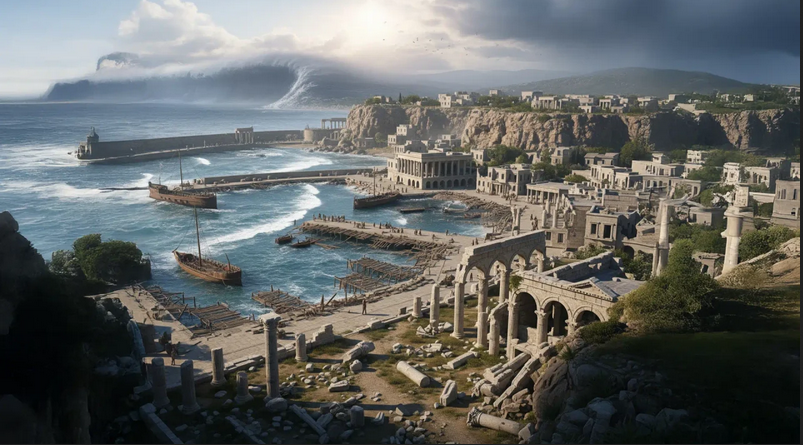
On July 21st, 365 AD, a powerful earthquake shook Crete and produced one of the ancient world’s worst natural disasters. Modern estimates place its magnitude between 8.0 and 8.5 – an exceptionally violent seismic event. The epicenter lay offshore of western Crete along the Hellenic subduction zone, where the African tectonic plate is forced beneath the Aegean plate. That tectonic setting is highly active, but the 365 Crete earthquake was extraordinary in both strength and geographic reach.
The 365 Crete Earthquake Lifted the Island

The immediate effects on Crete were catastrophic. Large portions of the island experienced extreme ground shaking, causing buildings to collapse and cities to suffer widespread destruction. In one gigantic push from below, coral reefs around the island erupted 33 feet upwards. Parts of western Crete were lifted by as much as 30 feet. Ancient shorelines, harbors, and coral formations were left stranded far above sea level. Several Cretan cities declined sharply afterward, and some were abandoned altogether, indicating long-term disruption rather than a quick recovery.
Even more destructive than the tremors was the tsunami triggered by the earthquake. Ancient accounts describe the sea first withdrawing dramatically from the shore, exposing the seabed and leaving ships grounded. The water then came rushing back in an enormous wave. Coastal areas of Crete were devastated, but great damage also occurred elsewhere as the tsunami raced across the Mediterranean. It struck Greece to the north, and Cyprus to the east. It raced south to devastate the North African coast, and caused extensive damage in Alexandria, Egypt’s Nile Delta and Libya. To the west, it wreaked havoc in Sicily and as far off as Spain. The wall of water was high enough and powerful enough that it carried ships and hurled them miles inland.
A Mediterranean Catastrophe

The 365 Crete earthquake and tsunami were described by many contemporaries. However, the quality of literary writing and intellectual discourse had significantly declined from earlier standards. The days of the high quality prose of a Thucydides, Cicero, Caesar or Livy, were centuries past by then. Late Antiquity writers paid less attention to details and actually describing what happened, than to ascribing occurrences to divine displeasure and intervention from up above in response to political and religious events on earth. Contemporary Christian writers often interpreted the disaster in religious terms, seeing it as a sign of divine anger or a warning to humanity, reflecting the spiritual worldview of the age. As a result, most of what know from ancient texts are mere references to the earthquakes occurrence and massiveness. For the rest, we have to rely on archeological evidence.
A rare exception was the historian Ammianus Marcellinus’ description of the impact on Alexandria: “The solidity of the earth was made to shake … and the sea was driven away. The waters returning when least expected killed many thousands by drowning. Huge ships perched on the roofs of houses … hurled miles from the shore”. Marcellinus was a rarity, though. The historical record lacks a reliable contemporary narrative describing the damage elsewhere in the Mediterranean with the degree of attention that was common when Greco-Roman civilization and culture were at their height. There was no equivalent to Pliny the Younger’s description of the 79 AD eruption of Vesuvius.
A Rare Mediterranean Tsunami

What is known is that the devastation caused by the 365 Crete earthquake and tsunami was massive and widespread. Also, that the loss of life was high, with estimated casualties between three hundred thousand to half a million. Coastal regions of Greece, Cyrenaica in North Africa, southern Italy, and possibly Sicily all experienced flooding, structural damage, or both. The widespread effects demonstrate how interconnected the Mediterranean world was, particularly through maritime trade and coastal settlement. Ports, warehouses, and ships were essential to the Roman economy, and their destruction had serious economic consequences.
The 365 Crete earthquake occurred during the later Roman Empire, a period already marked by political, economic, and social strain. It did not cause imperial collapse, but it added to existing pressures, especially in regions like Crete and North Africa. Today, the 365 Crete earthquake is of great importance to historians and geologists alike. It shows that the eastern Mediterranean is capable of producing rare but extremely destructive earthquakes and tsunamis. By combining limited ancient written accounts with geological evidence, modern researchers have been able to reconstruct the event. It is a lasting reminder of the region’s seismic vulnerability.

_________________
Some Sources & Further Reading
History Halls – The Eruption of Mount Vesuvius in 79 AD
Paleo, Smithsonian Institution – The 365 AD Tsunami of Alexandria, Egypt
Newest Articles
- Henry Jennings: The Privateer-Turned-Pirate Who Set the Stage for the Caribbean’s Golden Age of Piracy
- Fighting Women: Tomoe Gozen, the Fearsome Female Samurai
- From the NFL to the Sands of Iwo Jima: Medal of Honor Recipient Jack Lummus
- The Zanj Rebellion: The African Slave Revolt That Rocked Medieval Mesopotamia
- The Dacian Falx: The Curved Ancient Sword that Shocked the Romans

