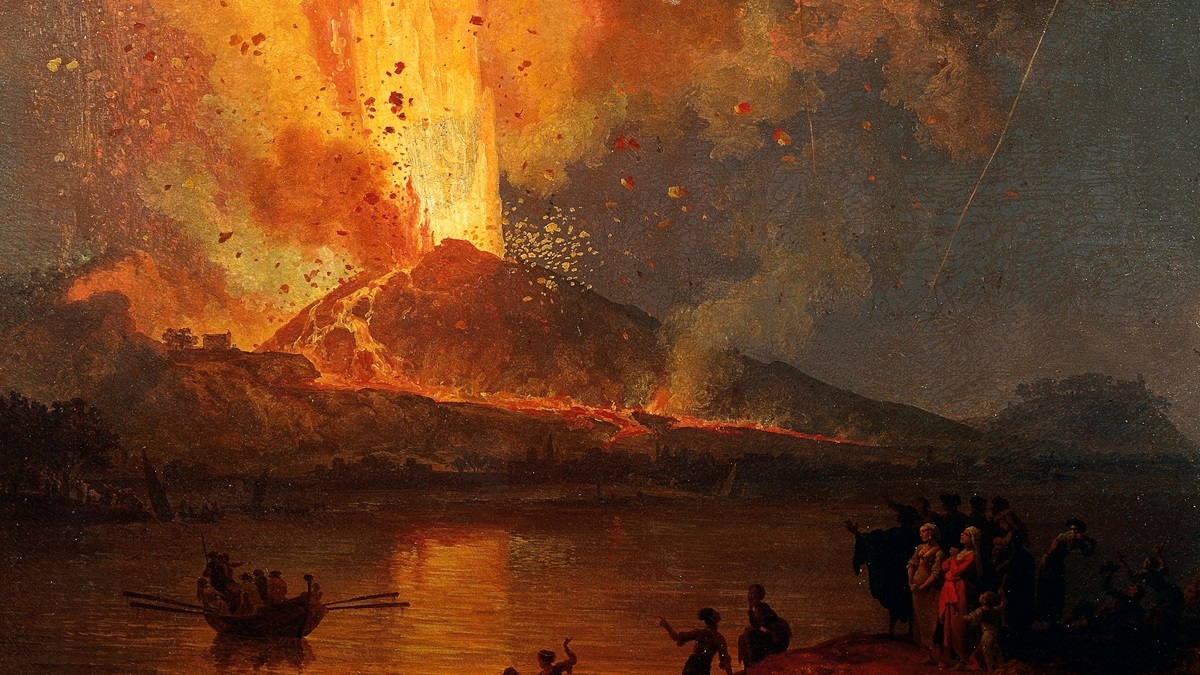
Mount Vesuvius, an active volcano that rises above the Bay of Naples in Italy, produced one of Europe’s most powerful explosions when it erupted in 79 AD. It was one of antiquity’s most remarkable natural disasters. Below are some fascinating facts about that catastrophic erupt.
An Explosion 100,000 Greater than Hiroshima and Nagasaki Combined

Around noon on August 24th, 79 AD, Mount Vesuvius blew its top with a force more than 100,000 times that of the Hiroshima and Nagasaki atomic bombs. The eruption tossed deadly debris mixed with a cloud of poisonous gasses over twenty miles up into the skies. As it spewed gasses into the air, lava and hot pumice poured out of the volcano’s mouth at a rate of 1.5 million tons per second. The scorching mixture raced down Vesuvius’ side to devastate the surrounding region.
Several nearby towns were destroyed, of which Pompeii and Herculaneum are the best known. Pliny the Younger, a Roman author and magistrate, was fifteen miles away at Cape Misenum. He was visiting his uncle, Pliny the Elder, a Roman admiral who would lose his in life the rescue efforts that followed the eruption. History is indebted to Pliny. His detailed description of the events he saw and those told him by first hand witnesses provide the best written and most thorough narrative of the disaster.
Ash, Falling Rocks, and Lava

Tremors had emanated from Mount Vesuvius for days, but they did not cause alarm among the locals because they were not unusual. Then, around noon on August 24th, a cloud appeared atop Vesuvius. About an hour later, the volcano violently erupted, and soon thereafter, ash began to fall on Pompeii, six miles away. By two in the afternoon, the ash falling began to be accompanied by volcanic debris. By five, there was so much and debris in the air that sunlight was completely blocked.
Roofs in nearby Pompeii began to collapse under the accumulating weight of ash and pumice. By then, there was ample cause for alarm, and panicked townspeople rushed to the harbor seeking any ship that would take them away. By midnight, the volcano was spewing a hot deadly column over twenty miles up into the air. In the meantime, lava flowed down the mountainside in six major surges, as Vesuvius vomited molten rock in a rapid flow that incinerated all that it encountered.
A Disaster That Proved a Boon for Historians

The lava that raced down Mount Vesuvius’ side did not reach Pompeii or Herculaneum, but it sent heat waves of more than 550 degrees Fahrenheit into those towns. The scorching temperatures turned the towns into ovens, and finished off any who had not yet escaped and had not already suffocated from the fine ash. About fifteen hundred bodies were found in Pompeii and Herculaneum when they were unearthed centuries later. Those bodies were recovered from but a small portion of the entire area impacted by the volcano’s eruption.
Extrapolating to the surrounding regions, it is estimated that total casualties were likely in the tens of thousands. The towns of Pompeii and Herculaneum, whose populations at the time numbered about twenty thousand, were buried beneath up to twenty feet of volcanic ash and pumice. Tragic and terrifying as that was, the ash deposits did a remarkably effective job of preserving those towns nearly entire. That afforded future historians an unrivaled snapshot of first century AD Roman architecture, city planning, urban infrastructure, and town life in general.

_________________
Some Sources & Further Reading
Beard, Mary – Pompeii: Life of a Roman Town (2008)
Butterworth, Alex, and Laurence, Ray – Pompeii: The Living City (2006)

