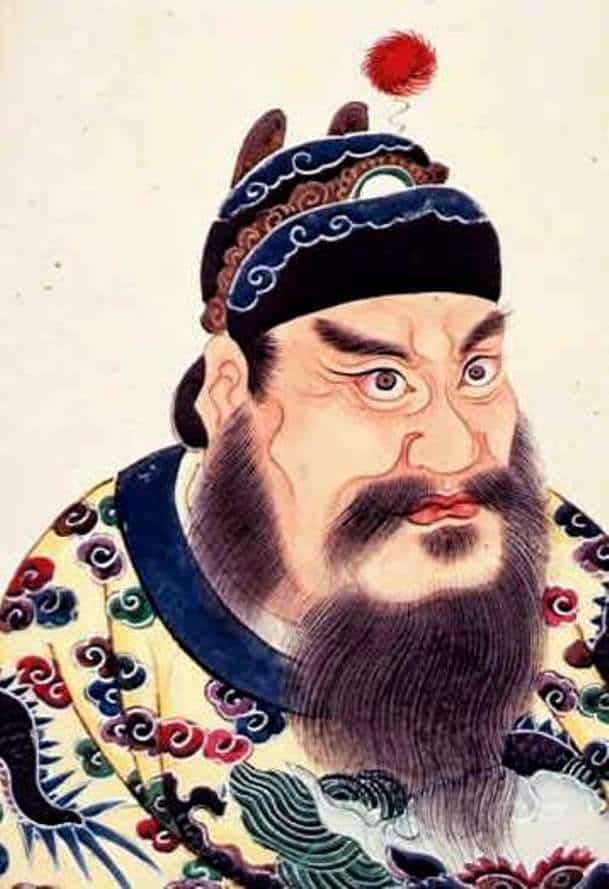
Chin Shi Huangdi’s death in 210 BC marked a turning point not only in his own dynasty, but in Chinese history as a whole. As the founder of China’s first unified empire, he had spent much of his reign seeking control over both the physical and metaphysical realms. Ironically, his obsessive quest for immortality may have hastened his death. The secrecy surrounding his final days triggered a chain of political intrigue that soon destroyed the empire he had built.
The First Emperor of Chin

King Zheng of Chin (259 – 210 BC) was king of the Chinese state of Chin during the Warring States Period. He ascended the throne as a child, and regents ruled during his minority. He wrested power from them in his teens, and massacred palace plotters who sought to usurp his prerogatives. The young king then went on the warpath. He pushed back the northern barbarians, and conquered all neighboring Chinese states. He consolidated them under his rule, and declared himself Chin Shi Huangdi, “First Emperor of Chin”.
The first emperor of a united China, Chin Shi Huangdi was a capable ruler. To unify his newly conquered empire, he standardized currency, weights and measures. He also introduced a new system of government known as Legalism, based on strict laws and harsh punishments. He ended the feudalism that had led to the centuries of warfare that gave the Warring States Period its name. In its place, he instituted a centralized bureaucratic government in which advancement was based on merit.
A Megalomaniacal Ruler

To keep the nobles in check, Chin Shi Huangdi kept those he favored in the capital, and controlled them with pensions and fancy titles. That transformed them from an uncontrollable warrior class into dependents and tame courtiers. He abolished all aristocratic titles and ranks, except for those created and bestowed by him. The former nobles who did not make the cut were killed or sent out to work on his many projects. Indeed, the new emperor put everybody to work.
With unchecked power and the resources of an entire empire to draw upon, Chin Shi Huangdi grew megalomaniacal. He launched huge projects with massive amounts of forced labor, such as 700,000 laborers who toiled on his tomb for three decades. Discovered in the 1970s with thousands of life-sized Terracotta Warriors, it is now open to tourism. That is but a fraction of his gigantic tomb complex, the bulk of which is yet to be unearthed. Millions more labored to dig canals, level hills, make roads, and build over 700 palaces.
A Quest for Immortality

The biggest project of all was the Great Wall of China. It did double duty: keep northern barbarians out, and keep Chinese seeking to flee heavy taxation and oppressive rule, in. Another manifestation of his megalomania, the pursuit of immortality drugs, led to Chin Shi Huangdi’s death. He lavishly funded searches for a “life elixir” that would keep him alive forever. The First Emperor’s rule had been marked by immense achievements, such as standardized writing, currency, weights, and measurements, and massive infrastructure projects such as roads, canals, and defensive walls.
However, Chin Shi Huangdi was also deeply fearful – of assassination, rebellion, and especially death itself. The First Emperor had been surrounded by plots and plotters ever since he ascended the throne as a child. He also survived numerous assassination attempts and plots. The man was traumatized, and lived in constant fear of death. That fear led him to seek immortality through supernatural means. He became heavily influenced by alchemists and magicians who promised elixirs that could prolong his life indefinitely.
Looking for the Elixir of Life

Among those who promised the First Emperor a life elixir was Xu Fu, who claimed he could find the secret of immortality on distant islands. He got the emperor to fund an expedition with hundreds of ships and thousands of young men and women, that sailed off into the Pacific in search of a mythical “Land of the Immortals”. It was never heard from again. Legend has it that it Xu Fu had conned the emperor out of resources and settlers to found his own kingdom – what became Japan.
Chin Shi Huangdi also patronized alchemists who claimed that they were close to inventing the Life Elixir. However, their R&D was always hobbled by a lack of funding – a problem the emperor generously put to rights. Chin Shi Huangdi’s death was caused by one of those charlatans, who gave the emperor daily mercury pills. He claimed they were a life-prolonging intermediate step in his research for immortality drugs. They ought to tidy the emperor over until the life elixir was ready.
The Quest for Immortality Led to Chin Shi Huangdi’s Death

Swallowing mercury every day, the emperor gradually poisoned himself and gradually grew insane. He became a recluse, concealed himself from all but his closest courtiers, and listened constantly to songs about “Pure Beings”. Some of his nuttier actions occurred during this time. Among other things, he ordered nearly all books burned, and had four hundred scholars buried alive. He also had had his son and heir banished. In 210 BC, Chin Shi Huangdi was on one of his frequent imperial tours of eastern China. Such tours had both symbolic and practical purposes.
They displayed imperial power, allowed him to inspect his realm, as well as consult mystics and seek divine favor. During this journey, while traveling through eastern territories, he fell gravely ill. His entourage stopped at the palace at Shaqiu, where his condition worsened rapidly. Rather than prolong his life, the First Emperor shortened it in his pursuit of immortality, and died of mercury poisoning. Present at his deathbed were some of the most powerful figures in the empire, including the chief minister Li Si and the influential eunuch Zhao Gao.
Keeping Chin Shi Huangdi’s Death a Secret

The First Emperor was forty nine years old when he died. Chin Shi Huangdi’s death was immediately kept secret. Officials feared that news of the emperor’s death, while they were far from the capital, could trigger unrest or rebellion. The secrecy surrounding Chin Shi Huangdi’s death led to one of the most consequential conspiracies in Chinese history. The First Emperor had designated his eldest son, Fusu, as his likely successor. Fusu was respected, and had been stationed on the frontier with loyal troops.
However, Zhao Gao and Li Si feared that Fusu would not favor them if he became emperor. Instead, they forged an imperial decree that ordered Fusu to commit suicide. Trusting the authenticity of the command, Fusu obeyed and took his own life. The conspirators then elevated Chin Shi Huangdi’s younger and more pliable son, Huhai, to the throne. He became known as Chin Er Shi, or Second Emperor. That act of deception undermined the stability of the Second Emperor’s regime from the very beginning. Meanwhile, the emperor’s body was transported back to the capital at Xianyang.
Chin Shi Huangdi’s Death Trigged the Unraveling of His Dynasty

Because of the summer heat, the corpse began to decompose during the journey. To conceal Chin Shi Huangdi’s death, the smell had to be concealed. So Zhao Gao ordered carts filled with salted fish to accompany the procession, to mask the odor of decay. That grim detail, recorded later by the historian Sima Qian, symbolized the fragile deception upon which the regime now rested. Chin Shi Huangdi was buried in his vast mausoleum complex, guarded by the famous Terracotta Army. The enormous force of clay soldiers was intended to protect him in the afterlife.
Chin Shi Huangdi had gone through considerable effort to secure eternal life and an everlasting dynasty. He got neither, and his empire collapsed only four years after his death. Widespread revolts broke out against the harsh rule of Chin Er Shi and his manipulative advisors. By 206 BC, the Chin dynasty had fallen completely. Chin Shi Huangdi’s death illustrates a profound historical irony. He had unified China and laid the foundations of imperial rule that would endure for over two millennia. However, his fear of death led him to consume poisonous elixirs, and the secrecy surrounding his passing triggered political chaos.

_________________
Some Sources & Further Reading
Clements, Jonathan – The First Emperor of China (2006)
Gonick, Larry – The Cartoon History of the Universe, Volume II (1994)
History Halls – The Great Leap Forward that Set China Back
Newest Articles
- The Johnstown Flood – Thousands Perished When A Dam Collapsed After Gilded Age Tycoons Modified it for their Private Resort
- The Jacquerie: The Medieval Peasant Uprising That Terrified France’s Aristocrats
- Things That Weren’t Thought Through: WWII’s Sticky Bomb Stuck to Users’ Hands Once Activated
- German Tanks of World War II – The Panzer 38(t), a Czech Tank in German Service
- Nicholas Alkemade: The WWII Airman Who Survived an 18,000 Foot Fall From a Bomber Without a Parachute

