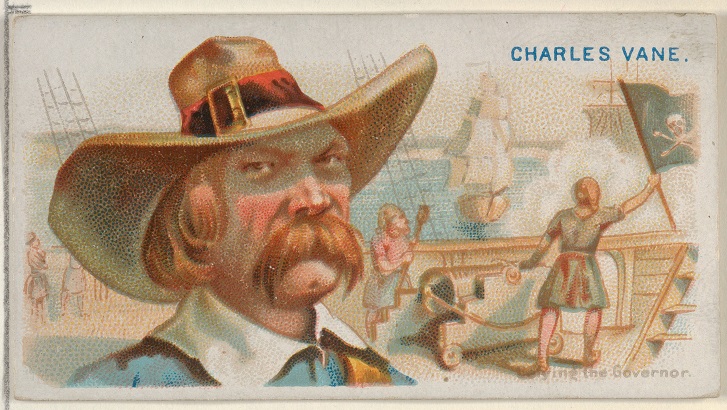
Charles Vane was one of the most infamous and paradoxical figures of the Golden Age of Piracy. He is remembered less for great plunder than for his ferocity, defiance of authority, and uncompromising devotion to pirate independence. Active primarily between 1716 and 1720, Vane embodied the ruthless freedom and internal violence that characterized the final, desperate years of Caribbean piracy before European navies reasserted control of the seas.
A Reputation for Fierce Defiance and Dangerous Instability

Little is known about the early life of Charles Vane, and his birthplace and background remain uncertain. He was likely English, and probably had experience as a privateer or sailor during the War of the Spanish Succession. Like many pirates of his generation, Vane emerged in the chaotic aftermath of the war. Privateering – legalized piracy against enemy ships – had flourished, but when peace arrived, thousands of armed seamen suddenly found themselves unemployed. Many turned to piracy. By 1716, Vane was operating out of New Providence in the Bahamas, a notorious pirate stronghold and de facto pirate republic.
The pirate republic was loosely governed by its captains’ collective will. Prominent among them was Vane, who quickly gained a reputation for extreme violence and unpredictability. Some pirates cultivated an image of democratic leadership or restraint toward prisoners. Vane relied on terror to enforce obedience and intimidate enemies. He commanded a small fleet, and took numerous prizes attacking merchant shipping around Jamaica, Cuba, and Hispaniola. Success brought notoriety, but his conduct also caused fear – even among fellow pirates, who viewed him as dangerously unstable.
Vane’s defiance peaked in 1718 with the arrival of Woodes Rogers. Appointed Royal Governor of the Bahamas, Rogers was tasked with suppressing piracy. He arrived with warships and a royal pardon offering amnesty to pirates who surrendered. Many accepted, including Benjamin Hornigold, once a leading pirate captain. Vane, however, refused outright, even though the only exit through which his ship could exit was blocked by Rogers. In a dramatic display of contempt, he set it ablaze and sent it drifting toward the governor’s fleet.
Charles Vane Was Marooned by His Own Men

Vane’s fireship missed Rogers’ fleet and failed to damage it. However, it forced it to get out of the way. Vane slipped away through the now-unblocked harbor in another, smaller, ship. That act of defiance cemented the legend of Charles Vane, but also marked the start of his decline. The British navy intensified its pursuit of pirates, and Vane’s refusal to accept pardon cut him off from safe havens. He continued to raid, but his leadership style alienated his crew.
Pirate crews were famously democratic, and captains could be removed if they lost the confidence of their men. In late 1718, Vane encountered a French warship. Rather than fight, he chose to flee, judging the odds unfavorable. His crew interpreted that as cowardice. Led by his quartermaster, Jack Rackham, later known as “Calico Jack”, the crew voted to depose Vane. Rackham was elected captain, and Vane was marooned with a handful of loyal followers. That did not end Vane’s career, though.
Vane managed to acquire another vessel and resumed piracy, though on a smaller scale. However, his luck had turned. In 1719, while sailing near the Bay of Honduras, his ship was caught in a violent hurricane and wrecked. Vane and one other survivor washed up on a deserted island, where they were stranded for months, living in isolation and near starvation. Ironically, they were eventually rescued by a passing ship captained by a former pirate who had accepted the royal pardon. Recognizing Vane, the captain arrested him and handed him over to colonial authorities.
The End of an Irascible Pirate

Charles Vane was transported to Jamaica and imprisoned in Spanish Town. His trial in 1721 was swift and largely symbolic, as British authorities were determined to make examples of notorious pirates. Vane’s record of violence and defiance ensured there would be no leniency. He was convicted of piracy and sentenced to death. He was hanged on March 29th, 1721, at Gallows Point in Port Royal, a location notorious for public executions. His body was displayed in chains at the harbor’s entrance, a grim warning to others who might consider piracy. He left behind a complex legacy.
Charles Vane was not the most successful pirate in terms of wealth. Nor did he cultivate the romantic image later associated with figures like Blackbeard. Instead, Vane represents the darker reality of piracy: brutality, internal conflict, and eventual self-destruction. His refusal to compromise, even when offered a chance at pardon, made him a symbol of absolute pirate autonomy. However, it also ensured his downfall. In popular culture, Vane is often portrayed as a near-madman, driven by rage and obsession with freedom at any cost. Such portrayals might exaggerate his cruelty, but they reflect how contemporaries saw him. To colonial authorities, he was an irredeemable criminal. To other pirates, he was both a fearsome leader and a cautionary tale. In the end, his piratical career illustrates the limits of defiance in an era when the power of the state was closing in on the Caribbean’s last freebooters.

_________________
Some Sources & Further Reading
History Halls – The Flying Gang and Republic of Pirates: When Pirates Took Over the Bahamas
Marley, David – Pirates of the Americas (2010)
Newest Articles
- The Johnstown Flood – Thousands Perished When A Dam Collapsed After Gilded Age Tycoons Modified it for their Private Resort
- The Jacquerie: The Medieval Peasant Uprising That Terrified France’s Aristocrats
- Things That Weren’t Thought Through: WWII’s Sticky Bomb Stuck to Users’ Hands Once Activated
- German Tanks of World War II – The Panzer 38(t), a Czech Tank in German Service
- Nicholas Alkemade: The WWII Airman Who Survived an 18,000 Foot Fall From a Bomber Without a Parachute

