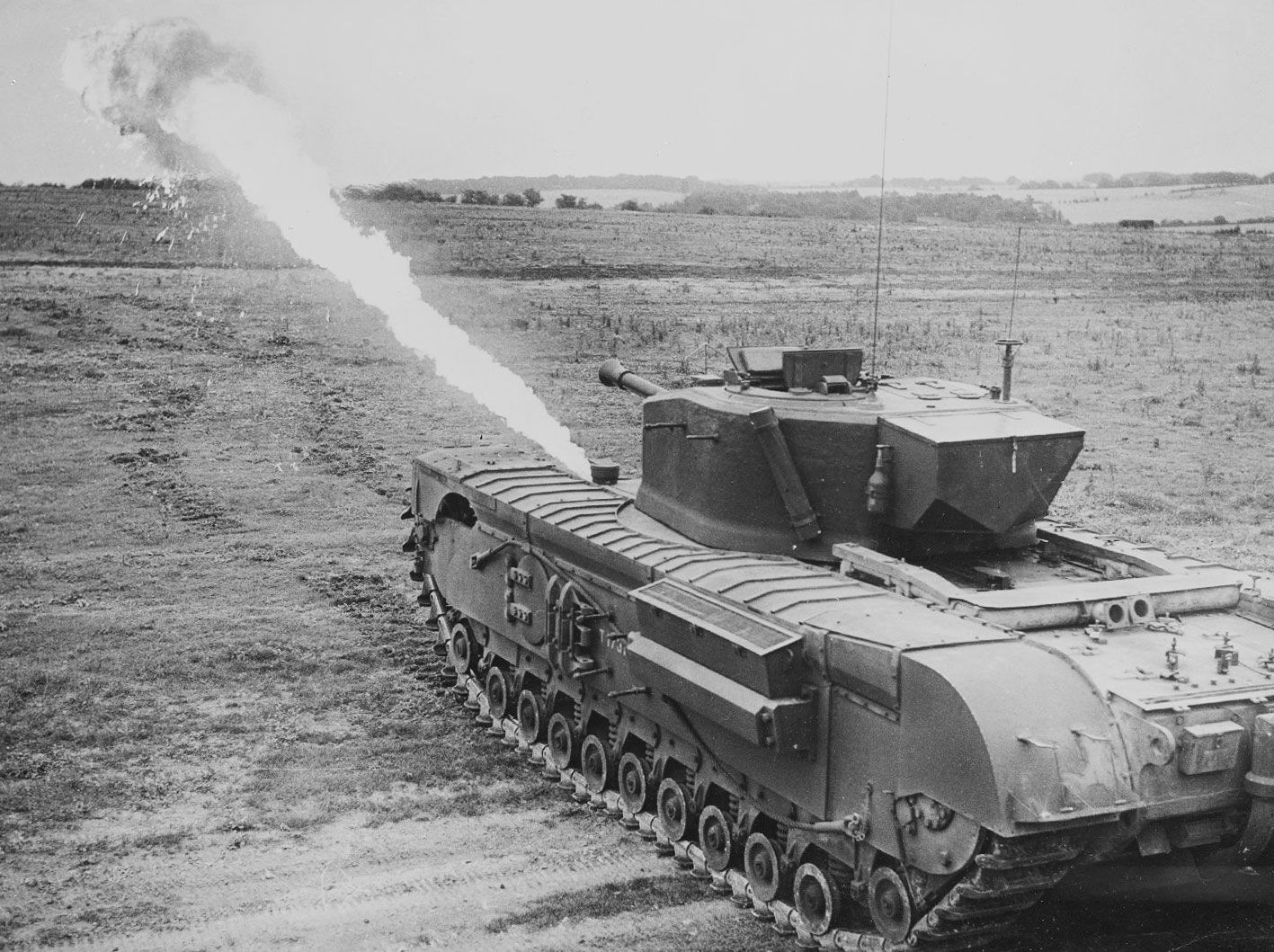
Britain invented tanks in World War I, and during that conflict and its immediate aftermath, British – and French – tank designs were the best in the world. By the 1930s, however, that design edge had been ceded to the Germans and Soviets. By the time World War II began, the British found themselves with distinctly second rate armor, that had not kept up with modern advances. Ironically, despite their poor reputation for tanks, the British ended WWII with the world’s best tank, the one upon which all modern tanks are modeled – the Comet, which led directly to the revolutionary Centurion main battle tank. Unfortunately, for purposes of Britain’s war effort, it was fielded too late in the conflict to make much of a difference. Below are some facts about one of Britain’s formidable but less successful tanks, the workaday Churchill.
The Churchill

The Churchill, whose most common version was officially termed the Tank, Infantry, Mark IV (A22), was named not after the WWII Prime Minister but after his ancestor, John Churchill, 1st Duke of Marlborough. It was designed to overcome conditions similar to those of WWI’s Western Front. As a result, one of its most distinguishing feature are long tracks intended to traverse trenches. It was rushed into production after the 1940 defeat in France revealed the limitations of Britain’s then-standard tank, the Matilda II, and Churchills went from the drawing board to rolling out the factory floor by June of 1941.
After it overcame early glitches, the Churchill went on to become the most successful British tank of WWII. It was intended as an infantry tank, and was designed to assist infantry attacks. That required heavy armor to allow Churchills to work closely with foot soldiers while taking heavy fire. Heavy armor came at the expense of speed, which was deemed unimportant for a tank whose mission was to accompany slow-moving infantry, and at 41 tons, the Churchill was one of the heaviest Western Allies’ tanks of WWII. In line with that close infantry support mission, Churchills were exceptionally good at climbing steep gradients and traversing rough terrain.

Churchill Tanks Were Outgunned, but They Could Take a Punch

The first Churchill tanks models had riveted armor. That was replaced by welded armor in later versions. The Churchill Mark I was armed with a two pounder gun in the turret, increased to a 6 pounder or 75mm gun in later models, and a 3 inch howitzer in the hull, which was replaced by a machinegun in later versions. The Mark IV was the most produced Churchill version and the one which saw the most combat.
A Mark IV Churchill weighed 39 tons, and had a range of 90 miles. It was armed with either a 6 pounder or 75mm gun, plus two machine guns. The Churchill tanks were generally outgunned by German tanks. However, they had not been designed to fight other tanks. When they did find themselves faced with panzers, Churchills’ heavy armor tended to compensate for what they lacked in firepower.
A Formidable and Adaptable Tank

In the Battle of El Alamein, six Churchill tanks were fired on repeatedly by German and Italian antitank guns. Despite the storm of shells, only one Churchill was knocked out, while the remainder survived up to 80 hits. The Mark VII version, introduced in 1944, was the best protected mass produced tank of the war. It afforded its crews greater safety than that afforded any other tankers.
The Churchill’s platform also proved adaptable to specialized tasks. In line with its primary mission of close infantry support, some Churchills were adapted to operate as flame throwers, or were equipped with 290 mm petards for bunker busting. Its powerful chassis also lent itself to uses such as bridge laying or mine sweeping, with some versions equipped with heavy chains on a rotating drum flailing the ground clear of mines on D-Day and subsequent campaigns.

Some Sources and Further Reading
Chamberlain, Peter, and Ellis, Chris – British and American Tanks of World War Two (2004)
Chamberlain, Peter, and Ellis, Chris – The Churchill Tank (1971)
Fletcher, David – Mr. Churchill’s Tank: The British Infantry Tank Mark IV (1999)
History Halls – German Tanks of World War II

