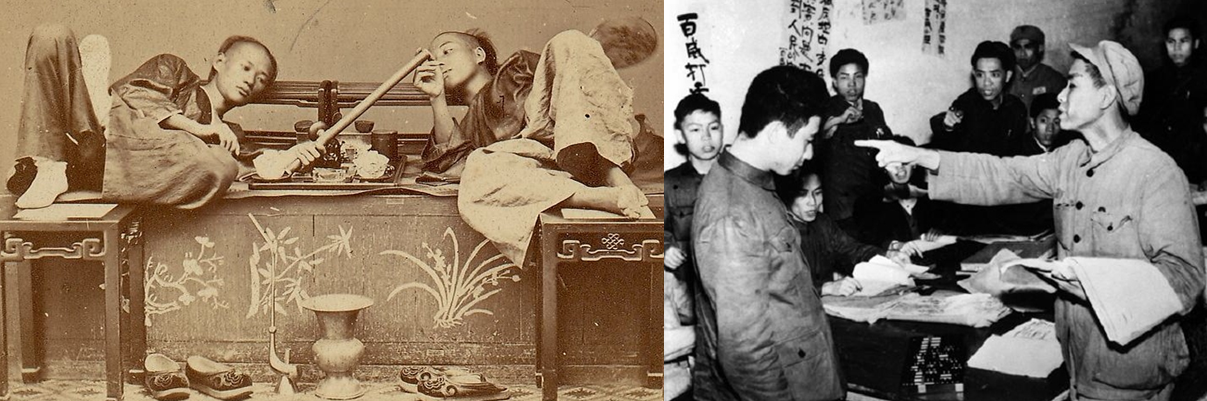
China’s 1950s anti-opium campaign was history’s most sweeping and consequential anti-drug effort. Within a few short years, the new communist government transformed a country long associated with widespread opium addiction into one where the drug was nearly eliminated. The campaign combined harsh repression, mass mobilization, medical treatment, and social restructuring. It was not merely a public health initiative, but also a political and ideological project. It was central to the consolidation of communist rule under Mao Zedong and the Chinese Communist Party.
China’s Serious Opium Addiction Problem

Opium was a major Chinese problem for over a century before the People’s Republic of China was founded in 1949. The drug entered China in large quantities, especially in the nineteenth century, largely due to trade with Western powers. Attempts were made to suppress the drug, such as those led by reformers like Lin Zexu in the 1830s. However, they led to foreign conflict and humiliation, most notably the Opium Wars. By the early twentieth century, opium addiction had become deeply embedded in Chinese society. It affected all social classes, from peasants and laborers to officials and intellectuals. Opium dens proliferated in major cities like Shanghai and countless smaller towns.
The drug trade also became a major source of revenue for various political factions, warlords, and criminal organizations. During the Republican period (1912–1949), successive governments attempted to suppress opium. Their efforts were inconsistent, however, and often undermined by corruption. The nationalist government led by Chiang Kai-shek and the Kuomintang publicly opposed opium. In practice, it sometimes tolerated or even taxed its production and distribution to finance military campaigns. As a result, China in 1949 was one of the world’s largest opium producers, and by far the largest consumer. Estimates vary, but tens of millions of Chinese were addicted to opium by the time the communists came to power.
The Communists Saw Drug Addiction as Political Matter

Mao’s communists did not see opium as a criminal matter, but as a political issue. Opium addiction weakened productivity, harmed public health, contributed to crime, and symbolized China’s past subjugation by foreign powers. For the new communist government, the elimination of opium was both a practical necessity and a powerful symbolic goal. From the start, the communist leadership viewed opium as a social evil that had to be eradicated. The party portrayed the drug as a tool of imperialism that had weakened China and exploited its people.
The elimination of opium therefore became part of a broader effort to rebuild national strength and restore dignity. The communists had already experimented with anti-drug campaigns in areas they controlled before 1949. In communist-held regions during the Chinese Civil War, opium production and consumption were often suppressed, sometimes with harsh punishments. Those experiences provided a model for nationwide efforts after victory. The new government moved quickly to launch an anti-opium campaign after it established control over mainland China in 1949. It was organized centrally, but implemented locally through a vast network of party officials, police, neighborhood committees, and mass organizations. It was coordinated nationwide among all government levels to deny opium a safe haven from which it might return someday to re-infect the rest of China.
Launch of China’s 1950s Anti-Opium Campaign

The anti-opium campaign was integrated into the broader revolutionary transformation of Chinese society. It coincided with land reform, political purges, and campaigns against corruption and counterrevolutionaries. Opium elimination was seen as essential to creating a disciplined, productive socialist population. One of the first priorities was to destroy the opium trade’s infrastructure. That meant targeting growers, dealers, smugglers, and criminal networks. The government issued strict laws banning the cultivation, sale, and transportation of opium. Violators faced severe punishments, including long prison sentences and, in many cases, execution. Public trials were held – and public executions carried out – to demonstrate the seriousness of the campaign and to deter others.
Prior to the campaign’s launch, lists were made of known or suspected drug dealers and traffickers. Labeled “counterrevolutionaries”, they were treated not as mere criminals, but as political enemies. That designation justified harsh penalties and reinforced the political nature of the anti-opium campaign. They were arrested by the thousands in waves, interrogated, sentenced to lengthy prison terms, and quite a few were executed. In cities, opium dens were closed, and their operators arrested. Criminal gangs that had profited from the drug trade were dismantled. Many traffickers fled to places beyond communist control, including Hong Kong and regions near China’s southwestern borders, where opium production later became concentrated in areas like the Golden Triangle.
The Anti-Opium Campaign Targeted Both Supply and Demand With Eradication and Treatment

The government also targeted farmers who grew opium poppies. About 3% of rural China’s agricultural sector was dedicated to opium production. From farmers’ perspective, opium was a great cash crop. It took less land to cultivate, and was more lucrative than food crops. An acre of opium plants could be two to six times more valuable than an acre of food crops. That gave farmers a strong incentive to grow opium. Mao’s communists ordered farmers to switch to other crops such as grain or cotton, and made sure they complied. In many cases, officials supervised the destruction of poppy fields directly.
Unlike traffickers, addicts were often treated as victims rather than criminals, although coercion was still common. The government encouraged addicts to voluntarily register with authorities. Those who did were promised treatment rather than punishment. Addicts who failed to register or failed to quit within a specified time frame were punished. Special detoxification centers were established across the country that provided medical treatment to help addicts withdraw from opium. They often used gradual reduction methods rather than abrupt quitting cold-turkey cessation.
Where such clinics were unavailable, however, as in many rural areas, addicts were often forcibly isolated – sometimes in pits dug into the ground – and left to endure withdrawal. Traditional Chinese medicine was sometimes used alongside modern techniques. Treatment was not purely medical, but also included political education. Addicts were taught that their addiction was a product of imperialism and social injustice. Their recovery was part of becoming productive citizens in the new socialist society. Group therapy and mutual support were common. Former addicts were encouraged to help each other remain drug-free.
Securing Public Buy-In With Mass Mobilization

Community pressure also played a role, as neighborhood committees monitored residents and encouraged compliance. For many addicts, recovery was compulsory. Those who refused treatment could be detained and forced into detoxification programs. One of the most distinctive features of the anti-opium campaign was its reliance on mass mobilization. The communist government used propaganda, public meetings, and grassroots organizations to involve ordinary citizens in the anti-opium campaign. Posters, newspapers, and radio broadcasts warned about the dangers of opium, and praised those who quit.
Public rallies encouraged communities to report drug dealers and support addicts in recovery. Neighborhood committees, workplace units, and local party branches were responsible for monitoring residents. Those organizations kept detailed records, and ensured compliance with government policies. Public confessions and denunciations were common. Former dealers and addicts were sometimes required to confess their actions publicly and pledge to reform. Such events reinforced social norms against drug use, and demonstrated the power of the new government. The campaign also emphasized moral transformation.
Addiction was portrayed not only as a physical condition, but also as a sign of moral weakness and political backwardness. Recovery was framed as a step toward becoming a loyal and productive socialist citizen. The anti-opium campaign achieved remarkable results in a short period. Within about three years, opium use declined dramatically across most of mainland China. By the mid-1950s, opium addiction had become rare in many urban areas. Opium dens had disappeared, and open drug markets were largely eliminated.
Why Did the Anti-Opium Campaign Succeed?

Several factors contributed to the success of the anti-opium campaign. First, the communist government had strong centralized authority and the ability to enforce policies consistently across the country. Second, the campaign combined punishment and treatment, addressing both supply and demand. Third, mass mobilization created social pressure that reinforced government policies. Fourth, the broader revolutionary transformation of society disrupted traditional networks that had supported the drug trade. Unlike earlier governments, which often tolerated opium for financial reasons, the communists had a strong ideological commitment to its elimination.
Finally, there was the impact of the confiscation of large landowners’ fields and redistribution in smaller plots to peasants. It severely impacted the economies of scale that had made opium so profitable. Mass produced opium on hundreds or thousands of acres controlled by a single landlord was significantly more profitable by the acre than opium grown in small peasant plots. Moreover, it was easier for large landlords to conceal opium cultivation deep in their estates, than it was for peasants to do so in their small plots or on collectivized farms visible to all.
A Smashing Success, at a High Cost

Despite its effectiveness, the anti-opium campaign came at a significant human cost. Many traffickers and dealers were executed, sometimes after brief trials. The exact number is unknown, but it was likely substantial and ran into the thousands. Addicts were often treated harshly, particularly those who resisted treatment. Forced detention and compulsory detoxification were common. The campaign was part of a broader pattern of political repression during the early years of communist rule. Anti-drug efforts overlapped with campaigns against “counterrevolutionaries”, landlords, and other perceived enemies. In some cases, accusations of drug trafficking may have been used to settle personal or political scores.
The use of fear and coercion raises ethical questions about the anti-opium campaign. Nonetheless, the campaign achieved its stated goals. When the communists seized power in 1949, China had an estimated twenty million opium addicts – 4.4% of the population. Within a few years, opium addiction was virtually eradicated throughout the country. For decades afterward, drug use remained extremely low compared to many other countries. That helped improve public health, increased productivity, and strengthened social stability. It also reinforced the legitimacy of the communist government, which presented itself as having solved a major problem that previous regimes had failed to address.
A Symbol of China’s Recovery

The anti-opium campaign became an important part of communist propaganda, extolled by the government. It symbolized China’s recovery from the “Century of Humiliation”, and its emergence as a strong, independent nation. The success of the anti-opium campaign also contributed to China’s international reputation. Organizations like the United Nations cited China’s efforts as an example of effective drug control. However, the campaign’s success depended heavily on the unique political and social conditions of early communist China. Chief among those were strong state control and limited individual freedoms.
Although opium use was largely eliminated by the mid-1950s, drug problems did not disappear entirely. After China began to open its economy in the late-twentieth century, drug trafficking and addiction reemerged, particularly in border regions. Heroin, methamphetamine, and other drugs became more common, especially in areas near Southeast Asia. However, the scale of renewed drug was far lower than it had been in 1949, reflecting the lasting impact of the original campaign. The government continued to maintain strict drug laws and aggressive enforcement.
Significance and Legacy of China’s 1950s Anti-Opium Campaign

China’s 1950s anti-opium campaign was probably history’s most successful anti-drug effort. It demonstrated that a determined government, using a combination of enforcement, treatment, and social mobilization, could dramatically reduce drug addiction. However, the campaign relied on questionable authoritarian methods. Its success depended, partially, on coercion, surveillance, and harsh punishments that would be controversial or unacceptable in many other societies. The campaign was also deeply political. It helped consolidate communist rule, reshape Chinese society, and reinforce the legitimacy of the new government.
More broadly, the anti-opium campaign symbolized China’s transformation. From a country weakened by addiction and foreign exploitation, it became a unified state determined to control its own destiny. The 1950s anti-opium campaign was thus a defining moment in modern Chinese history. Within a few years, the communist government eliminated a widespread and deeply entrenched problem that had plagued China for generations. Through a combination of harsh enforcement, medical treatment, propaganda, and mass mobilization, the government dismantled the opium trade and helped millions overcome addiction.
The anti-opium campaign strengthened state authority, improved public health, and became a powerful symbol of national renewal. However, the campaign also relied heavily on coercion and repression, raising important ethical questions. Its success came at the cost of executions, forced treatment, and strict social control. Even so, the anti-opium campaign remains one of the most dramatic examples of rapid social transformation in modern history. It illustrates both the potential and the dangers of state power when applied to deeply rooted social problems.

_________________
Some Sources & Further Reading
History Halls – The Great Leap Forward that Set China Back
Yangwen, Zheng – The Social Life of Opium in China (2005)
Newest Articles
- Edward England, the Humane Pirate Captain Deposed by His Men for Being Too Nice
- American Presidents: Abraham Lincoln, Hall of Fame Wrestler
- Henry Jennings: The Privateer-Turned-Pirate Who Set the Stage for the Caribbean’s Golden Age of Piracy
- Fighting Women: Tomoe Gozen, the Fearsome Female Samurai
- From the NFL to the Sands of Iwo Jima: Medal of Honor Recipient Jack Lummus

