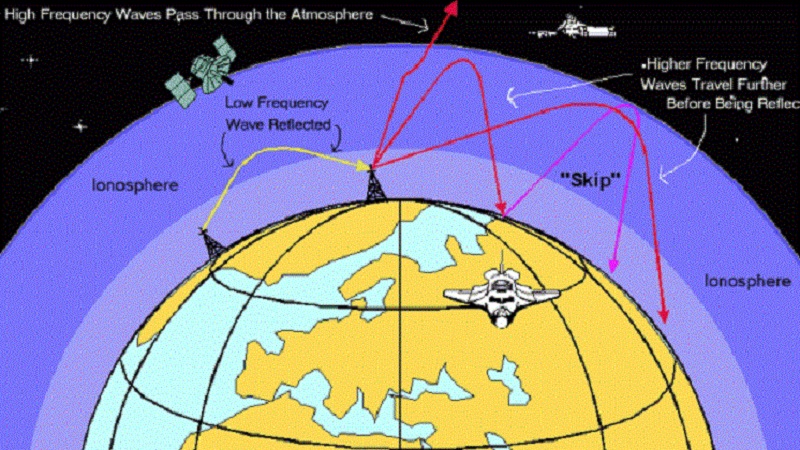
Project West Ford, often nicknamed “Project Needles”, was one of the early Space Age’s more unusual experiments. It was a Cold War scheme that quite literally tried to build a ring of metal filaments around the Earth. Conceived in the late 1950s and carried out in the early 1960s by the Massachusetts Institute of Technology’s Lincoln Laboratory on behalf of the U.S. military, the project aimed to create an artificial ionospheric reflector to ensure secure global communications in the event of nuclear war.
Why Seed Space With Needles?

Why would anyone want to put millions of tiny copper needles into orbit? To understand that, it helps to recall the era’s strategic anxieties. Long-distance military communications in the 1950s relied heavily on high-frequency (HF) radio waves. Those waves bounced off the ionosphere, a naturally occurring layer of charged particles in the upper atmosphere. Under normal conditions, the ionosphere reflects radio waves back toward Earth, which enables signals to travel beyond the horizon. However, scientists feared the negative consequences of nuclear detonations in space, whether deliberate attacks or fallout from high-altitude nuclear tests.
Nuclear detonations in space could disrupt or temporarily destroy the ionosphere’s reflective properties. That could severely degrade transoceanic communications between the United States and its allies at the worst possible moment. The US Department of Defense therefore funded research into alternative communication methods. One concept was to create an artificial belt of dipole antennas in orbit. Each dipole would be a tiny, lightweight copper needle cut to a specific length—about 1.78 centimeters (roughly 0.7 inches). That would resonate at a chosen radio frequency, around 8 GHz.
If enough such needles were dispersed in a thin orbital band, they could scatter radio waves. That would effectively form a man-made reflective layer independent of the ionosphere. Project West Ford was the codename for that experiment. The nickname “Project Needles” came from the copper dipoles themselves. The plan called for releasing hundreds of millions of these hair-thin copper wires from a satellite in low Earth orbit, at an altitude of roughly 3,500 kilometers. The needles were packaged in canisters designed to disperse them evenly into a broad ring that would encircle the planet.
Launching Hundreds of Millions of Tiny Needles Into Space

The first Project Needles launch attempt, in October, 1961, failed when the satellite did not achieve proper orbit. A second attempt, on May 9th, 1963, succeeded. Approximately 350 million copper dipoles were released. In total, they weighed only about 20 kilograms (roughly 44 pounds). Once dispersed, the needles formed a belt several miles thick and thousands of miles long. Ground stations transmitted radio signals toward the belt, and reflections were successfully received across the Atlantic. Technically, the experiment demonstrated that such a passive orbital reflector could work. However, the project quickly became controversial. Astronomers around the world had raised strong objections even before the successful launch. They worried that the metallic cloud would interfere with optical and radio astronomy. They were also concerned that it could create artificial streaks in telescope images or persistent background noise.
The idea of deliberately polluting near-Earth space with millions of objects alarmed many scientists. Especially since the long-term behavior of the needles in orbit was not fully understood. There were also diplomatic concerns. The project was conducted at a time when space law was still in its infancy. Critics argued that unilaterally altering the near-Earth environment could set a troubling precedent. The Soviet Union protested the plan, and framed it as reckless militarization of space. The US maintained that the experiment posed minimal risk and was temporary. The controversy added to growing international debates that would eventually lead to the 1967 Outer Space Treaty.
The Significance and Legacy of Project Needles

In practice, the feared long-term impacts of Project Needles proved limited. Rather than disperse evenly, many of the needles clumped together. Over time, atmospheric drag and solar radiation pressure caused much of the material to decay from orbit. Within a few years, the belt had thinned substantially. Some clusters stayed in orbit for longer, but they did not create the persistent global interference some critics had feared. As of 2023, there were 44 known needle clumps bigger than 10 centimeters still in orbit.
Ironically, by the time the project demonstrated partial success, it had already been overtaken by technological change. Active communications satellites, such as Telstar (launched in 1962), demonstrated the feasibility of reliable, direct microwave relay from orbit. Such satellites provided clearer, more controllable links than a passive needle belt ever could. As satellite technology rapidly improved, the need for an artificial reflector disappeared. Project West Ford remains a striking example of Cold War ingenuity and anxiety. It reflected a moment when policymakers seriously contemplated reshaping the space environment to secure military advantage. While it did not become an operational system, it helped spur debates about the responsible use of space. The debates continue today, as concerns about space debris and orbital congestion grow ever more pressing.

_________________
Some Sources & Further Reading
Butrica, Andrew J. (ed.)- Beyond the Ionosphere: Fifty Years of Satellite Communication (1997)
History Halls – When the Soviets Wanted to Melt the Arctic
Newest Articles
- The Johnstown Flood – Thousands Perished When A Dam Collapsed After Gilded Age Tycoons Modified it for their Private Resort
- The Jacquerie: The Medieval Peasant Uprising That Terrified France’s Aristocrats
- Things That Weren’t Thought Through: WWII’s Sticky Bomb Stuck to Users’ Hands Once Activated
- German Tanks of World War II – The Panzer 38(t), a Czech Tank in German Service
- Nicholas Alkemade: The WWII Airman Who Survived an 18,000 Foot Fall From a Bomber Without a Parachute

