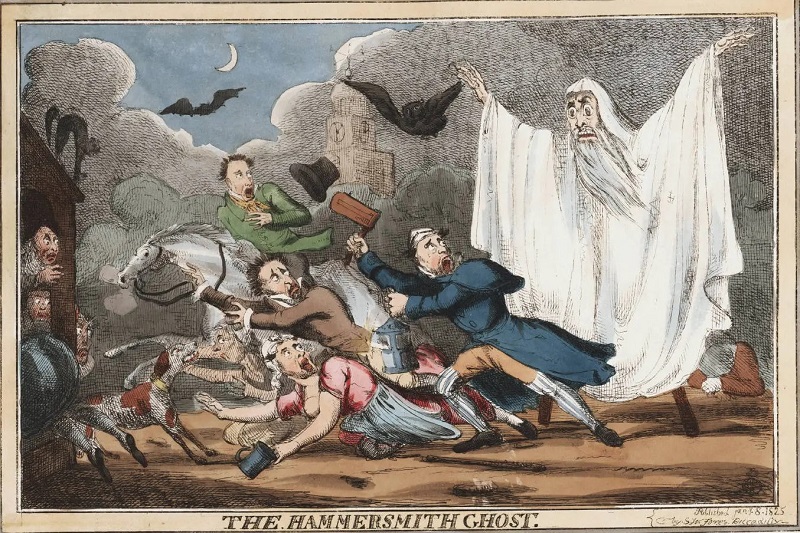
The 1804 Hammersmith Ghost hysteria and murder case was a bizarre episode in early nineteenth-century England. It was an unfortunate stew of superstition, fear, and flawed law enforcement. It culminated in the killing of an innocent man, and became a landmark case in English legal history.
Hysteria in Hammersmith

The Hammersmith Ghost hysteria unfolded in Hammersmith, then a semi-rural area west of London, now part of the city. In late 1803, rumors spread that a ghost was haunting the area. According to local accounts, the specter appeared at night, dressed in white, sometimes with horns, and a calfskin tight around its head. It reportedly frightened several residents, including a pregnant woman who reportedly died of shock after encountering it. Alarm at the sightings quickly grew to widespread panic, and then mass hysteria. More and more people stepped forward to report that they had not only seen the Hammersmith ghost, but had been attacked by it as well.
Many thought that the Hammersmith Ghost was that of a recent suicide buried in Hammersmith’s churchyard. That was in line with a widespread contemporary belief that suicides should not be buried in consecrated grounds, because their souls would then find no rest there. The story quickly took on a life of its own, fueled by candlelit streets, poor communication, and widespread superstition. Hammersmith was not unique in harboring such fears. Belief in ghosts and spirits remained strong in early nineteenth-century Britain, even as the Enlightenment and scientific thinking advanced. News of the supposed apparition spread through taverns and homes, and fed mounting anxiety. Residents armed themselves and organized patrols to capture or drive off the ghost.
Hunting the Hammersmith Ghost

One local excise officer, Francis Smith, took a leading role in the efforts to deal with the Hammersmith Ghost. Determined to end the panic, he armed himself with a shotgun and began nightly patrols. Smith reportedly declared that he would shoot the ghost if he encountered it. He believed that a spirit would not be harmed by gunfire, while a human impostor would be exposed. On the night of January 3rd, 1804, Smith saw a white-clad figure approaching in Beaver Lane. It was a bricklayer, Thomas Millwood, returning home from a visit to his parents.
Believing he had finally found the ghost, Smith challenged the figure, but received no response. So Smith leveled his shotgun and fired, striking and fatally wounding the man. Millwood’s white clothing and white apron were common among tradesmen to protect their garments. He had reportedly been mistaken for the ghost on previous occasions. On that night, he was simply walking home from visiting his parents when he encountered Smith. He died shortly after being shot. Smith was arrested and charged with murder.
A Tragedy and Trial

Smith’s defense argued that he had acted under a genuine belief that he was confronting a dangerous apparition or criminal. The case came before the courts at the Old Bailey in London. At trial, the central question was whether Smith’s mistaken belief mitigated his culpability. His counsel argued that he had no intention to kill a human being, and had acted in good faith to protect the community. The prosecution countered that Smith had intentionally fired at a person, and that ignorance or superstition could not excuse homicide.
The judge instructed the jury that if Smith had intended to shoot at what he believed to be a ghost but had killed a man, he was guilty of murder. The jury returned a verdict of guilty, but they recommended mercy. Smith was sentenced to death. However, public sympathy for Smith was considerable. Many believed that while he had acted recklessly, he had not possessed the malicious intent associated with murder. After petitions and appeals, the Crown commuted his sentence to one year of hard labor.
Legacy of the Hammersmith Ghost Hysteria

The Hammersmith Ghost case became legally significant because it raised important questions about “mistake of fact” in criminal law. If a person commits a criminal act under a mistaken belief about the facts, does that negate intent? The Hammersmith Ghost case was later cited in discussions of criminal responsibility and intent. Specifically, that an honest but unreasonable mistake does not excuse a crime. A mistaken belief might reduce the moral blameworthiness of a criminal defendant, which could play a factor in sentencing. However, it does not the defendant’s culpability for the criminal act. Adding a final twist, it later emerged that the Hammersmith Ghost had been a hoax. A local shoemaker named John Graham disguised himself in white to frighten an apprentice who had spread rumors about him. Though Graham’s actions had sparked the hysteria, it was Millwood who paid the ultimate price.
The Hammersmith Ghost case illustrates the dangers of panic and vigilantism. It also reflects a transitional moment in British society, where older beliefs in the supernatural coexisted with modern legal principles. Fear of the unknown, magnified by rumor and communal anxiety, led to an avoidable tragedy. Today, the case stands as a cautionary tale. It reminds us that acting on unverified fears can have irreversible consequences, and that the law must carefully balance human fallibility with the need for accountability.

_________________
Some Sources & Further Reading
History Halls – Public Panics: The Great Milan Poisoning Scare
Londonist – The Time Somebody Shot a Ghost Dead in Hammersmith
Proceedings of the Old Bailey – Francis Smith Trial Account, 11th January 1804
Latest Articles
- Henry Jennings: The Privateer-Turned-Pirate Who Set the Stage for the Caribbean’s Golden Age of Piracy
- Fighting Women: Tomoe Gozen, the Fearsome Female Samurai
- From the NFL to the Sands of Iwo Jima: Medal of Honor Recipient Jack Lummus
- The Zanj Rebellion: The African Slave Revolt That Rocked Medieval Mesopotamia
- The Dacian Falx: The Curved Ancient Sword that Shocked the Romans

