Public panics can be triggered suddenly, and spread like wildfire through a community, wreaking horrendous damage. A prime example was seventeenth century Milan, when the city was engulfed by hysteria over fears of a mass poisoning.
Preexisting Fears of Mass Poisoning

Seventeenth century Europeans often worried that dark forces plotted and schemed in the shadows to spread a plague. Usually through fell means, such as sorcery and witchcraft, or mysterious “poisonous gasses”. Those fears skyrocketed in the city of Milan, Italy, when its governor received a message in 1629 from King Philip IV of Spain, to be on the lookout for four Frenchman who had escaped from a Spanish prison, and were possibly en route to Milan to spread the plague via “poisonous and pestilential ointments”.
The royal warning led to months of mounting tensions in Milan. The alarmed citizens kept a wary lookout for suspicious characters and signs of poisoning. As time passed, tensions did not lessen when nothing happened, but grew steadily instead. Instead, the public became more and more stressed out and frazzled with mounting fears of an imminent poisoning. Milan sat on that powder keg for months. It finally exploded into what came to be known as “The Great Poisoning Scare of Milan”.
A City Explodes Into Public Panic

The mass panic started on the night of May 17th, 1630, when some citizens said that they saw mysterious people place what appeared to be poison in a cathedral partition. Health officials went to the cathedral, but found no signs of poisoning. The following morning, the Milanese woke to find that all doors on the main streets had been marked with a mysterious daub. Health officials inspected the daubs but found nothing harmful in them, and concluded they were a prank.
Apparently, some mischievous actors with a sick sense of humor got their kicks and giggles out of the citizens’ fears. Official reassurances did not calm things down, and the citizens took the mysterious daubs as a sign that the expected poison attack had finally arrived. So Milan exploded into a public panic, as frantic citizens began to accuse others at random of acts of poisoning. The accused ranged from passersby on the streets, to various nobles, to Cardinal Richelieu of France or General Wallenstein, commander of the Holy Roman Empire’s in the then-raging Thirty Years War.
Mass Hysteria Engulfed Milan

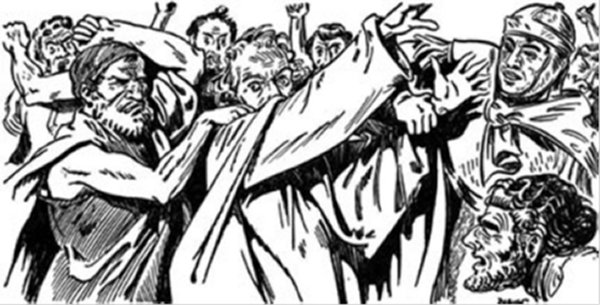
One of the earliest victims was an elderly man who was seen wiping down a bench in church before he sat down. A mob of crazed women accused him of poisoning the seat, and seized and viciously assaulted him in church. The frenzied women then dragged the battered old man to the magistrates, all the while continuing to beat him, and ended up killing him en route. Even more tragic was the case of a pharmacist whose potions were seen as evidence that he was in league with Satan. He protested his innocence and pointed out that all pharmacists had such potions, but to no avail.
He was tortured and stretched on the rack until he changed his protestations of innocence to a confession of guilt. To end the pain, he repeated whatever his torturers wanted to hear, and admitted that had entered into a compact with Satan and foreigners to poison the good people of Milan. Worse, forced to name fellow conspirators, he pointed the finger at random people who committed no crime. They in turn were arrested and tortured, and to end their suffering, they pointed the finger at yet more innocents, and the process was repeated, dragging in more and more unfortunates. All were tried, convicted based on the confessions extracted under torture, and executed.
Hysteria So Bad, People Began to Accuse… Themselves
As the mass hysteria tightened its grip on the fevered city, many Milanese stepped forward to accuse themselves. People went to the magistrates and voluntarily confessed to a variety of fantastic supernatural acts. They described how they met Satan, sorcerers, witches, and all kind of black magic practitioners of black magic, and schemed and plotted to poison city. Contemporaries reported that: “The number of persons who confessed that they were employed by the Devil to distribute poison is almost incredible”. Many were executed based on their voluntary false confessions.

_________________
Some Sources & Further Reading
Lapham’s Quarterly, April 16th, 2020 – ‘A Simulated Plague’: Watching Panic Spread in Italy in 1630

