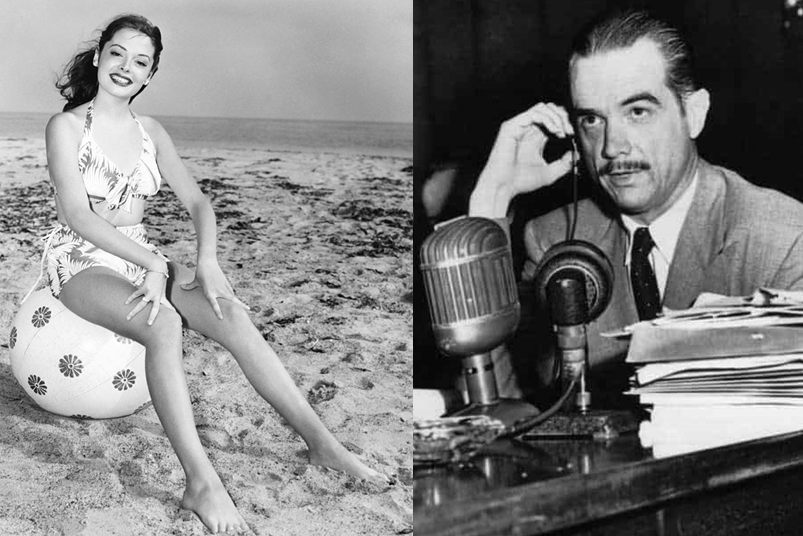
Jane Greer was once a rising starlet, until her career was derailed by Howard Hughes when she refused his advances. It was an unsettling example of how power, obsession, and control could shape Hollywood careers during the studio era. Unlike some of Hughes’ other romantic entanglements, his involvement with Greer was not so much about public romance. It was more about ownership, and his determination to dictate the course of her professional life when she resisted him. In 1942, eighteen-year-old Greer caught Hughes’ eye when he saw her modeling in Life magazine. Infatuated, he sponsored and sent her to Hollywood to become an actress. When she showed an interest in other men, it enraged Hughes. He figured he had made her, and thus had every right to break her. He went to great lengths to try and do just that.
The Tycoon and the Teenager

Jane Greer was born Bettejane Greer in 1924 and came to Hollywood as a teenager. She was intelligent, musically trained, and striking in a cool, aloof way. She differed from the more overtly glamorous stars of the early 1940s. Her intelligence and self-possession would later be key to her screen persona. However, those traits also made her a poor fit for Howard Hughes’ expectations of compliance. Jane Greer’s mother, who worked for the War Department, saw to it that her daughter was one of three young women chosen to model uniforms for the new Women’s Army Corps (WAC) in 1942. When her modeling appeared in the June 8th, 1942, issue of Life magazine, many across the country were smitten. They included Hughes.
The eccentric tycoon liked to collect people – especially beautiful women – like normal folk collect stamps. So he signed the teenaged Greer to a personal contract – which was as creepy as it sounds. Such contracts were not unusual back then, but Hughes’ personal involvement in Greer’s career went far beyond standard studio arrangements. He quickly became obsessed with her. He saw her not only as a potential star, but as someone he believed he could mold and possess. The controlling behavior started early: soon after she signed, Hughes told the teenager that he never wanted her to marry.
Howard Hughes’ Quest to Control Jane Greer

The nature of the personal relationship between Howard Hughes and Jane Greer has been described differently over the years. She insisted that they were never romantically involved in the way Hughes wanted, and that she actively resisted his advances. Hughes, by contrast, acted as though her rejection was a temporary obstacle rather than a definitive boundary. What is clear is that he became fixated on her, and grew deeply resentful of her independence. At first, that was no problem for the inexperienced Greer, who initially liked Hughes. As she put it years later: “I found him rather endearing, like a child. His idea was to go to the amusement park … He won a large collection of Kewpie dolls for me”.
When Greer welcomed the attentions of other men, however, Hughes was not happy. Hughes taking the teenager out to amusement parks was all well and good – for a while. Things got awkward, however, when Greer welcomed the attentions of other men. Men who saw her as a woman, and not a child. Men who had more in mind than taking her to amusement parks. Hughes wasn’t the only one who had been captivated by Greer’s 1942 modeling photo. Star Crooner Rudy Vallee was also smitten, and tried unsuccessfully to get her address from Life magazine. When he eventually found it, things got complicated.
Howard Hughes Was Rich, but Had No Game

Jane Greer might have liked hanging out with Howard Hughes. However, a wealthy eccentric treating her like a child with trips to amusement parks was no competition to a star singer romancing her like a woman. Rudy Vallee swept Greer off her feet, and after a whirlwind courtship, they wed in 1943. That left Hughes seething with jealousy. Whatever the legality of the “no marriage” clause in the personal contract that Greer had signed, Hughes had meant it. He now felt betrayed. So he went from doting to destructive, and set out to wreck Greer’s career. Hughes had initially used his power to advance Greer’s career. Until then, she had been given small roles at RKO and groomed for stardom. However, Hughes’ erratic management style meant she spent long periods under contract without meaningful work.
That pattern of signing actresses, promising them fame, then shelving them indefinitely, was typical of Hughes. He enjoyed the sense of control that came from keeping talented women dependent on his whims. Greer’s breakthrough came not through Hughes’ patronage but in spite of it. She first gained attention with films like Dick Tracy (1945). Next came Out of the Past (1947), in which she delivered one of the defining performances of classic film noir. As Kathie Moffat, Greer projected intelligence, ambiguity, and emotional restraint—qualities that made her performance timeless. Ironically, those were the same qualities that had frustrated Hughes.
Howard Hughes Bought a Studio to Wreck Jane Greer’s Career

By the late 1940s, Jane Greer’s career was gaining momentum, and she was no longer dependent on Hughes’ goodwill. That was precisely when Hughes’ behavior shifted from possessive to punitive. By then, Greer had divorced Rudy Vallee. When she remarried Edward Lasker, a wealthy attorney and former Olympic skier, in 1947, Hughes reacted with fury. That second marriage symbolized Greer’s escape from his influence, both romantically and professionally. From that point on, Hughes began actively interfering with her career. One of his most effective tools was his control over RKO and his willingness to weaponize contracts.
Greer had signed a contract with RKO – one of the Big Five studios of Hollywood’s Golden Age. She had a run of successful films with RKO – until Hughes bought the studio to wreck her career. He called Greer to his office, and told her he would not use her anymore. “Since I was under exclusive contract to Howard at RKO, that meant I would not be able to work for anybody else, either. I told him directly that this meant that he was ruining my film career. He replied by saying, ‘Yes, that’s right’”.
Taking Vindictiveness to Extremes

Jane Greer found herself blocked from desirable roles, and tied up in contractual disputes. She was quietly blacklisted from projects that should have been natural fits for her talents. Directors who wanted to cast her were discouraged or outright prevented from doing so. Hughes also spread damaging rumors about Greer, a common tactic used against actresses who defied powerful men in Hollywood. Such rumors could be devastating in an industry that depended on reputation, studio cooperation, and informal networks of approval.
Greer stated that Hughes tried to paint her as “difficult” and ungrateful – labels that often stalled or ended careers. Some actresses who attempted to placate Hughes, or remained trapped in contractual limbo. Greer took the rare step of fighting back. With the financial and emotional support of her husband, she legally challenged Hughes’ control, and sought work outside his reach. That resistance came at a cost: her film output slowed dramatically in the late 1940s and early 1950s. Those were precisely the years when she should have been at the peak of her career.
Harvey Weinstein Had Nothing on Howard Hughes

Jane Greer was blunt about Hughes. She described him as vindictive and emotionally immature – a man who could not tolerate rejection. Once he realized he could not control her personally, he decided to punish her professionally. In an industry where men like Hughes operated with near-total impunity, what he did to Greer was not unique. He exhibited similar patterns with other actresses, including Jean Peters and Faith Domergue. He oscillated between lavish attention and ruthless neglect, and used contracts, publicity, and intimidation as tools of dominance. What makes Greer’s case especially stark is how clearly her resistance triggered retaliation.
After six years of barely any work, Greer managed to buy out her RKO contract. By then, however, Hughes’ vindictiveness had cost her the best and most lucrative years of her acting career. Despite that, Greer managed to build a respectable and enduring career, and worked in film and television for decades. She appeared in projects like The Company of Wolves, and the 1980s noir aesthetics revival that rediscovered her iconic status. Her reputation grew over time, while Hughes’ behavior came to be seen as emblematic of Hollywood’s darker power structures.
Despite Howard Hughes’ Worst, Jane Greer Managed to Succeed to on Her Own Terms

In retrospect, the damage Hughes inflicted on Jane Greer’s career is impossible to quantify precisely, but the timing is telling. An actress who delivered one of noir’s most memorable performances should have become a top-tier leading lady. Instead, her trajectory flattened just as she asserted independence from one of the most powerful men in Hollywood. Greer never portrayed herself as a victim in the passive sense. She was clear-eyed about the risks she took, and proud of having refused to submit to Hughes’ demands. She was an early example of a Hollywood woman choosing autonomy over advancement, even at the cost of professional marginalization.
Howard Hughes liked to imagine himself as a kingmaker. He saw himself as someone who created stars through vision and willpower. Jane Greer exposed the limits of that fantasy. She succeeded on her own terms, and when she refused to belong to him, he tried to erase her. That he failed to do so completely is a testament to her resilience. It is also a reminder of how much talent Hollywood lost because powerful men could not tolerate being told no.

_________________
Some Sources & Further Reading
Barlett, Donald L., and Steele, James B. – Howard Hughes: His Life and Madness (2004)
Guardian, The, August 28th, 2001 – Jane Greer
Life – Jane Greer: The Actress Whose Career Howard Hughes Tried to Quash
Los Angeles Times, August 28th, 2001 – Jane Greer, Star of Film Noir ‘Out of the Past’
Newest Articles
- The Johnstown Flood – Thousands Perished When A Dam Collapsed After Gilded Age Tycoons Modified it for their Private Resort
- The Jacquerie: The Medieval Peasant Uprising That Terrified France’s Aristocrats
- Things That Weren’t Thought Through: WWII’s Sticky Bomb Stuck to Users’ Hands Once Activated
- German Tanks of World War II – The Panzer 38(t), a Czech Tank in German Service
- Nicholas Alkemade: The WWII Airman Who Survived an 18,000 Foot Fall From a Bomber Without a Parachute

