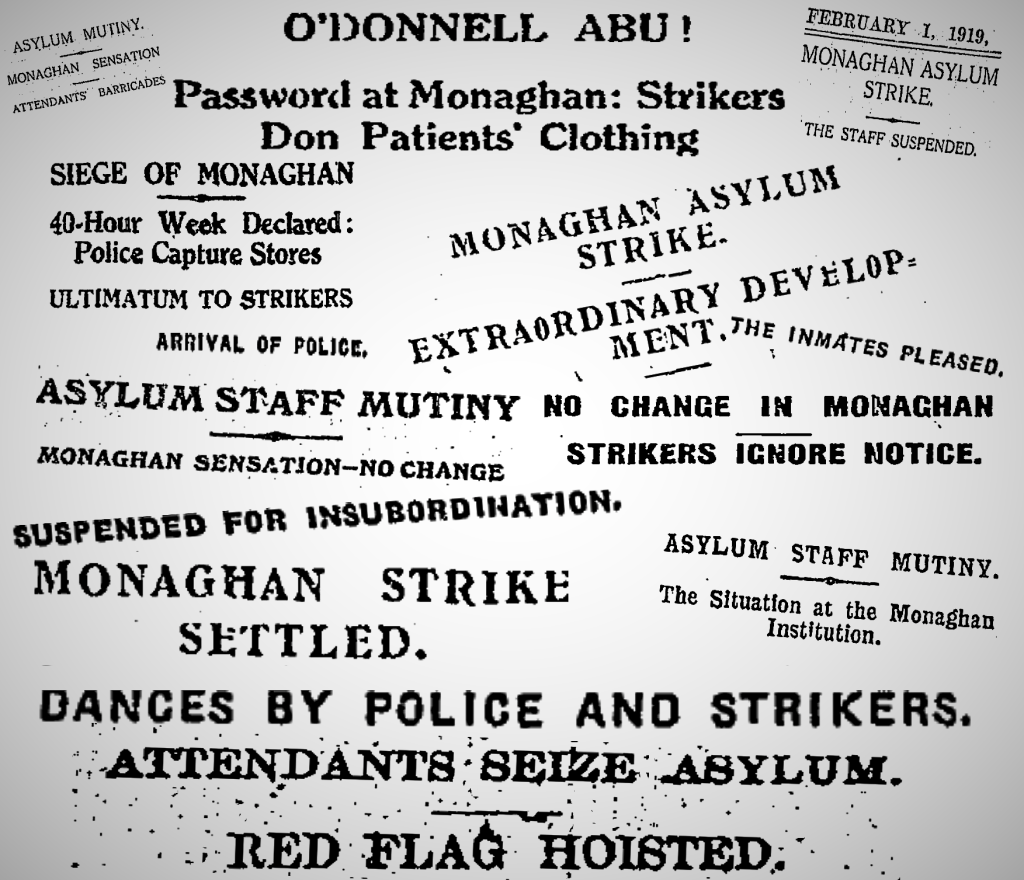
In 1919, staff and patients at the Monaghan asylum in Ireland barricaded themselves and declared a soviet – a workers’ council. It was one of the more unusual episodes to emerge from Ireland’s revolutionary years of 1918–1923. Workers in the Monaghan Lunatic Asylum Soviet seized control of their workplace and ran it in defiance of authorities. It was the first of many such labor actions over the following years. What made it different from other Irish “soviets” of that era was its setting: a psychiatric asylum, and the surreal contrast between revolutionary rhetoric and the deeply conservative social role such an institution played.
The Background of Irish Soviets

To understand the episode, it helps to place it within the broader context of the Irish soviet movement. It was inspired partly by the Russian Revolution, and partly by local labor traditions. Irish soviets were not usually attempts to create communist states. Instead, they were pragmatic industrial actions in which workers occupied factories, mills, and services to protest wages, conditions, or management. Red flags were raised, “soviet” was painted on gates, and workers’ committees took over day-to-day operations. Between 1919 and 1923, more than a hundred such actions occurred across Ireland.
Monaghan Lunatic Asylum, like many such institutions, was a major local employer. Asylums were overcrowded, underfunded, and rigidly hierarchical. Staff included attendants, nurses, orderlies, and domestic workers, many of whom worked long hours for low pay under strict discipline. Inflation during World War I had sharply eroded real wages, and after the war ended, expectations of reform rose rapidly. When those expectations were not met, tensions boiled over. In early 1919, workers at the Monaghan asylum became involved in industrial agitation. They demanded higher wages, better hours, and recognition of trade unions. The workers had already shown militancy during a 1918 strike, chasing away staff who tried to cross the picket line. Conditions had not improved by 1919, though: attendants worked 93-hour weeks, and made just £60-£70 per year.
The Monaghan Lunatic Asylum Soviet

The Irish Transport and General Workers’ Union (ITGWU) was expanding rapidly at the time. Its influence reached even into institutions like asylums. Peadar O’Donnell, a leading ITGWU militant, negotiated on behalf of the asylum workers. When negotiations failed, the workers raised the red flag and declared a soviet under workers’ authority. A committee of staff took charge of the Monaghan Lunatic Asylum Soviet. The choice of language was provocative. Calling the action a “soviet” deliberately aligned it with international revolutionary currents. It signaled defiance of both local authorities, and the British administrative system that still governed Ireland in early 1919.
There is little evidence that the Monaghan asylum workers were ideologically committed to communism. As with most Irish soviets, the term functioned more as a bargaining weapon and a symbol of worker power. It was not a call or blueprint for social transformation. Unlike in factories or creameries, abandoning work at the asylum was not an option. The vulnerable population housed therein required constant care. Staff stayed on the job, implemented a 48-hour week, ensured patients were fed and supervised, and maintained basic services. That gave the Monaghan soviet a paradoxical character. It was both a revolutionary gesture, and a demonstration of worker responsibility and professionalism.
Mixed Reactions

The strikers imposed labor discipline. For example, a worker was thrown into a padded cell for “defeatism”. Reactions to the Monaghan Lunatic Asylum Soviet were mixed. Authorities were alarmed, particularly given widespread contemporary fears about Bolshevism and social disorder in the postwar world. Newspapers often treated such actions with a blend of fascination and unease. They sometimes mocked the idea of a “lunatic asylum soviet”, and simultaneously expressed concern about public safety. However, the fact that patients were not mistreated and that order was maintained blunted some of the criticism.
Staff and patients showed extraordinary resolve to maintain the occupation, even when surrounded by 125 armed police. Unusually, there was no animosity between police and strikers. During the occupation, workers and cops co-organized football matches and dances. When rumors circulated that military police were about to force entry, the occupiers sealed the windows and barricaded corridors, and armed themselves with pitchforks and shovels. They also swapped clothes with patients to confuse the attackers. At some point, the bosses offered to meet wage demands for male workers only. The soviet turned them down, and insisted on equal pay regardless of gender.
Significance and Legacy of the Monaghan Lunatic Asylum Soviet

As with many similar actions, the Monaghan Lunatic Asylum Soviet was short-lived. Pressure from local government bodies, threats of dismissal, and concessions over pay and conditions eventually brought it to an end. The occupiers held a victory dance in one of the dining halls. It was attended by many local townspeople, as well as some policemen. The following morning, February 4th, 1919, they returned to work. It was a local victory, but did not lead to lasting worker management improvements or structural reforms. The asylum system remained deeply flawed for decades afterward.
Historically, the episode stands out as a vivid example of how far labor militancy spread during Ireland’s revolutionary period. Radical ideas had reached not only factories and farms, but also institutions associated with control, discipline, and social marginalization. At the same time, it illustrates the essentially pragmatic nature of Irish soviets. They were about dignity, wages, and power at the workplace, rather than abstract ideology. Today, the Monaghan Lunatic Asylum Soviet is remembered less for its immediate impact than for its symbolism. A red flag flying over a psychiatric asylum in rural Ulster encapsulates the strange, fluid, and often contradictory nature of the Irish Revolution. It was an era when struggles for national independence, social justice, and economic survival overlapped in unexpected ways.

_________________
Some Sources & Further Reading
Whistling in the Wind – Irish Soviets, 1919-23
Newest Articles
- The Brink’s-Mat Robbery: Britain’s Biggest Gold Heist
- Fighting Women: Artemisia I of Caria Led Her Ships at the Battle of Salamis
- Alexander the Great and Sisygambis, Mother of Persia’s King Darius III
- Unholy Holy Fathers: Pope Leo X’s Corruption Was So Brazen, it Triggered the Protestant Reformation
- Edward England, the Humane Pirate Captain Deposed by His Men for Being Too Nice

