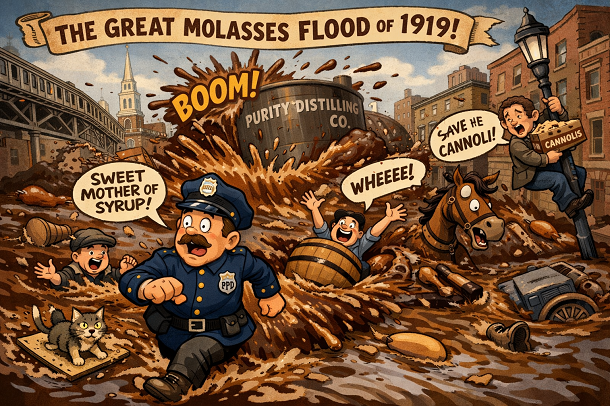
Boston’s Great Molasses Flood, which occurred on January 15th, 1919, was one of America’s most bizarre and tragic industrial disasters. Though often remembered with a touch of dark humor because of its unusual substance, the event was deadly and destructive. It was also transformative in terms of changes in its aftermath to engineering standards, corporate responsibility, and public safety.
When Molasses Was More than a Food Product

The Great Molasses Flood took place in Boston’s North End, a densely populated waterfront neighborhood. A massive steel storage tank dominated the area. It was owned by the United States Industrial Alcohol Company, through its subsidiary the Purity Distilling Company. The tank stood about 50 feet tall and 90 feet in diameter, and held roughly 2.3 million gallons of molasses. Molasses back then was not just a food product, but also a critical industrial commodity. It was a key ingredient in industrial alcohol production, and, during World War I, in the manufacture of explosives. Although the war had ended two months earlier, production and storage continued at a rapid pace.
A sudden failure occurred on the afternoon of January 15th, 1919, and without warning, the tank burst apart. The force of the collapse produced a thunderous roar that witnesses compared to machine-gun fire or a train wreck. Nearby residents initially believed a bomb had exploded. A molasses wave, about 25-feet-high, gushed out and rushed through the streets at speeds of roughly 35 miles per hour. The viscous liquid smashed buildings off their foundations, bent steel girders, overturned rail cars, and crushed all in its path.
A Molasses Tsunami

The disaster’s toll was severe. Twenty-one people were killed, and at least 150 were injured. Victims included dockworkers, teamsters, firefighters, children playing nearby, and residents trapped inside collapsing structures. Many horses and dogs were also killed and wounded. Molasses proved particularly deadly because of its density and stickiness, and those caught in the flood struggled to move. Some were drowned or suffocated as the syrup hardened in the winter cold. Rescue efforts were chaotic and harrowing. Firefighters, police officers, sailors from the nearby USS Nantucket, and volunteers waded through knee- to waist-deep molasses. It clung to clothing and equipment, and made movement exhausting and dangerous.
The cleanup efforts after what came to be known as the Great Molasses Flood lasted for weeks. Crews used seawater from Boston Harbor to wash molasses into storm drains, while sand was spread to improve traction. Despite those efforts, the molasses seemed impossible to eradicate completely. The substance tracked through Boston on shoes and trolley wheels, and for weeks, “Everything that a Bostonian touched was sticky”. Contemporary accounts claim that on hot summer days for decades afterward, the North End smelled faintly of molasses. Whether exaggerated or not, the event became a lasting part of Boston folklore.
Legacy of the Great Molasses Flood

Beyond the immediate tragedy, the Great Molasses Flood of Boston had profound legal and regulatory consequences. A massive lawsuit followed, involving 119 separate claimants. The case became one of the earliest and most significant class-action-style lawsuits in US history. The United States Industrial Alcohol Company attempted to deflect blame by suggesting sabotage by anarchists – a claim reflecting the era’s Red Scare anxieties. However, a lengthy investigation revealed that the tank had been poorly designed, inadequately tested, and never properly inspected.
The tank had leaked molasses for years. Rather than fix it, the company simply painted it brown to hide the leaks. The firm ultimately paid out $628,000 in damages – equivalent to about $12 million in 2026. Relatives of those killed received $7,000 each, or about $130,000 in today’s money. More importantly, the case set important precedents for corporate accountability and engineering oversight. It led to stricter building codes, requirements for professional engineering approval of large structures, and greater emphasis on safety standards in industrial construction.

Today, the Great Molasses Flood occupies a unique place in American memory. A small plaque near the site marks where the tank once stood. The image of Boston drowned in syrup is humorous – but also a reminder of the deadly consequences of industrial negligence. Cost-cutting, regulatory laxity, and disregard for safety had transformed an ordinary urban structure into a lethal hazard. In that sense, the molasses flood was more than a strange oddity. It was a turning point that reshaped how modern cities think about engineering responsibility and public safety.

_________________
Some Sources & Further Reading
History Halls – The Erfurt Latrine Disaster, When Dozens of Aristocrats Were Drowned in Excrement
Puleo, Stephen – Dark Tide: The Great Boston Molasses Flood of 1919 (2004)
Smithsonian Magazine, November 1983 – Without Warning, Molasses in January Surged Over Boston
Latest Articles
- The Johnstown Flood – Thousands Perished When A Dam Collapsed After Gilded Age Tycoons Modified it for their Private Resort
- The Jacquerie: The Medieval Peasant Uprising That Terrified France’s Aristocrats
- Things That Weren’t Thought Through: WWII’s Sticky Bomb Stuck to Users’ Hands Once Activated
- German Tanks of World War II – The Panzer 38(t), a Czech Tank in German Service
- Nicholas Alkemade: The WWII Airman Who Survived an 18,000 Foot Fall From a Bomber Without a Parachute

