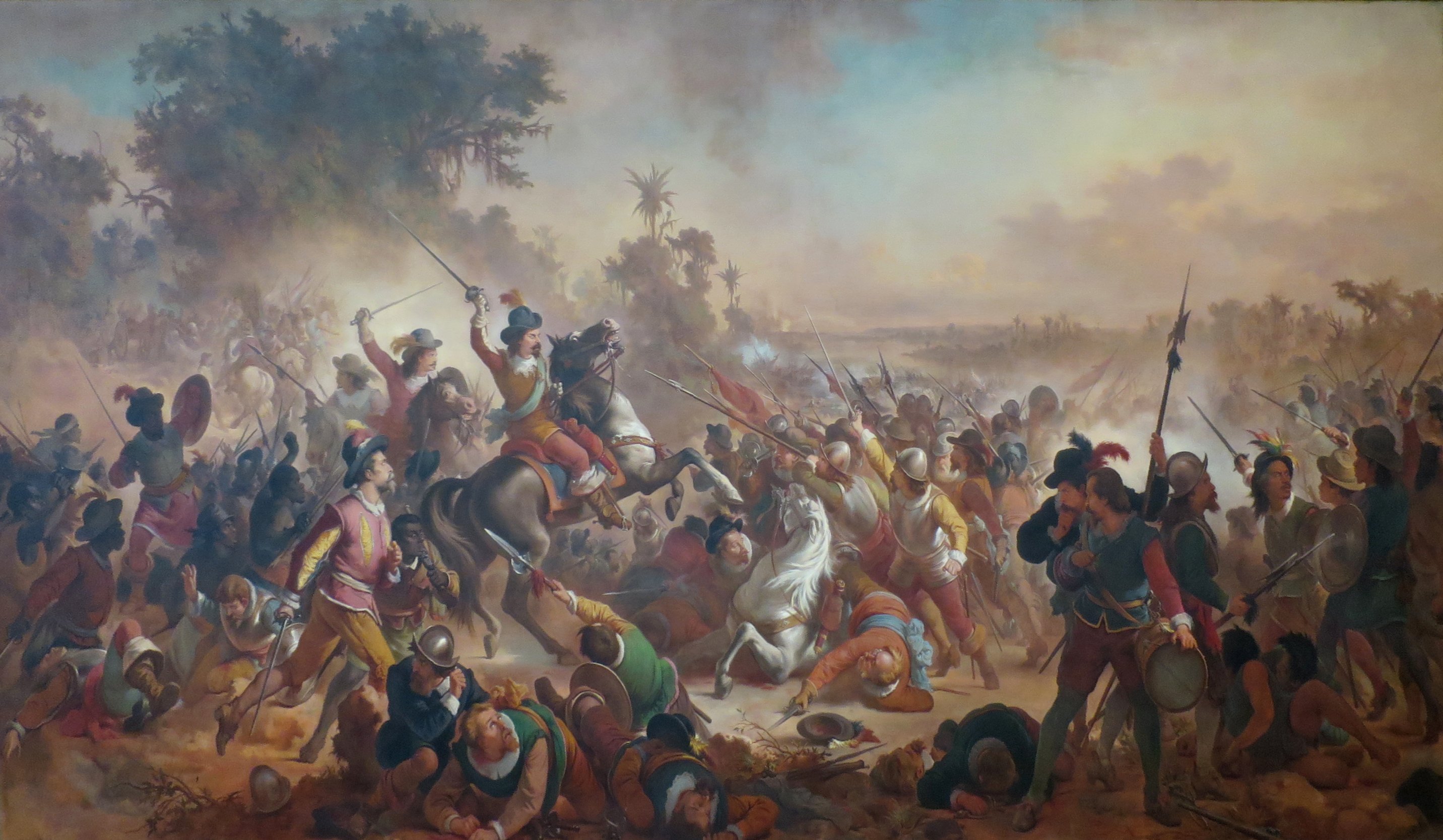
New Holland, or Dutch Brazil, was a short-lived but influential colonial experiment conducted by the Dutch Republic in northeastern Brazil. The colonization effort, which lasted 1630 to 1654, represented the high tide of Dutch overseas expansion. It was also a rare moment when Brazil’s sugar heartland fell under non-Portuguese European control. Though short-lived, New Holland left lasting marks on Brazilian society, Atlantic geopolitics, and the history of colonial governance. Especially through its distinctive approach to religious tolerance, urban planning, and scientific inquiry.
The Dutch in the New World

The origins of New Holland lay in the wider geopolitical upheavals of early modern Europe. In the late sixteenth century, Portugal fell under Spanish rule during the Iberian Union (1580–1640). Since the Dutch were fighting a bitter war of independence against Spain, Portuguese colonies became legitimate targets for Dutch attacks. At the same time, the Dutch were deeply entangled in the global sugar trade. Dutch merchants financed much of Brazil’s sugar production, transported it to Europe, and refined it in Amsterdam.
By seizing the sugar’s source, the Dutch hoped to break Iberian dominance and secure enormous profits. To carry out that ambition, the Dutch West India Company (Dutch initials GWC) was established in 1621. Unlike purely commercial enterprises, the GWC was granted sweeping powers. It could wage war, negotiate treaties, establish colonies, and govern conquered territories. After failed attempts to conquer Bahia in the 1620s, the company regrouped and launched a major expedition in 1630. This time, it successfully captured Olinda and Recife in the captaincy of Pernambuco, the core of Brazil’s sugar economy. That marked the beginning of New Holland.
The Governor Who Made New Holland Viable

The early years of Dutch Brazil were unstable and violent. Many Portuguese planters fled inland or sabotaged sugar mills, rather than submit to Dutch authority. Guerrilla warfare erupted almost immediately, with local resistance supported by Portuguese loyalists and Indigenous allies. The GWC struggled to impose order while keeping sugar production running. That task was made harder by the fact that many plantations had been damaged or abandoned during the conquest. The colony initially existed more as a military occupation than a functioning society.
That changed dramatically in 1637 with the arrival of Count John Maurice of Nassau-Siegen, appointed governor-general of New Holland. His tenure, which lasted until 1644, is regarded as the golden age of Dutch Brazil. John Maurice was an unusually enlightened colonial administrator for his time. A German nobleman in Dutch service, he combined military competence with genuine curiosity about the land and peoples he governed. Under his leadership, New Holland became more than a mere profit-seeking colony. It also became an ambitious experiment in governance, science, and cultural exchange.
A Wave of Progress

One of John Maurice’s most notable policies was religious tolerance. While the Dutch Reformed Church was officially favored, Catholics were largely allowed to practice their faith. Jews, who had been severely persecuted by the Portuguese, were granted unprecedented freedom in the Americas. Recife became home to one of the first Jewish communities in the New World, including the Kahal Zur Israel synagogue. Many of those Jews were Sephardim who had fled Iberian persecution, and now found relative security under Dutch rule. That atmosphere of tolerance contrasted sharply with the rigid Catholic orthodoxy enforced by Portuguese colonial authorities and the Inquisition.
Urban development was another hallmark of Maurice’s governorship. Recife was transformed from a rough port into a planned colonial capital. Maurice founded the city of Mauritsstad nearby, complete with paved streets, canals, bridges, gardens, and public buildings. The governor’s palace, Vrijburg, symbolized Dutch confidence in the permanence of their rule. Infrastructure improvements facilitated trade, and made New Holland one of the era’s most modern colonial cities in the Americas. Equally remarkable was the scientific and artistic activity encouraged by John Maurice.
Bringing (Relative) Tolerance to Brazil

John Maurice brought with him scholars, cartographers, physicians, and artists to document the natural environment and peoples of Brazil. Figures such as Willem Piso and Georg Marcgraf produced groundbreaking studies of Brazilian flora, fauna, and medicine. Their works laid the foundations for tropical science. Artists like Frans Post and Albert Eckhout created detailed paintings of Brazilian landscapes, Indigenous peoples, Africans, and colonial life. Those works were not mere curiosities, but part of a broader effort to understand, catalog, and ultimately control the colony.
Despite those achievements, the economic foundations of New Holland remained fragile. Sugar production depended on enslaved African labor, a system the Dutch continued and expanded. The GWC actively participated in the Atlantic slave trade. It captured Portuguese slaving ports in Africa such as Elmina and Luanda to supply Brazilian plantations. While Dutch rule was more tolerant in religious matters, it was no less brutal in its reliance on slavery. Enslaved Africans formed the backbone of the sugar economy, and their suffering underpinned the colony’s wealth.
The Shaky Foundations Dutch Brazil

Relations with Portuguese planters were also tense. Many landowners returned to their estates under Dutch rule, often with loans from the GWC to rebuild sugar mills. However, those debts bred resentment. Planters viewed the Dutch as foreign occupiers, and chafed under high interest rates and commercial restrictions. Loyalty to the Dutch was often pragmatic rather than heartfelt, and when political circumstances changed, that loyalty quickly evaporated. Circumstances shifted dramatically in the 1640s. In 1640, Portugal regained its independence from Spain, which fundamentally altered the strategic calculus. The Dutch were no longer fighting a united Iberian enemy, and the Portuguese crown was eager to reclaim Brazil. At the same time, the Dutch Republic became increasingly preoccupied with conflicts closer to home, particularly the First Anglo-Dutch War.
Financial pressures mounted, and the GWC, dissatisfied with John Maurice’s costly administration, recalled him in 1644. His removal proved disastrous for New Holland. Without Maurice’s diplomatic skill and personal authority, tensions exploded. In 1645, Portuguese planters and their allies launched a massive revolt against Dutch rule, known as the Insurrection of Pernambuco. The rebellion united white colonists, Indigenous fighters, and enslaved and free Africans under Portuguese leadership. Two major battles at Guararapes in 1648 and 1649 saw Portuguese forces defeat Dutch armies, relying on local knowledge, mixed-race troops, and guerrilla tactics rather than European drill.
The Fall of New Holland

Although the Dutch managed to hold on to Recife for several more years, their position was increasingly untenable. Cut off from sufficient reinforcements and facing relentless resistance, the colony underwent a slow collapse. In 1654, Dutch forces finally surrendered Recife, and New Holland came to an end. The formal recognition of Portuguese sovereignty came with the Treaty of The Hague in 1661. Per its terms, Portugal agreed to compensate the Dutch financially in exchange for final acknowledgment of Portugal’s Brazilian control.
The fall of Dutch Brazil had significant consequences for the Atlantic world. For Portugal, it reinforced and secured the continued importance of Brazil as the crown jewel of its empire. For the Dutch, the loss marked a turning point. Although they remained major commercial and maritime powers, they increasingly shifted away from large territorial colonies toward trade-based empires. Henceforth, they focused on places like Suriname, the Caribbean islands, and the East Indies. As to the legacy left behind by New Holland in Brazil, it is complex and multifaceted.
Dutch Brazil is often remembered for its relative tolerance, urban sophistication, and scientific curiosity. Especially when contrasted with the later rigidity of Portuguese colonial administration. Recife’s early development owes much to Dutch planning, and aspects of its urban layout still reflect that period. The Jewish community established under Dutch rule also had lasting repercussions. Some Brazilian Jews later migrated to North America and contributed to the founding of early Jewish congregations in places like New Amsterdam, the future New York.
Significance and Legacy of Dutch Brazil

New Holland was not all positive: it was deeply enmeshed in the violence and exploitation of colonialism. Its prosperity rested on slavery, warfare, and the extraction of wealth for European benefit. The Dutch were not benevolent outsiders, but ruthless competitors in an imperial system that commodified land and people alike. Their brief experiment did not fundamentally challenge the structures of colonial domination: it merely administered them in a different style. In Brazilian historical memory, Dutch Brazil occupies a curious place. It is often portrayed as a fascinating “what if” moment. A glimpse of an alternative colonial path that might have produced a more pluralistic society had it endured.
Such speculation is tempting. However, it risks romanticizing a regime that, for all its innovations, remained a colonial project driven by profit and power. Ultimately, New Holland stands as one of the most intriguing episodes in the history of colonial Brazil. It brought together global trade, religious diversity, scientific exploration, and brutal exploitation in a single, short-lived experiment. Its rise and fall illustrate the volatility of early modern empires, and the decisive role played by local resistance in shaping colonial outcomes. Dutch Brazil was erased as a political entity. However, it left behind enduring traces that continue to inform how Brazil’s colonial past is understood today.

_________________
Some Sources & Further Reading
Boxer, Charles R. – The Dutch in Brazil, 1624-1654 (1957)
Groesen, Michiel van – The Legacy of Dutch Brazil (2014)
History Halls – Piet Hein: The Dutchman Who Captured the Spanish Treasure Fleet
Schmidt, Benjamin – Innocence Abroad: The Dutch Imagination and the New World, 1570-1670 (2001)
Newest Articles
- The Johnstown Flood – Thousands Perished When A Dam Collapsed After Gilded Age Tycoons Modified it for their Private Resort
- The Jacquerie: The Medieval Peasant Uprising That Terrified France’s Aristocrats
- Things That Weren’t Thought Through: WWII’s Sticky Bomb Stuck to Users’ Hands Once Activated
- German Tanks of World War II – The Panzer 38(t), a Czech Tank in German Service
- Nicholas Alkemade: The WWII Airman Who Survived an 18,000 Foot Fall From a Bomber Without a Parachute

