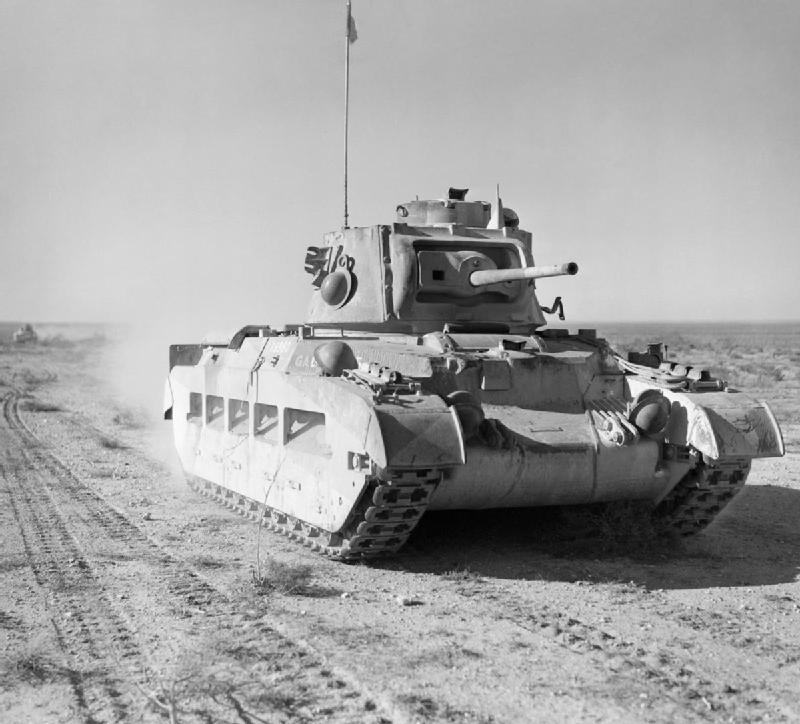
The Matilda II was one of Britain’s most distinctive and controversial armored vehicles of early World War II. Officially designated the Infantry Tank Mark II, it entered service in 1939, and embodied British interwar tank doctrine. The British divided armored vehicles into fast “cruiser” tanks, and slow, heavily armored “infantry tanks”. Fast cruiser tanks were for exploitation, while infantry tanks were to advance alongside foot soldiers and smash through fortified positions. The Matilda II was the most formidable expression of that concept. It combined exceptionally thick armor with reliability and simplicity, but at the cost of speed, flexibility, and long-term relevance.
Exceptionally Heavy Armor Made the Matilda II Formidable at WWII’s Start

The Matilda II was a substantial improvement over earlier Matilda Is, that were lightly armed with only a machine gun. Designed by Vickers-Armstrong, the new tank mounted the standard British 2-pounder (40 mm) anti-tank gun in a fully rotating turret. That gave it considerable offensive capability against enemy armor of the period. However, it lacked a high-explosive shell for its main gun. That limitation would later prove significant when it had to engage infantry and anti-tank positions. Secondary armament consisted of a coaxial machine gun, initially the Vickers and later the Besa.
What truly set the Matilda II apart was its armor protection, with frontal armor up to 78 mm thick. That made it, at the time of its introduction, one of the most heavily armored tanks in the world. In 1940 most German anti-tank guns, including the widely used 37 mm Pak 36, could not penetrate the Matilda’s armor at normal combat ranges. That gave the tank a fearsome reputation among Axis troops. They nicknamed the Pak 36 the “door knocker” because it could hit a Matilda without effect. In the early war years, the Matilda’s armor allowed it to dominate engagements where enemy firepower was limited. That strength, however, came with serious trade-offs.
The Matilda’s Glory Days of 1940-1941

The Matilda II was slow, with a top speed of around 15 mph (24 km/h) on roads, and significantly less off-road. Its twin AEC diesel engines were reliable, but underpowered for a vehicle that weighed over 27 tons. The suspension, while robust, further limited cross-country mobility. In fast-moving operations, the Matilda struggled to keep pace. Once breakthrough warfare replaced the more static fighting envisioned by prewar planners, its role became increasingly awkward. The Matilda II first saw combat during the Battle of France in 1940.
There, it shocked German forces during counterattacks such as the engagement at Arras. British Matildas advanced under heavy fire, and shrugged off hits that would have destroyed most other tanks of the era. Although those actions were tactically limited and strategically unsuccessful, they left a deep impression on German commanders. The result was a rapid reassessment of anti-tank tactics to deal with heavily armored tanks like the Matilda. The Germans turned to heavier guns, field artillery, and the famous 88 mm Flak gun in a ground role.
The Matilda’s most famous service came in the North African Campaign. There, it became the backbone of British armored units in 1940 and early 1941. In the open desert, its mechanical reliability and thick armor were valuable assets. Italian forces, whose anti-tank weapons were generally weak, were largely helpless against it. Matildas played a key role in Operation Compass, which smashed Italian positions and contributed significantly to Britain’s early successes. Against Italian tanks, the Matilda II was virtually invulnerable. Things changed, however, when Hitler rushed German forces to buttress his Italian ally.
Decline and Displacement of the Matilda II

The arrival of the German Afrika Korps marked the beginning of the end for the Matilda II. German 50 mm anti-tank guns, and 88 mm guns pressed into ground roles, penetrated its armor and negated its advantage. Simultaneously, the tank’s lack of speed and absence of high-explosive ammunition made it less effective in combined-arms warfare. As battles became more fluid and tactically sophisticated, the Matilda increasingly appeared outdated. By 1942, the Matilda II was being phased out of frontline service, replaced by newer infantry tanks such as the Valentine and later the Churchill. Nonetheless, it continued to serve in secondary roles and specialized variants.
They included mine-clearing versions like the Matilda Scorpion, which used rotating chains to detonate mines. There were also flamethrower conversions such as the Matilda Frog, used by Australian forces in the Pacific. In jungle warfare, where speed mattered less than protection and reliability, the Matilda found a surprising second life. In retrospect, it was superbly protected for its era and dependable, and in the right circumstances was devastatingly effective. However, it was constrained by doctrine and technology that could not adapt quickly enough to the realities of modern warfare. The Matilda II was a dead end design that did not shape the future of tank development. In the dark early days of WWII, though, it gave British forces a rare and badly needed battlefield advantage.

_________________
Some Sources & Further Reading
Chamberlain, Peter, and Ellis, Chris – British and American Tanks of World War Two (2004)
Fletcher, David – The Great Tank Scandal: British Armour in the Second World War (1989)
History Halls – Fighting Women: Empress Matilda Was So Formidable, they Named Two Tanks After Her
Latest Articles
- The Brink’s-Mat Robbery: Britain’s Biggest Gold Heist
- Fighting Women: Artemisia I of Caria Led Her Ships at the Battle of Salamis
- Alexander the Great and Sisygambis, Mother of Persia’s King Darius III
- Unholy Holy Fathers: Pope Leo X’s Corruption Was So Brazen, it Triggered the Protestant Reformation
- Edward England, the Humane Pirate Captain Deposed by His Men for Being Too Nice

