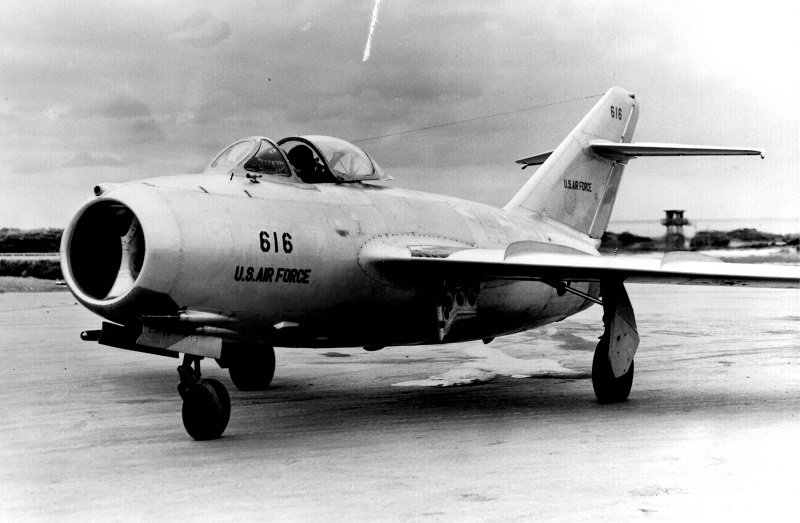
The Mikoyan-Gurevich MiG-15, NATO codename Fagot, was one of aviation history’s most important warplanes, and not just because of its technical qualities. Its significance lay in the strategic shock it delivered to the West at the dawn of the jet age. The MiG-15 emerged from World War II’s wreckage, and was first revealed to the world during the Korean War. Its arrival transformed air combat, reshaped Cold War military planning, and established the Soviet Union as a first-rank aerial power. Its swept wings, heavy armament, and high-altitude performance marked a decisive break from piston-engine fighters and earliest generation jets.
A Soviet Jet Built Around a British Engine

At WWII’s end, the Soviet Union urgently needed to catch up with Western advances in jet propulsion and aerodynamics. During the war, Soviet aircraft design had emphasized ruggedness, simplicity, and short-range tactical support. By 1945, it was clear that the days of propeller aircraft were over. The future of aerial warfare would be dominated by jet fighters. German research provided a crucial starting point. As the Red Army overran eastern Germany, Soviet engineers gained access to German swept-wing studies, wind tunnel data.
They also got their hands on unfinished jet aircraft projects such as the Messerschmitt Me 262. While the Me 262 itself was not directly copied, its concepts deeply influenced Soviet thinking. Equally critical was the acquisition of advanced jet engines. In a remarkable episode of postwar diplomacy, the British sold Rolls-Royce centrifugal-flow turbojet engines to the Soviet Union in 1946. They believed that they would be used for civilian purposes. Soviet engineers promptly reverse-engineered the engine, and produced it domestically as the Klimov RD-45, and later the more powerful VK-1.
That engine became the heart of the Mikoyan-Gurevich MiG-15, and gave it performance that rivaled or exceeded contemporary Western fighters. The MiG design bureau, led by Artem Mikoyan and Mikhail Gurevich, moved quickly, and early prototypes flew in 1947. They had a 35-degree swept wing to reduce drag at high subsonic speeds. That was revolutionary for operational fighters at the time, and was essential for improved performance near the speed of sound. The MiG-15 first flew on December 30th, 1947. It entered Soviet Air Force service in 1949, just as Cold War tensions hardened into open rivalry.
The Heavily Armed Mikoyan-Gurevich MiG-15

From a technical standpoint, the Mikoyan-Gurevich MiG-15 was optimized for high-altitude interception. It featured a single-engine layout and mid-mounted swept wings. It also had a high tail plane to avoid disturbed airflow from the wings at transonic speeds. The aircraft’s airframe was relatively simple and robust, reflecting Soviet manufacturing priorities. However, it incorporated advanced features such as pressurized cockpit and ejection seat, both of which enhanced pilot survivability. One of the MiG-15’s most distinctive characteristics was its armament. At the time, many Western fighters still relied on multiple small-caliber machine guns. The MiG-15 carried two 23 mm cannons, and a single 37 mm cannon.
That heavy armament was intended to destroy large bomber formations. It reflected Soviet fears of strategic bombing by aircraft like the B-29 Superfortress. A short burst from the MiG-15’s heavy guns could cripple or destroy a bomber, which made it a formidable interceptor. The MiG-15 might have remained largely unknown in the West if not for the Korean War’s outbreak in June, 1950. Initially, United Nations forces enjoyed air superiority, and American jets such as the F-80 Shooting Star faced little effective opposition. That changed dramatically in late 1950, when MiG-15s appeared over northwestern Korea near the Yalu River. Their arrival stunned UN pilots. The MiG-15 could climb faster, operate at higher altitudes, and accelerate more quickly than most American aircraft then in theater.
The MiG-15 Shocked the West

The MiG-15’s sudden appearance forced the US to rush in its most advanced jet fighter, the North American F-86 Sabre. The ensuing air battles over “MiG Alley” became the first large-scale jet-versus-jet combat in history. Those encounters revealed both the strengths and weaknesses of the MiG-15. In terms of raw performance, especially climb rate and ceiling, the MiG often held the advantage. Its swept wings and powerful engine allowed it to reach altitudes where it could dictate the terms of engagement. However, the MiG-15 also had limitations. Its cockpit visibility was inferior to that of the F-86, particularly to the rear. Its roll rate at high speeds was also less responsive.
American pilots benefited from better gun sights, radar-assisted fire control, and generally superior pilot training and tactics. As a result, despite Soviet claims of high kill ratios, the F-86 achieved a favorable exchange rate against the MiG-15. The exact margin, though, remains a subject of debate. An important and often overlooked aspect of MiG-15 operations in Korea was the role of Soviet pilots. Although officially denied at the time, many MiG-15s were flown by experienced Soviet aviators, many of them WWII veterans. To avoid political escalation, they operated under strict rules. To avoid the risk capture, they were prohibited from flying too far south. Chinese and North Korean pilots also flew the MiG-15, and they gradually gained experience as the war progressed.
MiGs vs Sabres Over Korea

Combat between the Mikoyan-Gurevich MiG-15 and the F-86 over Korean skies was not simply a contest of machines. It was also a clash of doctrines, tactics, and training systems shaped by very different military cultures. The two fighters were broadly comparable in overall performance. However, the way they were flown and the men who flew them often proved more decisive than raw technical specifications. Tactically, MiG-15 operations reflected Soviet interceptor doctrine. MiGs were designed to fight at high altitude, where their excellent climb rate and ceiling gave them a natural advantage. MiG pilots typically sought to gain altitude superiority before engaging, and used “boom-and-zoom” attacks rather than prolonged turning dogfights.
From above, MiGs would dive through American formations, fire short bursts from their heavy cannon, then climb back to safety. That approach conserved energy and exploited the MiG’s strengths, and minimized its weaknesses in roll rate and high-speed handling. The MiG-15’s armament strongly shaped its tactics. Its 37 mm and 23 mm cannons were devastating against bombers. However, they had a low rate of fire and relatively slow muzzle velocity. That made accurate deflection shooting against agile fighters difficult. As a result, MiG pilots preferred head-on or near head-on passes, where closure rates were high and aiming was simpler. Such attacks were especially devastating against B-29 bomber formations early in the war. B-29 losses grew so high that the US Air Force was forced to shift daylight bombing missions to night.
MiG-15 vs F-86 Tactics

In contrast to the Mikoyan-Gurevich MiG-15, F-86 Sabre tactics emphasized flexibility and sustained maneuvering combat. The Sabre was slightly inferior in climb and ceiling, but had superior high-speed handling, roll rate, and cockpit visibility. American pilots exploited those advantages by forcing MiGs into turning engagements at lower altitudes. There, the F-86’s hydraulically boosted controls and stable gun platform were decisive. Sabre pilots also relied heavily on teamwork, and flew in well-coordinated elements that emphasized mutual support and situational awareness. One of the most significant tactical advantages of the F-86 was its fire-control system. The Sabre was equipped with radar-assisted gun sights that automatically computed lead, which greatly increased hit probability in deflection shots. That allowed American pilots to engage MiGs effectively in turning fights, even when firing brief bursts.
MiG pilots relied on simpler optical sights, and had to estimate lead manually – a demanding skill that required extensive practice. Pilot training differences further widened the tactical gap. Many early MiG-15 pilots in Korea were experienced WWII Soviet veterans. In those encounters, the MiG often performed very well. However, political constraints limited the extent of Soviet participation. As the war progressed, a growing number of MiGs were flown by Chinese and North Korean pilots with far less experience, flight time, and combat training. Those pilots were often trained primarily in ground-controlled interception, and relied on radar operators to vector them toward enemy aircraft. Once visual contact was made, they frequently struggled in the fluid, fast-paced environment of jet combat. American F-86 pilots, by contrast, received more extensive training in air combat maneuvering.
The Pilot Was More Important than the Plane

Many American F-86 Sabre pilots were WWII veterans with hundreds of combat hours in propeller-driven fighters. That gave them a strong foundation in dogfighting instincts, situational awareness, and gunnery. US training emphasized individual initiative, flexible tactics, and decentralized decision-making. Pilots were encouraged to adapt in the air rather than rigidly follow ground instructions – a critical advantage in chaotic engagements. Those training philosophies shaped battlefield behavior. MiG pilots often disengaged quickly if an attack failed or if they lost altitude advantage. Sabre pilots interpreted that as timidity, but it reflected doctrinal discipline and an understanding of the MiG’s limitations and vulnerabilities.
F-86 pilots, confident in their aircraft and training, were more willing to pursue and press engagements, even at the risk of crossing into dangerous airspace near the Yalu River. Ultimately, the MiG-15 versus F-86 contest demonstrated that technological parity does not guarantee equal results. The MiG-15 was a superb high-altitude interceptor with lethal firepower, but its effectiveness depended heavily on pilot skill and coordination. The F-86, supported by superior training, avionics, and tactical doctrine, was better suited to the jet-age air combat’s evolving demands. The lessons learned over Korea shaped fighter training and air combat tactics for decades to come.
A Globally Influential Jet

Beyond Korea, the Mikoyan-Gurevich MiG-15 had a profound global impact. It was produced in enormous numbers. Over 12,000 units were manufactured across the Soviet Union and through licensed production in countries such as Czechoslovakia and Poland. That made it one of the most widely built jet fighters in history. Its relatively low cost, rugged construction, and formidable performance made it an ideal export aircraft for Soviet allies. MiG-15s served across Eastern Europe, the Middle East, Asia, and Africa. They appeared in conflicts ranging from the Arab-Israeli wars to crises in the Taiwan Strait.
In many of these theaters, the MiG-15 represented a quantum leap in capability for air forces that were transitioning from propeller-driven aircraft to jets. Even against more advanced Western fighters, the MiG-15 could be dangerous in the hands of a competent pilot. Especially at high altitude. The aircraft also played an important role in intelligence and technology transfer. In 1953, a North Korean pilot defected to South Korea in a MiG-15. That allowed the US to evaluate the aircraft firsthand.
The evaluation confirmed many Western assessments of the MiG’s performance and construction, and revealed its shortcomings. That helped refine American tactics and informed future aircraft development. In terms of design legacy, the MiG-15 was the foundation for a family of Soviet jet fighters. Its immediate successor, the MiG-17, refined the basic design with improved aerodynamics and performance. It remained in frontline service well into the 1960s. The MiG-15 thus marked the start of a lineage that defined Soviet fighter aviation for decades.
The Legacy of the Mikoyan-Gurevich MiG-15

Strategically, the Mikoyan-Gurevich MiG-15 altered Western perceptions of Soviet technological capabilities. Prior to its appearance, many Western analysts assumed that Soviet aviation lagged significantly behind. The MiG-15 shattered that assumption. It demonstrated that the Soviet Union could rapidly assimilate foreign technology, and innovate upon it to mass-produce effective weapons systems. That realization influenced NATO air doctrine, aircraft development, and defense planning throughout the Cold War. By the late 1950s, as supersonic fighters entered service, the MiG-15 was increasingly relegated to training and secondary roles. Its influence endured, though.
The MiG-15 had proved that swept-wing jet fighters armed with heavy cannon could dominate high-altitude air combat. It had also demonstrated the importance of pilot training, avionics, and tactics alongside raw performance. Most importantly, it had inaugurated the jet age of aerial warfare in dramatic fashion. In historical perspective, the MiG-15 deserves recognition not just as a successful aircraft, but as a turning point. It bridged the gap between wartime experimentation and mature jet fighter design. Few aircraft have appeared on the scene so suddenly, so shockingly, and with such far-reaching consequences. The MiG-15 was more than a fighter: it was a symbol of the new jet age’s arrival.

_________________
Some Sources & Further Reading
Belyakov, Rostislav Apolossovitch – MiG: Fifty Years of Secret Aircraft Design (1994)
Gordon, Yefim – Famous Russian Aircraft: MiG-15 (2011)
History Halls – The F-86 Sabre
Thompson, Warren, and McLaren, David – MiG Alley: Sabres vs MiGs Over Korea (2011)
Newest Articles
- Henry Jennings: The Privateer-Turned-Pirate Who Set the Stage for the Caribbean’s Golden Age of Piracy
- Fighting Women: Tomoe Gozen, the Fearsome Female Samurai
- From the NFL to the Sands of Iwo Jima: Medal of Honor Recipient Jack Lummus
- The Zanj Rebellion: The African Slave Revolt That Rocked Medieval Mesopotamia
- The Dacian Falx: The Curved Ancient Sword that Shocked the Romans

