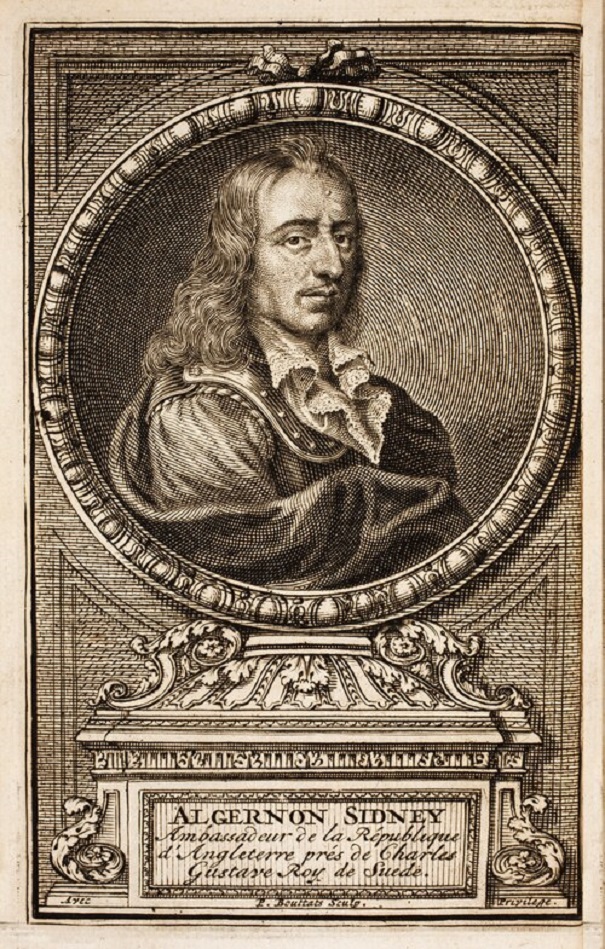
Algernon Sidney was one of the most uncompromising republican thinkers and political martyrs of seventeenth-century England. A soldier, diplomat, and political theorist, he ultimately became a victim of the restored Stuart monarchy. He became a symbol of resistance to absolutism, and influenced later liberal and revolutionary thought, particularly in Britain’s American colonies. Indeed, at the time of the American Revolution Sidney was the world’s most celebrated martyr for liberty. His writings and example inspired revolutionaries and radicals in colonial America and elsewhere. When Thomas Jefferson penned the Declaration of Independence, he cited Sidney among his sources for the ideas contained therein.
An Aristocrat Opposed to Royal Absolutism

Born in 1623 into a prominent aristocratic family, Algernon Sidney was the second son of Robert Sidney, Earl of Leicester. Despite his noble background, he strongly opposed to royal absolutism. Educated in a culture steeped in classical republican ideals, Sidney admired the political models of ancient Rome and Greece. He especially admired their emphasis on civic virtue and resistance to tyranny. That shaped his belief that legitimate government rested on the consent of the governed, not the divine right of kings. Sidney came of age during the English Civil Wars, and was firmly committed to Parliament’s cause against King Charles I. He served with distinction, and gained firsthand experience of revolutionary politics and military discipline. As lieutenant colonel of the Earl of Manchester’s Regiment of Horse, he gallantly led charges at the Battle of Marston Moore, 1644, and received numerous wounds.
Unlike more cautious parliamentarians, Sidney believed that monarchy itself was incompatible with liberty. That radical stance placed him among the most committed republicans of his generation. After the defeat of the royalists, Sidney entered political life. He was elected to Parliament and served on the Council of State during the Commonwealth period. When Charles I was tried, Sidney supported his execution in principle. However, he refused to sign the death warrant, partly because he objected to procedural irregularities. That refusal did not indicate sympathy for the monarchy. Rather, it reflected his deep concern with lawful authority, even in revolutionary circumstances.
Algernon Sidney Was a Principled Opponent of Tyranny in All Forms

Algernon Sidney later grew disillusioned with Oliver Cromwell’s Protectorate, which he viewed as a betrayal of republican ideals. When Cromwell dissolved Parliament, Sidney called him a tyrant, refused to leave, and had to be forcibly ejected. After the Restoration of Charles II in 1660, Sidney’s uncompromising republicanism made him a marked man. As a prominent opponent of monarchy, he had good reason to be concerned about his safety. He went into exile on the Continent, and lived in Italy, Switzerland, and the Netherlands. He survived two assassination attempts while abroad.
When not ducking assassins, Sidney engaged in diplomatic and intellectual pursuits, and maintained contacts with European republicans and anti-absolutist thinkers. Exile hardened rather than softened his political convictions. It reinforced his belief that liberty could only survive through active resistance to corrupt power. Sidney returned to England in the late 1670s, amidst the political crisis surrounding the succession of the Catholic Duke of York, the future James II. He aligned himself with the Whig opposition, which sought to exclude James from the throne and limit royal power. Sidney’s views were more radical than those of most Whigs. While many sought constitutional monarchy, he remained committed to republican principles.
Sidney’s Influential Discourses Concerning Government

Upon his return to England, Algernon Sidney worked on his most important intellectual legacy, the Discourses Concerning Government. Written as a rebuttal to Sir Robert Filmer’s defense of absolute monarchy, the Discourses argued that political authority originated in the people. Rulers were bound by law, and citizens had not only the right, but the duty to resist tyrannical government. Sidney grounded his arguments in history, classical philosophy, and natural law, rejecting the idea that kings ruled by divine appointment. Discourses became “the textbook of the American Revolution”.
In 1683, Sidney was arrested in connection with the Rye House Plot, an alleged conspiracy to assassinate Charles II and his brother James. The evidence against Sidney was weak, and his involvement in any violent conspiracy remains doubtful. However, the royal government was determined to silence a dangerous ideological enemy. In a notorious miscarriage of justice, Sidney was convicted of treason largely on the basis of his unpublished Discourses. In his book, Sidney had argued that legitimate government requires the consent of the governed, and that citizens have a right to overthrow and replace a tyrannical ruler. His writings were treated as proof of seditious intent.
The Legacy of Algernon Sidney

To secure a conviction for treason, English law normally required at least two witnesses. There was only one, however, so the trial judge deemed Sidney’s own writings a second witness against him. Sidney argued that his conviction was illegal, but once he saw that his death was inevitable, he went out unbowed. “We live in a time when truth passes for treason”, he declared. Even more defiantly, he said “The King can make a snuffbox from my arse”. Algernon Sidney was beheaded on December 7th, 1683.
Sidney met death calmly, affirming his belief that he was dying for the cause of liberty. His execution shocked many contemporaries and cemented his reputation as a martyr to republican ideals. After the Glorious Revolution of 1688, Sidney’s conviction was posthumously overturned, and his Discourses were published. The work became highly influential, especially in America, where its arguments echoed through the writings of revolutionary leaders. Thomas Jefferson, John Adams, and others drew upon Sidney’s insistence that liberty depended on vigilance and resistance to tyranny.
Sidney’s life and death embodied the risks of principled opposition in an age of absolute monarchy. He failed to see his ideals realized in his lifetime. However, his ideas helped shape the modern understanding of constitutional government, popular sovereignty, and the moral legitimacy of resistance. A derivation of Sidney’s personal motto, “This hand, enemy to tyrants, by the sword seeks peace with liberty”, is the official motto of the Commonwealth of Massachusetts. Algernon Sidney is one of the namesakes of Virginia’s Hampden-Sydney College.

_________________
Some Sources & Further Reading
History Halls – August Landmesser: A Man Who Refused to Follow the Crowd and Go Along With Evil
Scott, Jonathan – Algernon Sidney and the Restoration Crisis, 1677-1683 (1991)
Latest Articles
- The Johnstown Flood – Thousands Perished When A Dam Collapsed After Gilded Age Tycoons Modified it for their Private Resort
- The Jacquerie: The Medieval Peasant Uprising That Terrified France’s Aristocrats
- Things That Weren’t Thought Through: WWII’s Sticky Bomb Stuck to Users’ Hands Once Activated
- German Tanks of World War II – The Panzer 38(t), a Czech Tank in German Service
- Nicholas Alkemade: The WWII Airman Who Survived an 18,000 Foot Fall From a Bomber Without a Parachute

