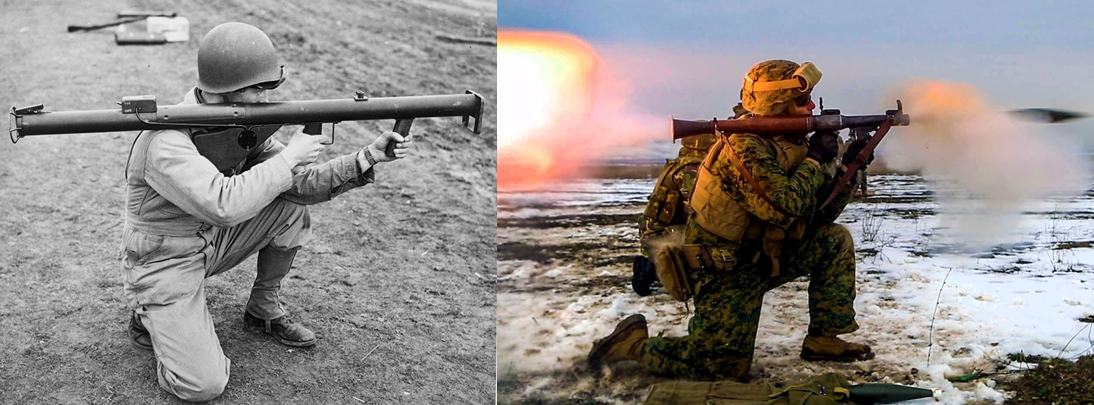
The M1 Bazooka was one of the most influential infantry weapons of World War II. It fundamentally changed how foot soldiers could confront armored vehicles. Before its introduction, infantry anti-tank defense relied largely on towed guns, mines, grenades, or risky close-range tactics that exposed soldiers to enormous danger. The Bazooka offered something new: a lightweight, shoulder-fired rocket launcher capable of penetrating armor. It was portable enough for two men to carry and deploy under combat conditions. Though imperfect and rapidly overtaken by improved models, the M1 Bazooka marked the birth of man-portable rocket anti-armor warfare.
Marrying a Shaped-Charge Grenade to a Rocket

The origins of the Bazooka lie in interwar experimentation with rockets and shaped charges. In the 1930s, several nations explored rocket propulsion for military use. American focus on the Munroe effect – shaped-charges concentrating explosive force into a narrow jet – research made the Bazooka possible. Experiments at the US Army’s Aberdeen Proving Ground and by scientists working with the National Defense Research Committee demonstrated that a hollow or shaped charge warhead could penetrate armor regardless of velocity. That realization freed designers from the need for heavy launchers or high-velocity guns.
By the early 1940s the US had a shaped-charge munition that could penetrate 2.4 inches (60 mm) of armor. That was enough to destroy contemporary tanks. It was developed into an antitank grenade, the M10, but getting it to the tank was a problem. The M10 weighed 3.5 pounds (1.6 kg), which was difficult to throw by hand, and too heavy for a rifle grenade. An infantrymen could place the M10 directly on the tank, but that was extremely dangerous. It was also unrealistic in most likely combat situations that an infantryman could get so close to an enemy tank. It was a sad conundrum: a shaped-charge grenade that allowed infantry to destroy enemy tanks, with no means of delivery. Then somebody had a bright idea: what if you married a shaped-charge grenade to a rocket?
Birth of the M1 Bazooka

Two men are most often associated with the creation of the Bazooka: Colonel Leslie Skinner and Lieutenant Edward Uhl. Skinner, who had been working on a rocket grenade, directed Uhl to come up with a launcher. As Uhl put it: “I was walking by this scrap pile, and there was a tube that… happened to be the same size as the grenade that we were turning into a rocket. I said, That’s the answer! Put the tube on a soldier’s shoulder with the rocket inside, and away it goes”.
Uhl devised a simple electrical ignition system for firing rockets. In 1942, he and Skinner combined their ideas into a crude but workable prototype. A steel tube open at both ends was fitted with a shoulder rest and sights. An electrical trigger connected to a battery that fired a shaped-charge rocket grenade. The Bazooka launcher fired a 2.36-inch rocket officially designated the M6. The weapon’s nickname came from its resemblance to a novelty musical instrument popularized by comedian Bob Burns, called a “bazooka”. The name stuck almost immediately.
The M1 Bazooka entered service with remarkable speed. At trials in mid-1942, despite using improvised sights made with a coat hanger and bent nail, the Bazooka was the only weapon that managed to hit a moving tank. The US Army rushed it into production and fielded it during Operation Torch, the November, 1942, North Africa landings. At the time, American infantry had little effective means of engaging German armor beyond 37mm anti-tank guns that were increasingly ineffective against newer tanks, or improvised methods such as explosive charges. The Bazooka promised to give GIs a fighting chance.
A Weapon With Great Potential…

The M1 Bazooka was both simple and innovative. The launcher was a smoothbore steel tube approximately 54 inches long, and weighed about thirteen pounds unloaded. It was operated by a two-man team: a gunner and a loader. The loader inserted the rocket into the rear of the tube, connected the electrical ignition wire, and called “Up!” to signal readiness. The gunner aimed using simple iron sights. He fired by pulling the trigger, which completed an electrical circuit powered by dry-cell batteries mounted in the grip.
When fired, the Bazooka projectile’s rocket motor ignited and propelled the projectile forward and out of the tube. Exhaust gases were vented harmlessly out the rear – provided no one was standing there. The M6 rocket carried a shaped-charge warhead capable of penetrating roughly 3 inches (about 75 mm) of armor under ideal conditions. On paper, that was sufficient to defeat early and mid-war German tanks such as the Panzer III and Panzer IV. All things considered, the effective range was relatively short.
The Bazooka could hit targets up to 100 yards away, but best accuracy was typically closer to 50 yards. Beyond that distance, the slow-moving rocket was difficult to aim and easily affected by wind. In combat, the M1 Bazooka produced mixed results. In North Africa, it was useless. Later in Sicily and Italy, though, American troops used it successfully against German armor, armored cars, and fortified positions. The psychological effect was significant. Infantrymen who previously felt helpless against tanks now possessed a weapon that could at least damage or disable them.
… and Serious Shortcomings

The M1 Bazooka was also highly effective against bunkers, machine gun nests, and field fortifications. Its rocket’s explosive power was devastating against such targets. However, the Bazooka had serious shortcomings. Early models were notoriously unreliable, particularly in cold or wet conditions. The electrical firing system depended on batteries that often failed in rain, mud, or freezing temperatures. Misfires were common, and forced gunners to troubleshoot under fire. The launcher’s wiring and contacts were fragile, and rough handling could render the weapon inoperable.
The rockets themselves also suffered from inconsistent manufacturing quality early in the war, which affected penetration and accuracy. Armor penetration, while adequate early on, became increasingly problematic as German tanks grew heavier and more heavily armored. Against later Panzer IV variants with thicker frontal armor, and especially against Panthers and Tigers, the Bazooka struggled. While side or rear hits could still be lethal, frontal engagements were often ineffective. That forced Bazooka teams to rely on ambush tactics, concealment, and close coordination with other infantry and anti-tank weapons.
The Germans Turned Out to be the Biggest Beneficiaries of the M1 Bazooka in 1942

Despite its flaws, the Bazooka’s impact was global. Ironically, it proved of little use to American GIs when first deployed in North Africa. Troops were issued Bazookas, but none had received instructions on how to use them before they landed. A general inspecting the front in 1943 could find no GIs who had seen the weapon stop an enemy tank. It was not until the invasion of Sicily – and basic training on the weapon plus improvements to its rocket – that the M1 Bazooka started to knock out enemy tanks and be of use to GIs.
The biggest beneficiaries of the Bazooka’s 1942 deployment turned out to be the Germans. They captured some samples, and immediately recognized the weapon’s significance and potential. They reverse-engineered it, and improved on its design to create the Raketenpanzerbüchse 43 and 54, better known as the Panzerschreck. The Germans used a larger 88mm rocket for greater penetration, with a blast shield to protect the gunner from backblast. The Bazooka’s basic concept thus returned to American troops in a more lethal form via its German descendant.
The Bazooka also influenced Soviet and British thinking. To be sure, the British pursued alternative infantry anti-tank weapons such as the PIAT. The Soviets emphasized massed anti-tank guns, and later their own rocket launchers. However, the Bazooka’s principle of a portable shaped-charge launcher became universally accepted. It demonstrated that infantry anti-tank capability could be decentralized and organic to small units, rather than confined to specialized artillery. As seen below, production of the M1 Bazooka was substantial, though it was soon eclipsed by improved versions.
A Jack of All Trades

Manufacturing contracts were awarded to multiple American companies, and tens of thousands of launchers were produced in 1942 and 1943. As battlefield experience accumulated, the US Army sought to correct the M1’s deficiencies. That led to the M1A1 Bazooka, which simplified the design by removing the electrical safety switch and improving reliability. It was followed by the M9 and M9A1, which featured a collapsible two-piece tube and improved sights. Nevertheless, the M1 retains a distinct place in history as the original combat bazooka. It was the first widely issued, shoulder-fired anti-tank rocket launcher to see extensive combat use.
Although designed as an anti-tank weapon, the Bazooka proved to be a jack of all trades. In practice, it was mostly used against fixed fortifications and emplacements, rather than against tanks. The introduction of the Bazooka forced changes in tactics. It encouraged the spread of infantry anti-tank teams, and altered the balance between tanks and foot soldiers. Even when it could not reliably destroy the heaviest tanks, it compelled tank crews to operate more cautiously. Tanks were now well-advised to operate supported by infantry, to keep other infantry with Bazookas or Bazooka-like weapons at bay. They had to be wary of close terrain such as forests, villages, and urban environments.
Legacy of the M1 Bazooka

Beyond its technical and tactical impact, the M1 Bazooka also left a cultural legacy. The word “bazooka” became a generic term for rocket launchers in many languages, much like “jeep” for light utility vehicles. The weapon became a symbol of American ingenuity and industrial adaptability in WWII. It was a simple, mass-produced weapon that rapidly improved based on combat feedback. Photographs of soldiers carrying bazookas became iconic representations of the modern infantryman. That secured the Bazooka’s place as one of the most important weapons of the twentieth century.
In assessing the Bazooka, it is important not to judge it solely by the standards of later weapons. Compared to postwar launchers such as the RPG-7 or American M20 Super Bazooka, the M1 appears crude and underpowered. In 1942, however, it represented a revolutionary step forward. It bridged the gap between grenades and artillery, and gave infantry a credible means to fight armored threats with a weapon they could carry on their backs. Its true achievement lies less in its individual battlefield performance, and more in the concept it introduced.
The M1 Bazooka proved that rocket-propelled, shaped-charge weapons could be practical, effective, and widely distributed throughout an army. Every modern infantry anti-tank launcher, from disposable single-shot weapons to sophisticated guided missiles, traces part of its lineage back to that simple steel tube first fired in 1942. By the end of WWII, the M1 Bazooka itself had largely been replaced, but its influence endured. It had transformed infantry warfare, reshaped combined-arms tactics, and permanently altered the relationship between tanks and soldiers on foot.

_________________
Some Sources & Further Reading
History Halls – The Spence Repeating Rifle: The Civil War Firearm that Revolutionized Warfare
Hoffman, Jon T., Ed. – A History of Innovation: US Army Adaptation in War and Peace (2011)
Rottman, Gordon L. – The Bazooka (2012)
Zaloga, Steven J. – Bazooka vs Panzer: Battle of the Bulge, 1944 (2016)
Newest Articles
- Edward England, the Humane Pirate Captain Deposed by His Men for Being Too Nice
- American Presidents: Abraham Lincoln, Hall of Fame Wrestler
- Henry Jennings: The Privateer-Turned-Pirate Who Set the Stage for the Caribbean’s Golden Age of Piracy
- Fighting Women: Tomoe Gozen, the Fearsome Female Samurai
- From the NFL to the Sands of Iwo Jima: Medal of Honor Recipient Jack Lummus

