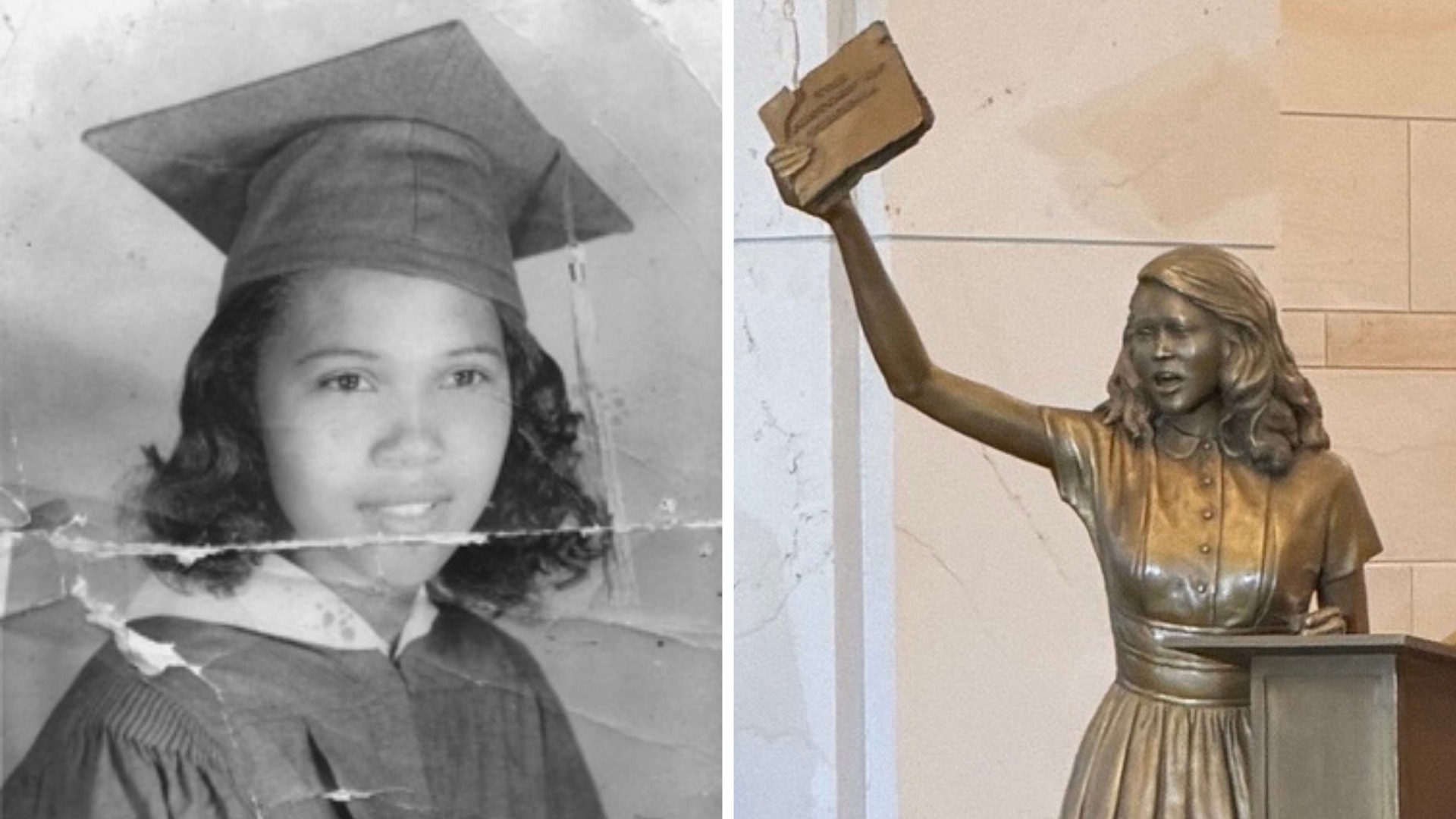
Barbara Rose Johns was one of the youngest and most consequential figures in the American civil rights movement. However, she is far less known than many adult activists. Johns was only sixteen years old when she sparked a student-led protest. It set in motion one of the most important legal battles in American history: Brown v. Board of Education (1954). Her courage, strategic thinking, and willingness to challenge authority made her a pivotal figure in the struggle to end racial segregation in public schools.
A Student Leader in a Terrible School

Barbara Rose Johns Powell, born on March 6th, 1935, in New York City, was raised in Prince Edward County, Virginia. She grew up in a family that emphasized education, independence, and moral responsibility. Her uncle, Vernon Johns, was a prominent Baptist minister and early civil rights advocate. He instilled in her a sense of social justice and personal agency. When Barbara attended the segregated Robert Russa Moton High School in Farmville, Virginia, she encountered conditions that starkly illustrated the inequality of segregation’s “separate but equal” doctrine. Moton High School was severely overcrowded, with many students forced to attend classes in tar-paper shacks. They lacked proper heating, insulation, and facilities. Meanwhile, nearby white schools enjoyed modern buildings, adequate resources, and far smaller class sizes. By 1951, frustration among Moton students had reached a breaking point.
Although parents and school officials had complained for years, little had changed. Johns, then the student council president, decided to act. Without informing teachers or administrators, she organized a school-wide strike whose planning demonstrated remarkable savvy and leadership. First, she arranged for the principal to be absent, then got the teachers to assemble the students for a meeting. Once gathered, Johns addressed her peers, articulated their grievances, and called for a strike until meaningful improvements were made. The resultant student walkout lasted two weeks, during which they picketed with placards reading “Down With Tar-Paper Shacks” and “We Want a New School or None at All”. They attracted national attention. Initially, the protest focused on improving facilities rather than directly challenging segregation itself. When lawyers from the National Association for the Advancement of Colored People (NAACP) became involved, however, the focus shifted.
The Cost of Courage

The NAACP lawyers persuaded the students and their families to pursue a bold legal strategy. Rather than simply demand a better segregated school, they should challenge the very concept of school segregation. That was risky, especially in the deeply segregated and hostile environment of early 1950s Virginia. The resultant lawsuit, Davis v. County School Board of Prince Edward County, named Johns as one of the plaintiffs. It was later consolidated with four other cases into Brown v. Board of Education, which reached the US Supreme Court. Of those cases, Davis was the only one initiated by students. In 1954, the Court ruled that racial segregation in public schools was unconstitutional. In so doing, it overturned the 1896 Plessy v. Ferguson decision that had legitimized segregation for more than half a century.
Johns’ actions were the catalyst that brought one of the Brown cases into existence. She was a heroic teenager, but heroism is seldom easy or cheap, else we’d all be heroes. John paid a significant personal price for activism. She and her family faced intimidation, threats, and social ostracism within their community. The Ku Klux Klan burned a cross in her front yard. For her safety, she was sent to live with relatives in Montgomery, Alabama. There, she attended high school under an assumed low profile. Despite her historic role, Johns rarely spoke publicly about her actions later in life, and avoided the spotlight. She eventually became a librarian, married, raised a family, and lived much of her adult life in relative anonymity.
The Legacy of Barbara Rose Johns

Barbara Rose Johns passed away in 1991 at the age of fifty six. In the decades since her death, her contributions have received increasing recognition. Schools, scholarships, and historical markers now bear her name. Historians have highlighted her role as a reminder that young people were not merely participants in the civil rights movement. As in Johns’ case, they were often the movement’s initiators. Her legacy is particularly powerful because it underscores the capacity of ordinary individuals, especially youth, to challenge entrenched systems of injustice.
At an age when many are just beginning to define their identities, Johns demonstrated extraordinary moral clarity and resolve. Her story complicates the popular narrative of the civil rights movement as being driven solely by charismatic adult leaders. It shows instead how grassroots action, student courage, and local resistance fueled national change. In American civil rights history, Johns stands as a testament to the transformative power of youthful activism and principled defiance. Her strike at Moton High School helped dismantle legal segregation, and reshaped the nation’s understanding of equality.
Johns’ activism left its mark on American democracy. Virginia chose a statue of her to represent it in the US Capitol, which was unveiled in 2025. It shows a young Johns to the side of a lectern, holding a tattered book over her head. Upon the pedestal are engraved words from the Book of Isaiah: “And a child shall lead them”. Also engraved is a quote from Johns: “Are we going to accept these conditions, or are we going to do something about it?”

_________________
Some Sources & Further Reading
History Halls – The Crimean War’s Other Nurse: Mary Seacole
Newest Articles
- The Johnstown Flood – Thousands Perished When A Dam Collapsed After Gilded Age Tycoons Modified it for their Private Resort
- The Jacquerie: The Medieval Peasant Uprising That Terrified France’s Aristocrats
- Things That Weren’t Thought Through: WWII’s Sticky Bomb Stuck to Users’ Hands Once Activated
- German Tanks of World War II – The Panzer 38(t), a Czech Tank in German Service
- Nicholas Alkemade: The WWII Airman Who Survived an 18,000 Foot Fall From a Bomber Without a Parachute

