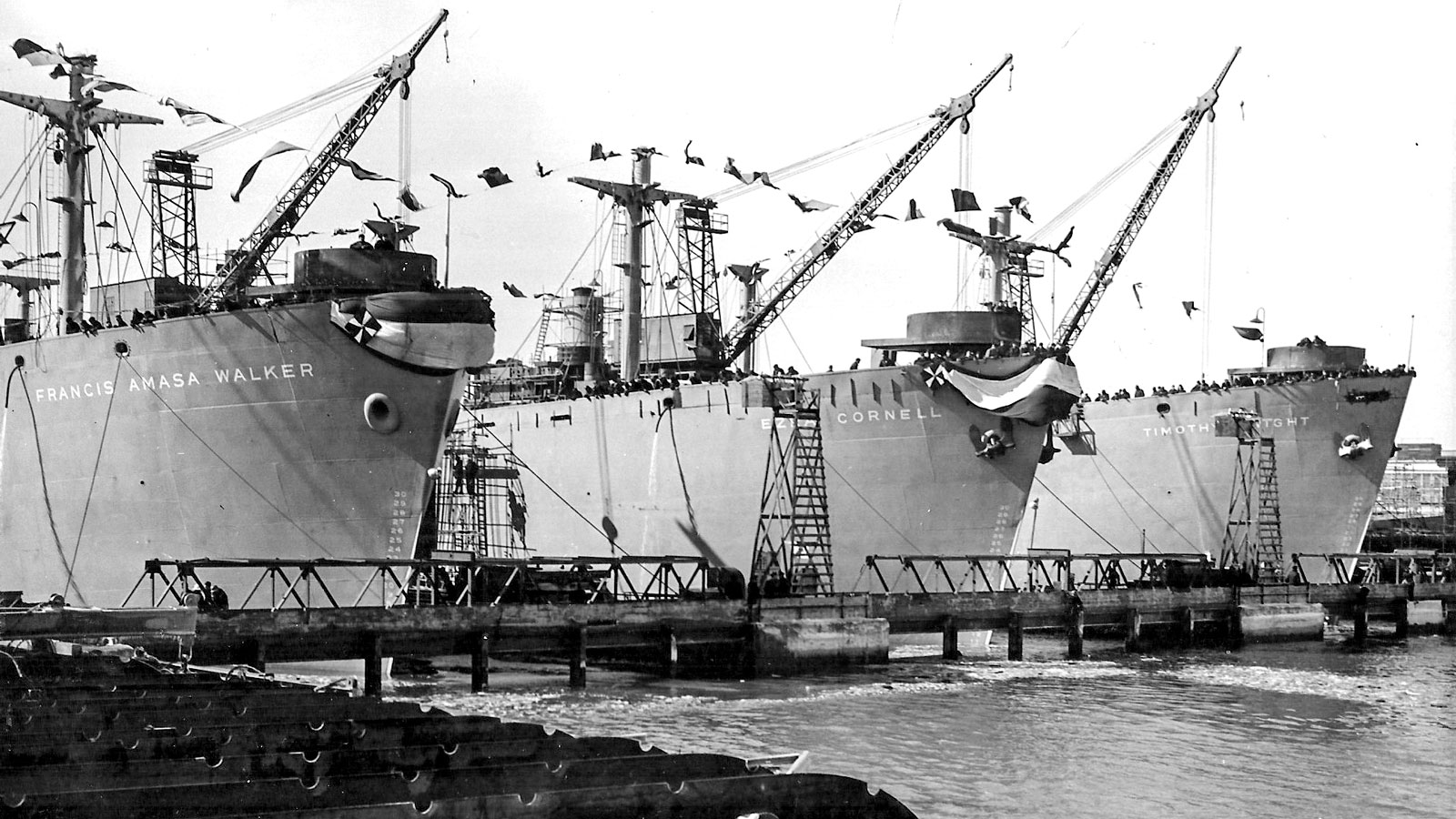
Henry J. Kaiser and Liberty ships stand as enduring symbols of America’s industrial might in World War II. The war was a crucible in which innovation, organization, and sheer determination forged the tools that turned global conflict’s tide. The story of Kaiser and the Liberty ships is one of speed, ingenuity, and mass production on an unprecedented scale. One man’s vision reshaped wartime logistics, and redefined modern shipbuilding.
A Race Against German U-Boats

Henry John Kaiser was born in 1882 in New York to German immigrant parents. With little formal education, he began his career as a photographer and salesman, before he ventured into construction. By the 1920s and 1930s, Kaiser had become a major figure in American infrastructure projects, and helped build highways, dams, and bridges. His consortium, “Six Companies”, was responsible for monumental works like the Hoover Dam (1931–1936) and the Grand Coulee Dam. Through these ventures, he earned a reputation as an organizer and innovator.
Kaiser further enhanced his reputation as a man who could tackle impossible projects and deliver them under pressure in WWII. When America was thrust into the conflict after Pearl Harbor was attacked, Kaiser turned his attention from land to sea. The Allies faced a critical shortage of cargo ships: German U-boats were sinking merchant vessels faster than they could be replaced. Britain, already stretched thin, needed help to maintain the supply lines across the Atlantic. The US government sought a way to produce simple, sturdy cargo ships in massive numbers – fast. Liberty ships were designed to meet that urgent need.
The Liberty Ships

Henry Kaiser did not create the Liberty ships, but he revolutionized their production – and that of ship production forever after. The ships’ origins lay in a British design, the Ocean class, developed to be cheap and easy to build. The US Maritime Commission adopted and modified the design, and labeled it the EC2-S-C1. The ships were 441 feet long, 57 feet wide, and able to haul around 10,000 tons of cargo. They were powered by triple-expansion steam engines, an outdated but reliable technology, chosen because the parts were easy to produce in large quantities. The ships were not glamorous, and sailors nicknamed them “ugly ducklings”. Regardless of how they looked, Liberty ships were tough, practical, and, most importantly, quick to build.
The concept was simple: create a standardized vessel that could be built from prefabricated sections, then assemble it like a giant industrial puzzle. Henry Kaiser basically took Henry Ford’s method of building cars on an assembly line, and applied it to ships. This approach revolutionized shipbuilding, and Kaiser was the man who brought it to life. Before the war, he had no experience in shipbuilding. However, his construction background proved invaluable. He approached the challenge not as a shipbuilder, but as an engineer and industrialist. His notion that ships could be built like cars on an assembly line was a radical idea at the time.
Manufacturing Ships Like Cars on Assembly Lines

In 1941, Henry Kaiser established several shipyards on the US West Coast. Notably at Richmond, California; Vancouver, Washington; and Portland, Oregon. The Richmond yards became the most famous, and employed over 90,000 workers at their peak. Kaiser transformed the shipyard environment. Rather than rely on traditional, highly skilled craftsmen, he recruited workers from all walks of life – women, African Americans, and people with no prior industrial experience. To bring them up to speed, he developed intensive training programs. Kaiser’s workers did not to know all the ins and outs of shipbuilding. Like Henry Ford’s car assembly line workers, Henry Kaiser’s ship assembly line workers only needed to know how to perform one specific task. That made training easier and faster.
Kaiser also sped up work by welding the ships together wherever possible, rather than rivet them as had traditionally been done. Riveting was precision work that required experienced and skilled workers. Welding, by contrast, could be taught in a short time to anybody off the street. More importantly, riveting took far more time – time that was simply not there in the wartime emergency. Welding had its shortcomings, and some Liberty ships cracked along their welds or even split apart. Most, however, did not, and the few that did were seen as an acceptable price to pay.
A Liberty Ship Was Built in 4 Days

Construction was also streamlined through prefabrication, which was the cornerstone of Kaiser’s approach. The traditional method was build ships piece by piece on the slipway. That, however, meant that workers responsible for other tasks had to wait idly by until it was their turn to add further touches to the ship. Kaiser revolutionized the process by having entire sections – hull plates, decks, and bulkheads – manufactured in separate workshops. That kept all the workers busy and productive at the same time. The completed sections were then brought together for assembly.
Kaiser’s method allowed thousands of workers to work simultaneously on different parts of a ship, which drastically reduced construction time. The results were astonishing. At the start of the program, Liberty ships took about 230 days to build. By 1943, the average time had fallen to 39 days. The record was set by the SS Robert E. Peary, built at Kaiser’s Richmond Yard No. 2 in just 4 days, 15 hours, and 29 minutes – a feat that made headlines around the world. While this was largely a publicity stunt, it demonstrated what was possible with coordination and motivation.
Liberty Ships Were Instrumental in Sustaining the Allied War Effort

Between 1941 and 1945, 2,710 Liberty ships were constructed – the largest class of ships ever built. During the program’s lifetime, an average of three Liberty ships were launched every two days. They became the workhorses of the Allied merchant fleet, and transported everything from ammunition and food to fuel and tanks and troops. Each ship carried about 9,000 tons of cargo, and had a crew of roughly 40 to 50 men. Despite their simplicity, they proved essential to the Allied war effort. Liberty ships sailed across treacherous seas, often under threat from German submarines and aircraft. Many were lost to enemy action, but the rate of replacement far exceeded the losses.
Liberty ships were instrumental in sustaining Britain during the Battle of the Atlantic. They supplied the Soviet Union through the Arctic convoys, and supported invasions in North Africa, Italy, and Normandy. While the ships were durable, they were not without flaws. Some early models were made of brittle steel, which led to hull fractures in cold waters. Nonetheless, their overall contribution far outweighed such problems. Many continued in service long after the war, some converted for peacetime trade, others repurposed for humanitarian missions or stored in reserve fleets.
Henry Kaiser’s Impact Went Far Beyond Ships

Economically, the Liberty ship program represented a triumph of American industrial mobilization. It demonstrated how public-private cooperation could achieve extraordinary results when guided by clear goals and innovative management. Kaiser’s ability to coordinate vast supply chains, manage thousands of workers, and deliver consistent results, made him a legend of wartime production. His methods had profound social consequences beyond the ships themselves, and even beyond the war. His shipyards became models of diversity and inclusion at a time when racial and gender barriers were still strong.
Women – the the iconic “Rosie the Riveters” – took on welding, riveting, and assembly roles that until then had traditionally been reserved for men. African American workers gained access to better-paying industrial jobs, although they still faced discrimination. Kaiser also recognized that a healthy and stable workforce was essential for productivity. To support his employees, he established health care and child care facilities near his shipyards. That eventually led to Kaiser Permanente, one of America’s first large-scale health maintenance organizations (HMOs), which still operates today.
Liberty Ships After the War

The need for mass shipbuilding evaporated almost overnight when WWII ended in 1945. Many Liberty ships were decommissioned, sold, or scrapped, and some continued to serve in various capacities for decades. A few were preserved as museum ships, including the SS Jeremiah O’Brien in San Francisco, and the SS John W. Brown in Baltimore. Both remain operational today. As for Kaiser, he did not rest on his wartime laurels. He expanded into peacetime industries, and founded Kaiser Aluminum, Kaiser Steel, and Kaiser Motors. He was also was instrumental in postwar housing developments and automobile manufacturing.
Kaiser’s ventures reflected his strong belief in the power of mass production and accessibility – cars, homes, and health care for the average American. Though not all his peacetime enterprises succeeded, his influence on American industry endured long after he passed away in 1967. The legacy of Henry Kaiser and the Liberty ships is one of efficiency, inclusivity, and national unity under pressure. He proved that innovation was not limited to inventing new technologies. Innovation could also mean reimagining processes, empowering workers, and redefining what was possible.
The Legacy of the Liberty Ships

Liberty ships became symbols of perseverance. They were unglamorous but indispensable – floating testaments to teamwork and industrial courage. Without them, the Allies would have struggled to move the vast quantities of material needed to sustain global war. As Winston Churchill later noted, “The foundation of all our hopes and plans for victory lay in the immense output of the American shipyards”. Kaiser’s vision went beyond wartime success. He embodied the belief that large-scale organization and social responsibility could coexist – that industry could serve both profit and people. His health care system, his commitment to worker welfare, and his democratization of opportunity made him not just a wartime manufacturer, but a social pioneer.
Henry J. Kaiser transformed America’s wartime shipbuilding into a triumph of industrial democracy. Through his leadership, the Liberty ships became a lifeline of freedom – not elegant or fast, but reliable and strong. They carried the weight of a world at war, and the hopes of millions who depended on them. In so doing, they demonstrated that ingenuity and cooperation could overcome the greatest of challenges. Kaiser’s ships, and the spirit behind them, helped deliver victory, and left a legacy that continues to inspire innovation and enterprise today.

_________________
Some Sources & Further Reading
Elphick, Peter – Liberty: The Ships that Won the War (2006)
Herman, Arthur – Freedom’s Forge: How American Business Produced Victory in World War II (2012)
If you liked this article, you will probably also like Flower Class Corvettes: The Unglamorous Ships That Averted Allied Defeat in WWII

