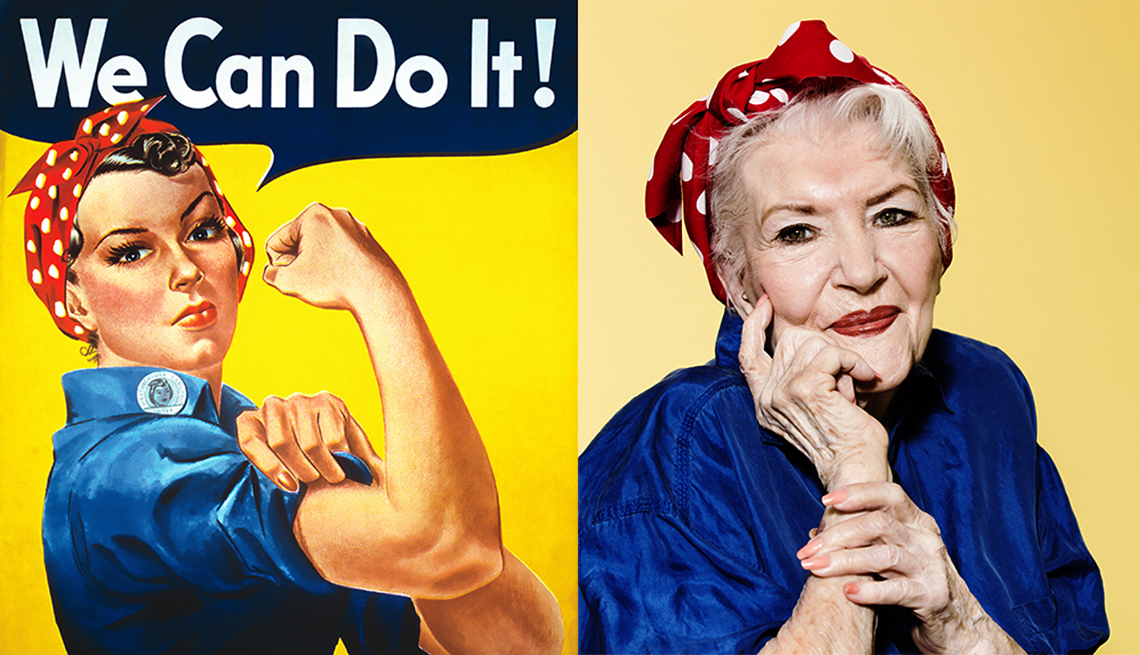
The World War II “We Can Do It!” poster, commonly known as “Rosie the Riveter”, has become globally famous as a feminist icon. Below are some interesting facts about Rosalind P. Walter, the real life Rosie the Riveter, and As seen below, however, the general public hardly knew of its existence during the war.
The Origins of an Iconic Poster

The We Can Do It! poster is a feminist symbol today, and considered to be one of the Second World War’s most iconic images. In its day, however it was not nearly as empowering of women as conventional wisdom has it today. Indeed, hardly anybody saw the poster or was even aware of its existence during the war. The image was not created by the US government as inspirational propaganda for the public. Instead, it was a private sector commission by Westinghouse Electric and Manufacturing Company.
We Can Do It! was created by graphic artist J. Howard Miller in 1943, one of a series of posters that were displayed for two weeks in some Westinghouse factories, before it was taken down. Nowadays, the poster is seen as a symbol of female empowerment, to the effect that women are strong and can do whatever they put their minds to. When Westinghouse commissioned it, though, the goal was to get its female factory workers to work harder and follow orders.
We Can Do It! Did Not Mean What We Assume it Means Today

The “It” in the We Can Do It! poster is clarified by a companion poster, in which a male manager counsels: “Any Questions About Your Work? Ask Your Supervisor”. In context, the poster was a paternalistic exhortation to female employees that all was possible. Not possible because they were women and women could whatever they put their minds, which is how the poster is widely interpreted today. Instead, Westinghouse told its female workers that all was possible so long as they were team players who followed orders. In another twist, the woman depicted and often referred to as Rosie the Riveter was not a riveter. The posters were displayed in factories that produced helmet liners, a process that involves no riveting.
After its two week run in the Westinghouse factories, the poster was taken down and pretty much forgotten. Its revival and greater second life is owed to the Washington Post Magazine, which published an article in 1982 about posters in the National Archives that included We Can Do It! Nearly four decades after WWII, the poster finally gained notice, and went viral. It appeared on US Postal Service stamp, was published on the cover of Smithsonian Magazine, and was misinterpreted – or reinterpreted – by feminists as a symbol of female empowerment.
Rosalind P. Walter, the Real Life Rosie the Riveter

Although the We Can Do It! poster had nothing to do with Rosie the Riveter, there was a real life woman, Rosalind P. Walter, nee Palmer, who inspired the Rosie the Riveter meme. Born in 1924, she was still a teenager when America was thrust into WWII. Almost immediately, she joined the war effort as an airplane factory riveter. A hard worker, teenaged Rosalind broke speed records on the production line, even as she called for equal pay for women.
The conscientious teenager who showed herself a demon on the factory floor attracted attention. A New York Times article about her inspired a 1942 hit song, Rosie the Riveter, about civilian women employed in war industries. It became a meme that went viral, and came to represent the millions of women who worked on the home front to supply and support the men in the field. Rosie the Riveter, with a Mein Kampf beneath her feet, appeared in a 1943 Saturday Evening Post cover painted by Norman Rockwell.

The real life Rosie the Riveter went on to greater things after the war. Born into money, Rosalind P. Walter married into even more money, and became a renowned socialite and philanthropist. She established the Walter Foundation – now known as the Rosalind P. Walter Foundation – in 1951, and used it to support various causes. Among other things, she donated millions to help fund the Public Broadcasting System, and became a trustee of both the American Museum of Natural History and Long Island University. After a long and productive life, she passed away in 2020.

_________________
Some Sources & Further Reading
Bird, William L. – Design for Victory: World War II Posters on the American Home Front (1998)
History Halls – Myths and Realities: Did Betsy Ross Make the First American Flag?

