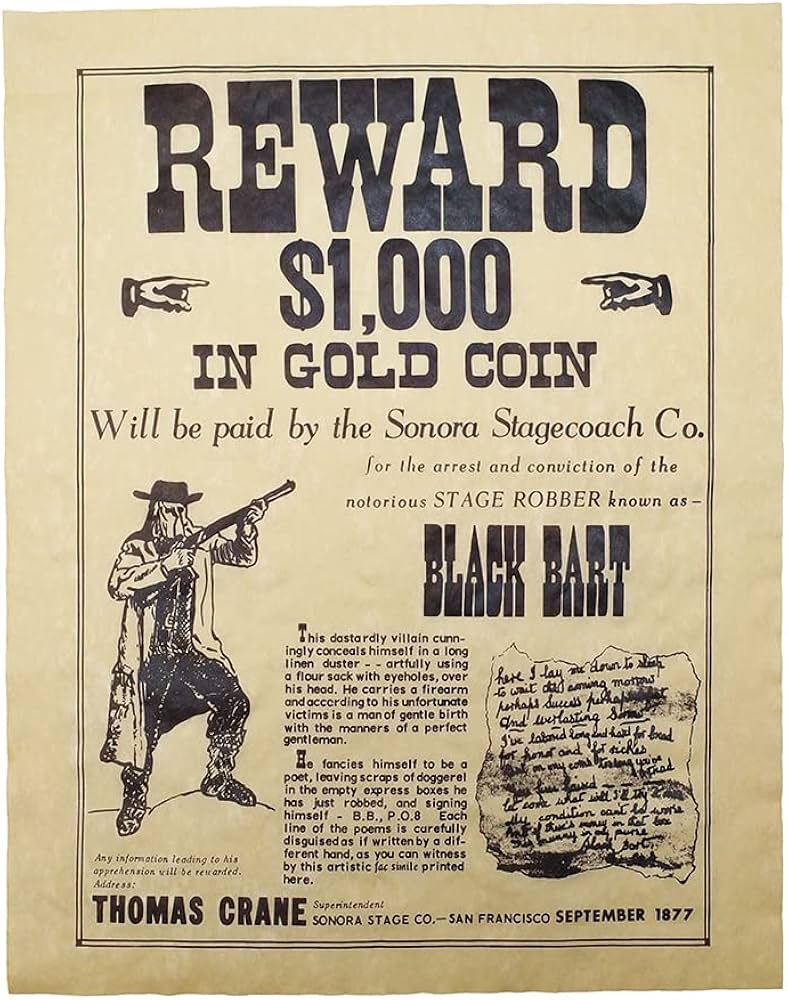
Wild West outlaw Charles Earl Boles, better known as Black Bart (1829 – after 1888), was born in England, before his family emigrated to New York in 1831. He ended up as a stagecoach robber, with a reputation as a “gentleman bandit” because of his politeness during the commission of his crimes. Below are some fascinating facts about gentleman bandit Black Bart.
A Beef With Wells Fargo Agents Transformed a Lawful Gold Prospector Into a Stagecoach Robber

As a young man, Charles Boles trekked west to join the California Gold Rush in 1849. He spent a few years prospecting, then trekked back east and settled in Illinois. When the US Civil War erupted, Boles enlisted in an Illinois regiment and proved himself a good soldier. He was promoted to Company First Sergeant within a year. By the time he was discharged in 1865, he had been brevetted as a lieutenant.
After the war, Boles returned to the West to prospect for gold. There, he had a run in with Wells Fargo agents in 1871 that left him vowing vengeance. To exact his revenge, he turned outlaw. Boles changed his name to Black Bart, after a character from a dime novel, and took up a career as a highwayman who specialized in robbing Wells Fargo stagecoaches in northern California and southern Oregon.
A Gentleman Bandit

The former Charles Earl Boles, now Black Bart, was viewed as a gentleman bandit. Both because of his politeness, and because he exuded an air of sophistication. He wielded a double barreled shotgun and robbed on foot, clad in a linen duster and bowler hat, his face concealed by a flour sack with eyeholes cut into it. His standard operating procedure was to step out of cover to halt a stagecoach, and cover the driver with his shotgun as he politely ordered him to throw down the strongbox.
Once the driver complied, he would be politely told to move on, and then Bart would recover the strongbox and abscond. He never fired his weapon, and sometimes left behind handwritten poems. That further enhanced his notoriety and gained him the nickname “Black Bart the Poet”. All things come to an end, however, and the end of Black Bart’s highwayman career came in 1883, when a robbery went bad and he was shot in the hand. As seen below, that set in motion a chain of events that ended with his capture.
The End of the Road for Black Bart

Black Bart fled after he was shot in the hand in a robbery gone wrong. In his hurried flight, he dropped some personal items, including a handkerchief with a laundry mark. Wells Fargo detectives canvassed San Francisco laundromats until they found the one that used that mark, and from it learned the identity of the handkerchief’s owner. Under interrogation, Black Bart eventually confessed that he had, indeed, robbed Wells Fargo stagecoaches, but only before 1879. He chose that date on the mistaken assumption that the statute of limitations had run out on robberies committed before that year.
Bart was wrong, but it did not matter because the company pressed charges only for the last robbery. He was tried, convicted, and sentenced to six years behind bars, but was released after only four in 1888 for good behavior. In poor health, Black Bart did not return to his family. He wrote his wife that he was depressed and wanted to get away from everybody. His last known whereabouts are a hotel in Visalia, California, from which he vanished a month after he regained his freedom.

_________________
Some Sources & Further Reading
History Halls – Wild West Outlaws: The Reno Gang, Train Robbery Pioneers
Nolan, Frederick – The Wild West: History, Myth & the Making of America (2003)
True West Magazine, October 11th, 2016 – October Was Black Bart’s Favorite

