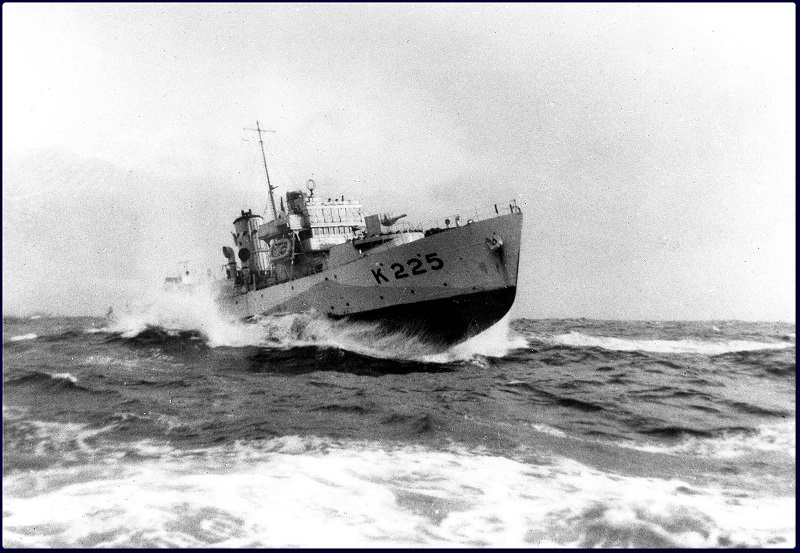
Flower-class corvettes were some of World War II’s most important warships. They served as the backbone of Allied convoy escort forces during the Battle of the Atlantic. Though humble in size, speed, and firepower, they played an outsized role in securing vital supply lines against the deadly threat of German U-boats. Their story is not only one of naval engineering, but also of adaptability, improvisation, and endurance amidst one of history’s longest and most grueling maritime struggles.
A Simple and Easy to Construct Design

The Flower-class corvettes were born of necessity. By 1939, as war loomed in Europe, the Royal Navy realized that it did not have enough small escort ships to protect merchant convoys against submarines. Destroyers were ideal for anti-submarine warfare, but they were expensive and time-consuming to build. Most important of all, Britain simply did not have enough of them to cover the vast Atlantic. The solution was to produce a simpler, cheaper escort that could be built quickly in civilian shipyards. The design chosen was adapted from a commercial whaler – a type already known for seaworthiness and ease of construction. The resultant corvette was relatively small, about 205 feet in length, and displaced around 940 tons. Top speed was modest, at about 16 knots. That was slower than a surfaced U-boat, but fast enough to keep up with a convoy – the corvette’s main job.
They were powered by reciprocating triple-expansion steam engines – an older technology – rather than more modern and complex turbines. That was intentional: it allowed construction in smaller commercial yards without specialized expertise. Production could thus be spread across Britain and Canada. The ships were named after flowers, hence the “Flower-class”. Common flower names were easy to find at first for corvettes like HMS Bluebell, Honeysuckle, and Buttercup. As the war progressed and more and more corvettes were produced, naval authorities had to reach for ever more obscure flower names, such as Asphodel, Borage, and Snowberry. The Royal Canadian Navy, which became one of the class’ largest operators, also gave them names of towns and communities. That fostered a close connection between the ships and Canadian society.
Flower-class Corvettes Were Tough on Their Crews, but Effective in Fulfilling Their Mission

Though lightly armed compared to larger escorts, Flower-class corvettes were optimized for anti-submarine warfare. Their primary weapon was depth charges. Carried in racks on the stern, they were launched by throwers to create patterns around suspected submarine contacts. Early versions carried a single 4-inch naval gun on the bow, suitable for engaging surfaced U-boats or even strafing small surface craft. They were also fitted with machine guns and later 20 mm Oerlikon cannons for defense against aircraft. Detection equipment was equally crucial. At first, corvettes carried simple ASDIC (sonar) to detect submarines underwater. As the war progressed, radar was added, which greatly improved their ability to locate surfaced U-boats at night.
High-frequency direction finding – HF/DF, nicknamed “Huff-Duff” – also became standard. It enabled corvettes to intercept enemy radio transmissions and triangulate positions. Despite such advancements, Flower-class corvettes were not ideal fighting platforms. Their short length and high superstructure made them prone to heavy rolling in rough seas. That earned them a reputation as uncomfortable ships. Many sailors recalled constant seasickness, wet decks, and the difficulty of maintaining speed in stormy weather. Despite those shortcomings, they were highly successful in fulfilling their mission: they were rugged, able to endure long voyages, and could be built in enormous numbers.
Shepherding Convoys and Fighting Off Wolf Packs

The Battle of the Atlantic, which raged from 1939 through 1945, was the longest continuous campaign of the Second World War. Allied and Axis naval forces struggled for control of vital shipping lanes that, had they been severed, could have won the Nazis the war. German U-boats sought to cut Britain off from supplies of food, fuel, and materiel from North America. The Flower-class corvettes became that struggle’s frontline escorts. The Flower-class corvettes operated in groups to escort merchant convoys across the Atlantic, constantly vigilant for signs of submarine attack.
When sonar contacts were made, they would charge in to drop depth charges, and often faced counterattacks from torpedoes. They also played a crucial psychological role: their mere presence forced U-boats to operate more cautiously. That disrupted the German submarines’ wolf pack tactics and reduced their effectiveness. Corvettes also rescued survivors of torpedoed ships. Many merchant sailors owed their lives to escort crews, who braved icy seas and enemy threats to haul them aboard. That humanitarian aspect made the corvettes symbols of hope in a brutal war at sea.
A Steadily Improving Design

Flower-class corvettes were produced in prodigious numbers. Between 1939 and 1944, more than 260 were built in Britain, and over 120 more in Canada. Canadian shipyards in particular proved invaluable, and cities such as Halifax and Montreal turned out corvettes that escorted escort convoys not only across the North Atlantic, but also in the Caribbean, Mediterranean, and even the Arctic routes to Russia. The ships were not identical: as the war progressed, modifications were made to improve performance. Later “improved Flowers” featured a lengthened forecastle – the raised deck at the bow. That resulted in better seaworthiness and more space for crew quarters. Weaponry was upgraded, and radar became standard.
Each new batch of corvettes reflected lessons learned in combat, which made them steadily more effective. 25 were transferred to the US Navy, where early original versions were known as the Temptress class, and modified ones as the Action class. In US service, they were not designated “corvettes”, but classified as Patrol Gunboats (PG) instead. For the crews, service aboard a Flower-class corvette was rough. Accommodations were cramped, with hammocks slung close together, and dampness permanently permeated the ship. The corvettes had limited fresh water and poor ventilation, which made conditions more uncomfortable still during long Atlantic crossings. Food was basic, and when seas were rough – a common occurrence in the North Atlantic – cooking was often impossible.
Unsung Heroes of Allied Victory

In addition to physical discomfort, the crews of Flower-class corvettes also had to handle psychological stress. The constant threat of U-boat attack weighed heavily on their minds. Long hours on watch in freezing spray or stifling heat tested endurance, and many crews went weeks without sight of land. Despite that, strong camaraderie developed on those small ships, as officers and men worked closely together in a shared struggle to keep convoys safe. By the end of the war, the Flower-class corvettes had secured their place as one of the unsung heroes of Allied victory. They were not glamorous ships, but their numbers and persistence helped turn the tide in the Atlantic.
As Allied wartime production increased, larger and more advanced escorts such as frigates and destroyer escorts became more available. So Flower-class corvettes gradually took on secondary roles, but they remained vital throughout the war. Many were transferred to other navies, including the Free French, Norwegian, and Greek fleets. After the war, surplus corvettes were sold to civilian operators, with some converted into merchantmen, whalers, or even private yachts. A few were preserved; HMCS Sackville, preserved in Halifax, Canada, remains a museum ship and memorial to the men who fought in the Battle of the Atlantic.
The Legacy of Flower-class Corvettes

In addition to military impact, Flower-class corvettes have left a cultural legacy. Their story was immortalized in Nicholas Monsarrat’s novel The Cruel Sea (1951), later adapted into a film. It captured convoy escort duty’s harsh realities, from the terror of U-boat attacks to the ocean patrols’ grinding monotony. It thus ensured that the contribution of these humble corvettes was not forgotten. The Flower-class corvette was a ship of paradoxes: simple yet vital, uncomfortable yet reliable, under-armed, yet essential. Designed as a stopgap measure, it became the cornerstone of Allied convoy escort forces, and proved to be one of the key instruments in defeating the U-boat menace.
Through their endurance, the crews of these ships kept supply lines open, safeguarded merchant shipping, and ultimately helped secure victory in the Atlantic. In naval history, the Flower-class corvette stands as a testament to how ingenuity and determination can turn modest vessels into decisive tools of war. They never had the speed of a destroyer, the firepower of a cruiser, or the glamour of other better known warships. However, their contribution to Allied survival and victory was immeasurable. Their legacy lives on not only in preserved ships and literature, but in the enduring memory of a small warship that carried the burden of a great struggle.

_________________
Some Sources & Further Reading
Brown, David K. – Atlantic Escorts: Ships, Weapons & Tactics in World War II (2007)
History Halls – The Sinking of the Lusitania: A World War I Tragedy Shrouded in Controversy
McKay, John, and Harland, John – The Flower Class Corvette Agassiz (2004)
Naval Encyclopedia – Flower Class Corvettes

