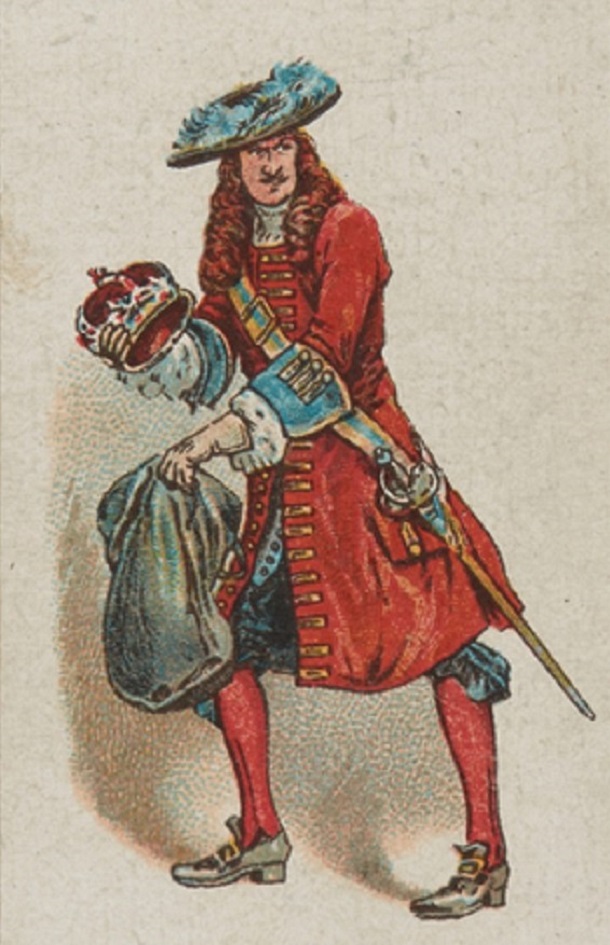
Thomas Blood’s audacious attempt to steal England’s Crown Jewels in 1671 is one of British history’s most extraordinary episodes. It was a tale of daring, deceit, and royal forgiveness. Known as “Colonel Blood”, he was an Irish adventurer, a master of disguise, and a man whose combination of boldness and charm would ultimately allow him to escape punishment for one of the most outrageous crimes imaginable: trying to steal the symbols of English monarchy from the Tower of London.
Colonel Blood Was an Opportunistic Rogue From Early On

Thomas Blood was born around 1618 in County Meath, Ireland, to a Protestant family of English descent. His early life was relatively unremarkable, but his character – ambitious, clever, and audacious – was already evident. During the English Civil War, 1642 – 1651, Blood, who styled himself “Colonel Blood”, initially supported King Charles I. He switched sides to join Oliver Cromwell’s Parliamentarians when it became clear that the Royalists were losing. Such opportunism was typical of Blood, whose loyalties often shifted with political fortune. After the war, he prospered under the Commonwealth government, and received land and favor in Ireland.
Unfortunately for Blood, the monarchy was restored in 1660. When the exiled Charles II returned and assumed his father’s throne, Blood’s prospects plummeted. The lands he had been granted were confiscated, and his family’s fortunes declined sharply. Filled with resentment toward the restored monarchy, Blood began to associate with other disaffected former Cromwellians and rebels. His first serious plot against the monarchy came in 1663, when he joined a conspiracy to seize Dublin Castle and kidnap the Duke of Ormond, the Lord Lieutenant of Ireland.
The Duke of Ormond’s Nemesis

Colonel Blood’s scheme to kidnap the Duke of Ormond was audacious, but it proved unsuccessful. The plot failed, and he was forced to flee to the mountains, where he hid for years with a price on his head. He escaped capture and made his way to England under an assumed name, where he started a new life of intrigue and disguise. In 1670, he attempted another plot against Ormond in London, in which the duke’s coach was attacked in the streets. Blood himself was reportedly among assailants who tried to hang the duke from Tyburn gallows.
Ormond fought free, and the attackers fled. Once again, Blood evaded capture, though by this point he was one of the most wanted men in England. The repeated acts of violence and treachery demonstrated that Blood possessed extraordinary nerve. They also showed his willingness to risk death in pursuit of political revenge and personal gain. However, even after those failed plots, his most daring act was still to come. By 1671, Blood had hatched his most ambitious plan: to steal England’s Crown Jewels.
An Audacious Scheme

The Crown Jewels of England, which were kept in the Tower of London, were symbols of royal authority and the continuity of the monarchy. They had been remade after the Restoration, as the originals were destroyed or sold off after the execution of Charles I. The new collection included the royal orb, scepters, and the Imperial State Crown, among other treasures. They were displayed to visitors by an elderly keeper, Talbot Edwards, who lived in the Martin Tower with his family.
Colonel Blood began his scheme by disguising himself as a clergyman. He called himself “Dr. Ayloffe”, befriended Edwards over several weeks, and visited him in the Tower on multiple occasions. Blood flattered Edwards to gain his trust, and showed interest – quite genuine – in the Crown Jewels entrusted to him. He even introduced his supposed “wife”, an accomplice who played the role, who feigned admiration for Edwards’ spinster daughter. The “couple” hinted at the possibility of a match between the young woman and a wealthy nephew of Blood’s. That fictitious family connection helped strengthen the friendship.
Theft of the Crown Jewels

By May, 1671, Thomas Blood had thoroughly ingratiated himself with Edwards. The keeper of the Crown Jewels invited him and his “nephew” for a visit to discuss the marriage proposal. On the morning of May 9th, Blood arrived with three accomplices, Robert Perrot, Richard Halliwell, and his own son. They were all armed and carried hidden tools. When the group was admitted to view the Crown Jewels, Blood suddenly attacked. Edwards was struck on the head with a mallet and knocked unconscious. As he lay bleeding, Blood and his men began to loot the collection.
The conspirators worked quickly. They flattened the crown with a mallet so it could fit under Blood’s clerical coat, stuffed the orb down another’s breeches, and began to saw the scepter in half to make it more portable. Just as they prepared to flee, however, Edwards’ son unexpectedly returned home and raised the alarm. The old keeper regained consciousness, and began to shout “Treason! Murder!” Blood and his men bolted for the exit, but were pursued by guards. They were captured at the drawbridge after a brief struggle, still in possession of the crown and other items.
Colonel Blood and the Merry Monarch

Colonel Blood remained defiant in defeat, and reportedly said: “It was a gallant attempt, however unsuccessful! It was for a crown!” Normally, an assault on the Tower and the theft of the Crown Jewels, would have led to certain execution. However, Blood’s story took an unexpected turn. King Charles II ordered that Blood be brought before him in person. During the audience, Blood displayed his usual charm and audacity. He freely admitted his guilt, but used the opportunity to flatter the king and portray himself as a daring, if misguided, adventurer rather than a traitor.
Blood also hinted at possible unrest if the king did not show mercy. He claimed that he had powerful allies who might seek revenge if he were executed. Charles II, an easy going sort nicknamed “The Merry Monarch”, was known for his wit and fondness for roguish characters. Amused, he asked the rogue before him: “What if I should give you your life?” Blood responded “I would endeavor to deserve it, Sire!” Charles liked that, and pardoned Blood outright. He not only freed him, but granted him estates in Ireland worth £500 a year.
A Restoration Era Legend

King Charles II’s astonishing act of clemency towards Thomas Blood shocked the court. It especially infuriated the Duke of Ormond, whom Blood had previously tried to murder. However, the king seemed to enjoy the scandal. Some historians believe Charles may have seen Blood as a useful informer among disaffected circles. Others think he simply admired the man’s audacity, and saw him as a colorful character in his own royal theatre. After his pardon, Blood became something of a minor celebrity. He appeared at court, enjoyed the king’s favor for a time, and lived comfortably on his Irish lands.
Colonel Blood’s reputation as a rogue and trickster never faded. His fortunes declined again in the late 1670s after he quarreled with a nobleman and was sued for defamation. He was briefly imprisoned and released on bail, but never regained royal favor. Thomas Blood died in 1680 at the age of about sixty two. Ever suspicious of the authorities, he left instructions that his body should be exhumed after burial to confirm that he was truly dead, and had not been kidnapped and spirited away by enemies.
The Legacy of Colonel Blood

Per Thomas Blood’s instructions, his coffin was indeed dug up and found to contain his corpse. Thus ended a life filled with deception, disguise, and daring. The story of Blood’s attempted theft of the Crown Jewels became one of Restoration England’s most enduring legends. It was a period of intrigue, shifting loyalties, and political chaos, and Blood’s escapade captured the era’s flamboyance and danger. His mixture of villainy and charisma made him a folk antihero – an audacious scoundrel who could even charm a king.
Colonel Blood’s plot remains the only known attempt to steal the Crown Jewels. It demonstrated both the vulnerability of royal institutions, and the allure of daring crime in a time of political unrest. Today, visitors to the Tower of London can still see the very jewels that Blood tried to steal. They are kept under far tighter security these days, though. And though centuries have passed, Thomas Blood’s name endures as the man who nearly stole the crown – and won the king’s pardon despite doing so.

_________________
Some Sources & Further Reading
Abbott, Wilbur Cortez – Colonel Thomas Blood, Crown-Stealer, 1618-1680 (1910)
Hanrahan, David C. – Colonel Blood: The Man Who Stole the Crown Jewels (2003)
History Halls – The Forty Elephants: The Female Gang That Preyed on London’s Elites for Centuries

