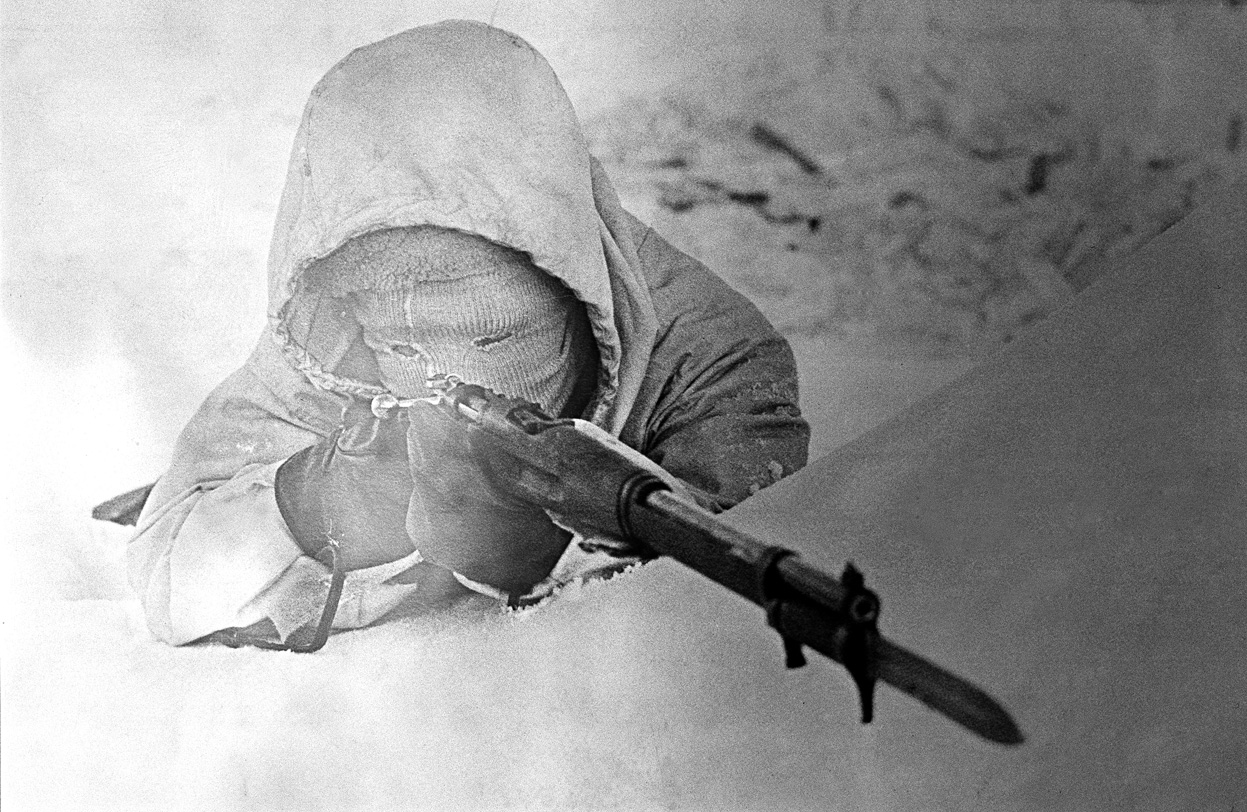
Finnish sniper Simo Hayha reportedly killed 505 Soviet soldiers when Stalin tried to conquer Finland in 1939. If true, that would make Hayha history’s deadliest sniper, ever. As seen below, however, the figure is disputed, and Hayha might have eliminated “only” half as many enemies as he claimed – which would still be an impressive record by any stretch of the imagination.
From Hunter to Sniper

Simo Hayha (1905 – 2002), nicknamed the “White Death”, was a Finnish sniper who reportedly shot dead 505 Red Army soldiers during the Winter War of 1939-1940. Born in a farming community, Hayha was accustomed from early childhood to hard work on the farm. He was also taught how to stalk and hunt game in the Finnish wilderness, and demonstrated a keen passion for target shooting. So from early on, Hayha developed the traits of toughness, patience, and skill with a rifle.
Those assets were destined to come in handy and serve Hayha quite well when he went to war. As with all able-bodied young Finnish men, Simo Hayha did one year of mandatory service in Finland’s army. After his honorable discharge, he signed up for Finland’s Civil Guard – equivalent to the National Guard in the United States. In the Civil Guard, Hayha’s years of hunting and target practice made him his unit’s best shot. So he was trained as a sniper, the first step towards becoming one of history’s deadliest men.
Finland’s Sniping Environment

Hayha’s sniper training commenced with a Russian Mosin-Nagant bolt action rifle. He eventually switched to an improved Finnish variant, when that became available. Hayha was mobilized when the Soviets invaded Finland in November, 1939. By then, he had honed his skills to where he was able to accurately hit sixteen targets in a minute, from a distance of about two hundred yards. That might not seem that far, especially compared to the longest known sniper kills, measured in the miles. However, the ability to consistently hit targets from two hundred yards was more than adequate for the environment in which Hayha was to operate.
In Finland’s heavily forested landscape, there were few unobstructed lines of sight. As such, there were few targets at distances farther away than a few hundred yards. The Soviet invaders greatly outnumbered the Finns. However, they were still reeling from Stalin’s recent military purges, which removed many experienced officers and left the Red Army in disarray. The Finns by contrast, while numerically inferior, were better trained and organized. Finland’s defenders were also more familiar with the local terrain than their enemies. Most importantly, since their own homes and families were in the invaders’ path, they were highly motivated.
One of History’s Deadliest Warriors

It was in the course of resisting the invaders that Hayha gained the nickname the “White Death”. Each morning, he put on white winter camouflage to blend into the snowy landscape, took his rifle and a day’s supply of food and ammunition, and went out into Finland’s forested wilderness to hunt Red Army soldiers. He would then pick a kill zone along a likely Soviet route of advance, and select a position overlooking it. Hayha would then burrow into the snow, and patiently wait for enemies to enter his death field. He did not use a scope, because he did not want to risk sunlight glare exposing his position. Instead, Hayha relied exclusively on iron sights, which makes his 505 kills that much more impressive.
It should be noted, however, that the 505 kills figure is disputed, and probably inaccurate. Sources from Hayha’s own unit pointed out that “only” 259 of his sniper kills were confirmed. The rest were possible kills, perhaps even probable ones, but unconfirmed. It seems that even heroes are no less prone to exaggeration than the rest of us. However, even if he had “only” killed 259 Soviet soldiers, it would still make Hayha one of history’s most lethal warriors. Especially in light of the relative brevity of the Winter War: it started on November 30th. 1939, and ended on March 13th, 1940. So Hayha slew at least 259 enemy soldiers, and perhaps as many as 505, in only three and a half months.
The “White Death” After the War

On March 6th, 1940, just a few days before the war ended, Hayha was shot in the face with an explosive bullet and severely injured. His comrades thought he was dead and placed him on a pile of corpses, until somebody noticed his foot twitching and he was rushed to a hospital. By the time he regained consciousness, the Winter War had ended. He tried to rejoin the military when Finland resumed the war on Germany’s side in 1941, but his request was denied because of the severity of his wounds. So he spent the rest of World War II on his farm.
It took many surgeries spread out over several years for Hayha to recover from his injuries, which left him disfigured for the rest of his life. His farm was located in a part of Finland ceded to the Soviet Union after WWII, so he was forced to move and begin anew elsewhere. Hayha got another farm, and on his free time, indulged his passion for hunting. He never married, and led a quite existence for the rest of his life – although one plagued by loneliness and night terrors, likely caused by post-traumatic stress disorder (PTSD). He was known in his small community as a lover of nature, who was often seen with his hunting dog. Simo Hayha passed away in 2002, aged ninety six.

_________________
Some Sources & Further Reading
History Halls – Soviet Fighting Women: Lyudmila Pavilchenko, History’s Deadliest Female Sniper
Saarelainen, Tapio – The White Sniper: Simo Hayha (2016)
Trotter, William R. – A Frozen Hell: The Russo-Finnish Winter War of 1939-1940 (1991)

