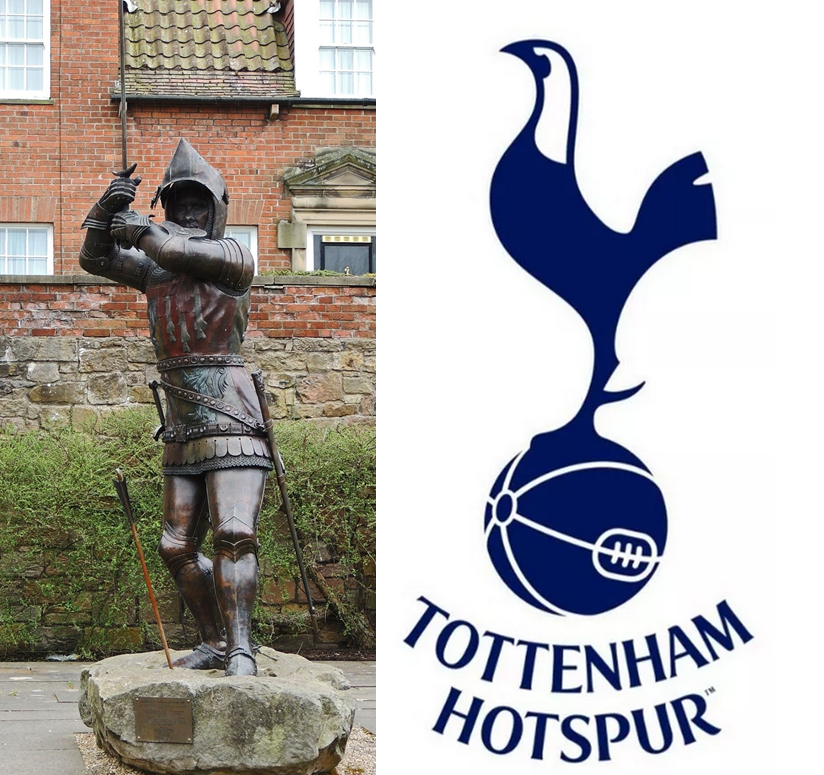
English Premier League club Tottenham Hotspur are named after Sir Henry Percy, commonly known as Sir Harry Hotspur, or just Hotspur. A medieval English nobleman and military commander, Hotspur distinguished himself fighting against the Scots. He then led a major rebellion against King Henry IV of England, that did not turn out well. He was immortalized by William Shakespeare, who made him a prominent character in his play, Henry IV.
Scion of a Mighty Family

Sir Henry Percy was born in 1364, the eldest son of Henry Percy, 1st Earl of Northumberland. The Percy family was one of England’s mightiest at the time. With power to rival that of the crown, much of northern England was practically their private kingdom. In 1377, Sir Henry Percy was knighted by King Edward III, along with future kings Richard II and Henry IV. He earned the epithet Hotspur from his Scottish enemies because of his diligence in patrolling the border between England and Scotland, and “[a]s a tribute to his speed in advance and readiness to attack”.
Hotspur performed brilliant military service in Scotland, and in 1386 was sent to France to reinforce the garrison at Calais. In addition to securing Calais, he raided into Picardy, and in 1387 commanded a naval force that tried to break a siege of Brest. As a reward, King Richard II made Hotspur a Knight of the Garter in 1388, and showered him with royal favors in the form of grants and appointments. The royal largess did not buy his loyalty, however.
The Problematic Percys

Hotspur and his father played a key role in helping Henry Bolingbrook, the future King Henry IV, to overthrow Richard II in 1399 and replace him on the throne. Henry IV was grateful, and generously rewarded father and son with titles, lands, and offices. However, the Percys soon soured on the new king. Henry IV failed to pay monies owed them for defending the border the Scotland, expanded his son’s military authority in Wales at the Percys’ expense, bestowed favors upon their enemies, and committed other slights, real and imagined.
In 1403, the Percys rebelled and sought to depose Henry IV. Hotspur raised an army in Cheshire, while his father raised another one in Northumberland. However, when the king heard the news, he acted swiftly and immediately marched to intercept Hotspur near Shrewsbury, before he could combine his army with that of his father. The two met at the Battle of Shrewsbury, fought on July 21st, 1403. As seen below, things started well for Hotspur, who had positioned his army on a rise behind a field of peas, whose roots he hoped would tangle any advance by royal soldiers.
The End of Harry Hotspur

Each side had thousands of archers, and fighting commenced with a storm of arrows. Hotspur’s archers proved superior, and amidst a hail of shafts that darkened the sky, the king’s right flank simply disintegrated. On the left flank, commanded by Henry, Prince of Wales, the future King Henry V was shot in the face with an arrow and suffered a grievous injury that left him with a permanent scar. At some point, Hotspur spotted the king’s banner in the royal army’s center, and made an all-out charge hoping to slay him. He almost succeeded. He overthrew the king’s banner, and personally killed the royal standard bearer.
However, in that desperate fighting, it was not the king who was slain, but Hotspur, shot in the face with an arrow when he raised his helmet’s visor. When the cry went up that Henry Percy was dead, his army fell apart and fled. Henry IV had a long history with Hotspur, having been knighted alongside him in 1377 when both were still boys. He reportedly wept when he saw the corpse of his erstwhile friend turned enemy. After the battle, he ordered that it be buried with honors. That changed when rumors started to make the rounds that Hotspur was not really dead. The king put them to a rest by having the corpse disinterred, salted, impaled, and put on display in Shrewsbury’s marketplace.
Hotspur’s Legacy

Afterwards, to make sure that the rest of the realm had no doubt that his enemy was well and truly dead, King Henry IV had Hotspur’s head chopped off and displayed on a pike in the main gate of York, Northumberland’s chief city. The rest of his body was quartered, and the pieces sent on tour to be displayed around England. Despite his track record of rebellion – or perhaps because of it – Henry Percy never ceased to be viewed as a formidable knight and heroic figure.
In the Renaissance, Hotspur featured prominently in Shakespeare’s Henry IV. In the modern era, there is an English Premier League team, Tottenham Hotspur Football Club, named after him. Formed in 1882, the Spurs were named in Sir Henry Percy’s honor because he had lived in the vicinity, and because his family used to own land in Tottenham, including Northumberland Park, where the club and its stadium are located. Hotspur had also been a huge fan of cockfighting, so the Spurs chose a fighting cock for their symbol.

_________________
Some Sources & Further Reading
Encyclopedia Britannica – Sir Henry Percy
History Halls – Peasant Rebellions: When the Downtrodden Fight Back
Oxford Dictionary of National Biography – Percy, Sir Henry (1364 – 1403)
Whitewood, Dickon – Shrewsbury 1403: Struggle for a Fragile Crown (2017)

