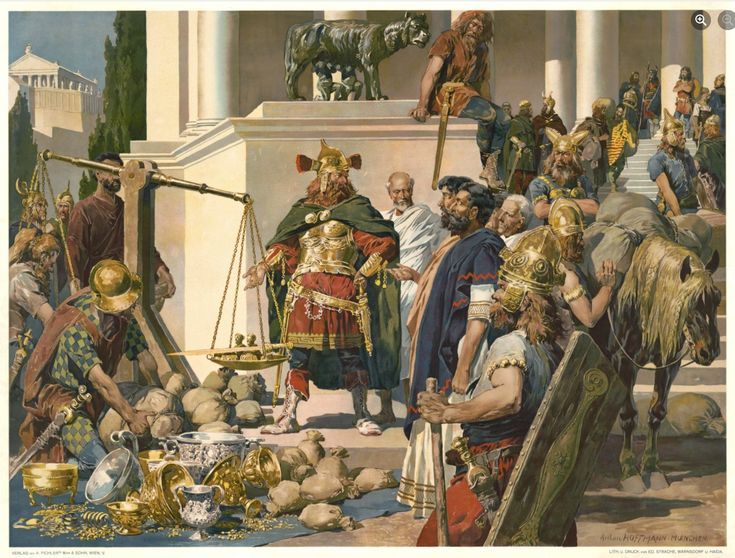
Rome started off as a small city-state on the Tiber. By the early fourth century BC, however, it had grown into a formidable regional power in central Italy. The Romans had fought the Etruscans to their north, subdued many Latin neighbors to their south, and established themselves as the dominant force in Latium. Yet, beyond the Apennines to their northeast, a new people were moving steadily into the Italian peninsula: the Gauls, or Celts. The Gauls were part of a vast network of Celtic tribes who had migrated across Europe. They were warlike, semi-nomadic and highly mobile, and often sought fertile land and plunder. Around 400 BC, several tribes had crossed the Alps into northern Italy, and settled in the fertile Po Valley. Their aggressive expansion soon brought them into conflict with the Etruscans, Umbrians, and eventually the Romans.
Clashing With the Gauls

The specific Gaulish tribe that ended up clashing with Rome was the Senones, led by a chieftain named Brennus. According to tradition, they were invited to attack the Etruscan city of Clusium by one of its influential citizens, who sought their aid against a rival. Rome, in an attempt to extend its influence, intervened. It sent ambassadors to warn the Senones that Clusium was under Roman protection, then offered to negotiate a peace settlement. Things went sideways during the negotiations, fighting broke out, and the Roman ambassadors got involved, with one of them killing a Senone chieftain. That angered the Gauls, and set the stage for a showdown. In 387 BC, the Gauls marched southwards, and the Romans scrambled to respond. They met near the Allia River, about eleven miles north of Rome. What followed was one of Rome’s most infamous defeats.
The Roman army, though experienced in fighting Italian neighbors, was unprepared for Gallic methods of warfare. The Gauls fought with long swords, immense physical strength, and terrifying war cries. Ancient sources describe them as tall, wild, and ferocious. Meeting them for the first time shocked and unnerved the Romans. At the Allia, the Romans made a grave tactical error. They placed a detachment on higher ground but failed to secure it properly. The Gauls overwhelmed that flank, routed the detachment, and rolled down upon the Roman center. Panic ensued, and the Roman line collapsed. Their soldiers fled in chaos, some to nearby Veii, others toward Rome.
A Suddenly Vulnerable City

The Roman defeat at the Battle of the Allia was catastrophic. Unlike other Italian wars, this battle left Rome completely exposed. The Gauls marched directly on Rome, which lacked strong defensive walls, except for the old earthworks. For generations, the expansionist Romans had seldom needed to think of defense, as they were the ones constantly on the offensive against their neighbors. Now, suddenly, Rome itself was vulnerable to attack. Terrified citizens fled south to neighboring towns, or took refuge in the countryside.
A core group of defenders – consuls, senators, priests, and soldiers – retreated to the Arx and Capitoline hills, the most defensible parts of the city. The Gauls entered an almost deserted Rome with little resistance. They looted, set fires, and slaughtered any remaining inhabitants. Ancient accounts paint scenes of chaos and horror: temples burned, houses ransacked, streets filled with corpses. Yet the Arx and Capitoline strongholds held out. Repeated assaults by the Gauls were repelled. The trapped and besieged defenders were determined not to surrender.
The Sack of Rome

One famous anecdote tells of the oldest Roman notables, too old to fight, sitting calmly in their chairs out in public. Wearing ceremonial robes, they awaited the Gauls’ arrival. They had pronounced the ancient formula of devotio, whereby a Roman vowed to sacrifice himself – along with an enemy – to the gods of the underworld in exchange for a Roman victory. When the Gauls entered the Forum, they were awed by the sight of the elderly men sitting motionless like statues. One of them, Senator Marcus Papirius, was so still that a Gaul stroked his beard to see if he was real. Papirius responded by striking him with his ceremonial staff. That enraged the Gauls, who fell upon and massacred the elderly Romans.
The siege of the Capitoline Hill began in July, 387 BC, and dragged on for months. Supplies grew short, and famine gnawed at both sides. In one celebrated episode, the Gauls attempted a night assault by climbing the Capitoline cliffs. Their movements were unnoticed by Roman guards, but not by sacred geese kept in the temple of Juno. The birds’ loud cackling woke the defenders, and the Romans, led by Marcus Manlius Capitolinus, repelled the assault. This event entered Roman legend as proof of divine protection. Despite this small triumph, conditions remained dire. The city outside the Capitoline lay in ruins, and as starvation loomed, the Romans considered terms.
Vae Victis!

Eventually, the Romans agreed to pay the Gauls to leave. The amount was enormous: one thousand pounds of gold. According to the historian Livy, the Gauls cheated and used altered weights to increase the amount. When the Romans protested, the Gauls’ leader, Brennus, rubbed it in by throwing his sword on the scales to add even more weight, and contemptuously uttered the infamous words: “Vae victis!” – woe to the vanquished! It was a phrase that encapsulated Rome’s humiliation, and one that the Romans never forgot. For the first and only time until the final decades of the Western Empire many centuries later, the Eternal City was taken and occupied by a foreign enemy.
Roman tradition sought to soften the shame of the sack of Rome. According to some accounts, just as the gold was being weighed, the exiled Roman general Marcus Furius Camillus arrived with an army. Having been recalled from exile, Camillus supposedly declared that Rome would not ransom itself with gold, but with steel. A battle followed, and the Gauls were defeated and driven from Rome. Modern historians doubt this version, and see it as a made up patriotic embellishment. Most likely, the Gauls accepted the ransom and departed voluntarily.
The Sack of Rome Left Permanent Scars

Camillus saving Rome’s honor from the humiliation of having to pay ransom might have been made up, but future generations of Romans were determined to believe that it had really happened. So Camillus became enshrined in Roman memory as the “Second Founder of Rome” – a heroic figure who saved the city in its darkest hour. The destruction was immense: temples, archives, and public buildings were lost, including many early historical records. Much of early Roman history before 387 BC is shrouded in uncertainty partly because of this loss.
The Gallic sack left deep scars on the Roman psyche, and was seared into Roman memory. The image of barbaric Gauls roaming its streets haunted Rome for centuries. Even at the height of their power, Romans retained a fear of barbarians from the north. Centuries later, Germanic tribes menaced Italy and defeated Roman armies sent to repel them. That triggered widespread fears of another sack of Rome, until the statesman and general Gaius Marius enacted radical military reforms that forever after transformed the Roman state, to create new legions with which he finally crushed the invaders. Decades later, Julius Caesar conquered Gaul in the first century BC, and partly justified it as preventing another sack of Rome.
Aftermath

Militarily, the sack of Rome exposed the inadequacy of the city’s defenses. Soon after, the Romans built the Servian Wall – massive stone fortifications encircling the city. They also reformed their army, gradually moving away from the phalanx-style formations borrowed from the Greeks, toward the more flexible manipular legion. Politically, the disaster fueled internal strife. Patricians and plebeians clashed over how to rebuild and defend the city. However, the shared trauma also fostered unity. Rome emerged hardened, more militarized, and more determined to dominate its neighbors. Within a century, it would subjugate Latium, Etruria, and eventually all of Italy.
The Gallic sack became a foundational myth of Roman resilience. Romans told and retold stories of the old senators awaiting death with dignity, of the geese of Juno saving the Capitoline, of Camillus’s heroic intervention, and of Brennus’s scornful “woe to the vanquished”. For centuries, Roman orators used the sack as a cautionary tale: a reminder of the price of complacency and the need for vigilance. The terror of foreign invasion became a political tool, used by hawkish statesmen to motivate Romans to maintain a strong military and justify expansion.
The Legacy of the Sack of Rome

The sack of Rome shaped Roman foreign policy forever after. Rome became determined to never again be at the mercy of “barbarians”. Later Roman campaigns against the Gauls, starting with the domination of the Gauls of northern Italy and culminating in Caesar’s conquest of Gaul, modern France, were driven as much by memory of the sack as by material interest. To the Romans, the Gallic sack of 387 BC was more than a military disaster – it was a defining trauma. Though the actual damage may have been less than legend suggests, the psychological impact was immense.
It humbled the Romans at a crucial stage in their rise. They were forced to rebuild stronger defenses, reform their military, and cultivate an identity centered on resilience and revenge. From the cry of “vae victis!” to the sacred geese of Juno, the sack entered Roman legend as both humiliation and catalyst. Rome was devastated, but it did not fall. Instead, it transformed the wound into a source of strength, ensuring that the city, though humiliated, would never again be so easily conquered.

_________________
Some Sources & Further Reading
Livy – The History of Rome, Book V
Plutarch – Parallel Lives: The Life of Camillus

