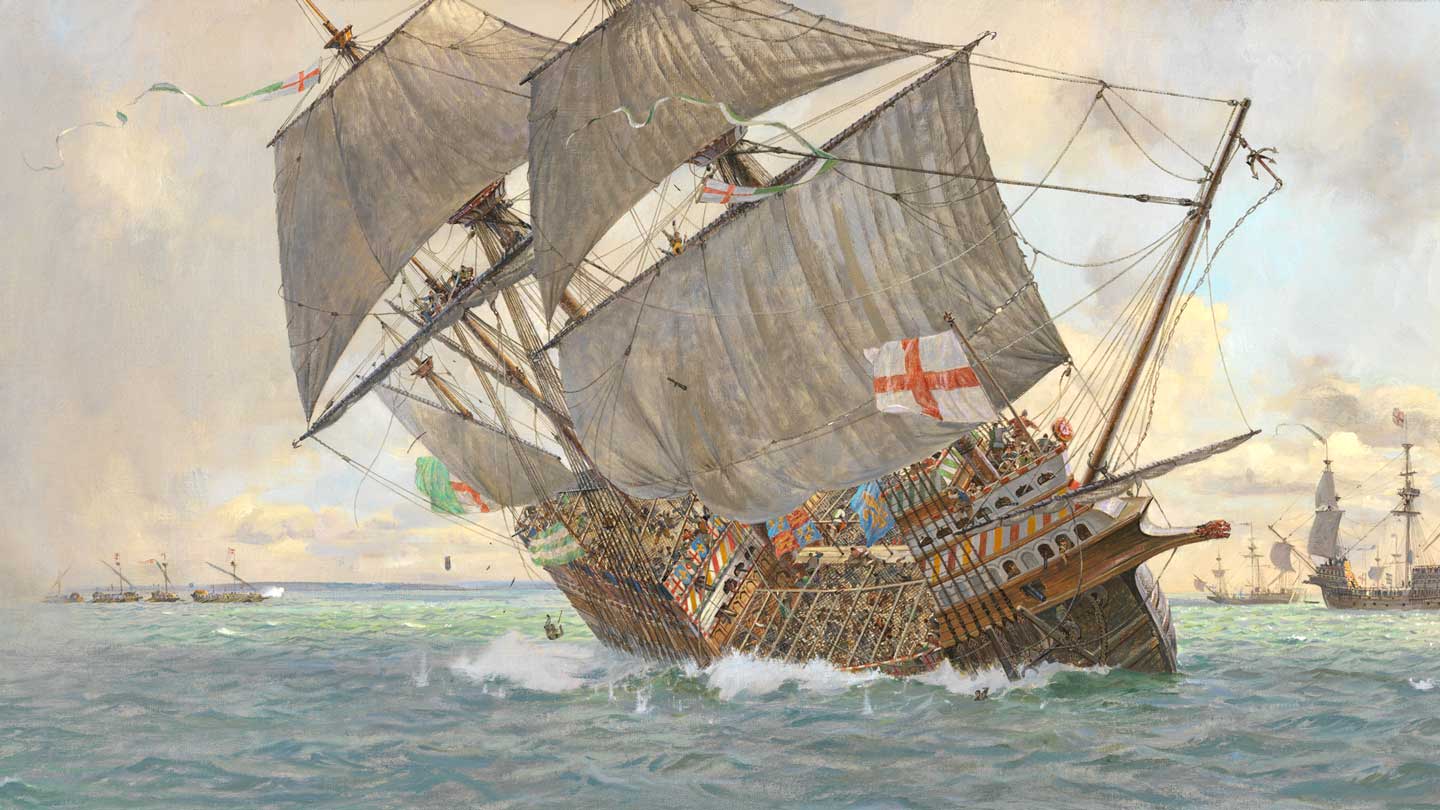
The English warship Mary Rose was built in the reign of King Henry VIII, and ably served for years as the English Navy’s flagship. Her career was cut short when a redesign, intended to improve her performance, backfired and led to her sinking with the loss of most of her crew.
The Revolutionary Mary Rose

The Mary Rose was built in Portsmouth, England, and when completed and commissioned in 1511, it was among a class of new vessels that revolutionized naval warfare. Ever since the introduction of cannons, warships had fired them from the top deck. The old placement of cannons on the top deck had meshed in with the norms of naval warfare that had existed for millennia. For thousands of years, ships had fought each other chiefly through direct physical contact with one another.
Warships had either tried to sink enemy vessels by ramming them, or drew close enough for the fighting men on board to grapple a targeted ship and try to board and seize or sink it. The Mary Rose and other pioneering ships of her class changed that, and placed the guns on the lower decks, from which they fired through portholes cut into the hull. That transformed naval warfare. Now, ships could fight at a distance by firing massed gun broadsides at each other.
A Redesign That Was Not Well Thought Through

The Mary Rose was a success, and gave the English Navy decades of solid service, until 1536. That year, she began an unfortunate redesign and upgrade. The logic seems to have boiled down to: “cannons are good. Therefore more cannons are better“. It was not a bad line of reasoning in of itself. However, it could prove problematic if more cannons were added to a ship that had not been specifically designed to accommodate more cannons and bear their additional weight.
The Mary Rose was just such a ship. The redesign and upgrade entailed the addition of a new gun deck, and with the addition of more and heavier cannon, increased the ship’s weight from 500 tons to 700. As a result, she began to ride lower in the water, which in turn brought its lower deck’s gun portholes closer to the sea’s surface. As seen below, the consequences of that caught up with the pride of the English fleet on July 19th, 1545, at the Battle of the Solent.
Doomed by an Unfortunate Upgrade

The Mary Rose was among a fleet of English sailing ships becalmed in the Solent, the strait that separates mainland England from the Isle of Wight. The English ships were unable to maneuver for lack of wind, when a fleet of French rowing galleys showed up and attacked them. Henry VIII’s flagship and her companions were in trouble. Unlike the English sailing vessels, the enemy galleys moved by oar power and did not rely on the wind. The French seemed on the verge of a victory over the immobilized English sailing ships. The latter were only saved at the last minute, when the wind finally picked up.
With a stiff breeze filling her sails, the Mary Rose led an English counter attack. The tables had turned, and the outgunned French galleys were the ones in trouble now. Unfortunately, her first broadside caused her to heel or lean over to her starboard (right) side. Her gun portholes were lower and closer to the water’s surface, thanks to the additional weight of the 1536 upgrade. They dipped into the water, and the sea rushed in through the open gun ports. The crew was unable to correct the sudden imbalance. Cannons, ammunition, and cargo shifted to the submerging side of the ship, which made it tilt even more. The Mary Rose sank quickly, and took nine tenths of her crew with her.

_________________
Some Sources & Further Reading
Bradford, Ernle – The Story of the Mary Rose (1982)
Mary Rose Organization – About the Mary Rose

