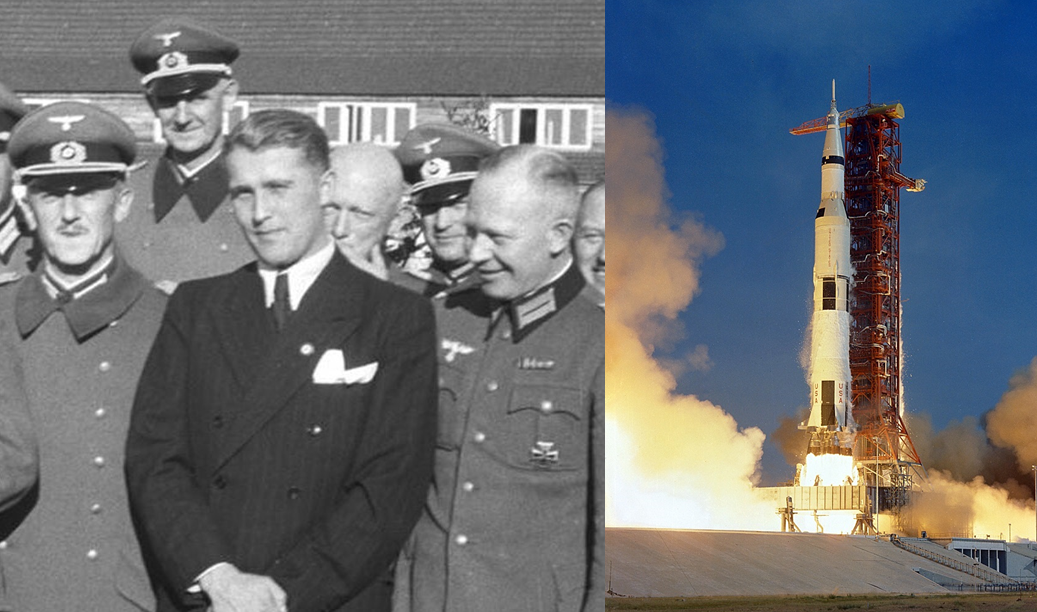
Thousands of German scientists, engineers, technicians, and other experts took part in war crimes during the Second World War. Many of the atrocities in which they participated were so heinous, that their perpetrators could have been not only imprisoned, but executed had then bee prosecuted. However, many of them possessed valuable expertise and knowledge, and to the war’s victors, national interests trumped justice. So many German experts with blood on their hands were hired to work for their former enemies. The United States was no exception: it executed Operation Paperclip in which roughly 1600 German experts were recruited. Many were saved from war crimes prosecutions, and relocated to America, where their pasts were glossed over as they became respectable citizens, working on various government projects.
A Treasure Trove of Nazi Scientific Expertise

At the close of World War II in 1945, the world confronted both the devastation of global conflict and the dawn of a new technological era. Nazi Germany’s defeat left behind not only rubble, but also a treasure trove of scientific knowledge, particularly in fields like rocketry, aeronautics, medicine, and chemical warfare. The United States was eager to secure an advantage in the coming Cold War against the Soviet Union. So it launched a secret program to recruit German scientists and engineers. This initiative, known as Operation Paperclip, became one of the most controversial intelligence projects in American history.
As Allied forces advanced through Germany in the final months of the war, intelligence officers quickly realized the strategic value of German research. The Nazis had invested heavily in advanced weapons systems – rockets like the V-2, jet propulsion technology, nerve agents, and even early experiments in space travel. Much of that progress came under the leadership of Wernher von Braun and his team at Peenemünde, who had designed the V-2 rocket that rained destruction on London and Antwerp in 1944–45. At the same time, the Soviet Union was also racing to capture German scientific talent. It was already becoming clear that in the postwar world, the USSR would emerge as the United States’ chief rival. Against that backdrop, American officials decided they could not allow such expertise to fall into Soviet hands.
Operation Paperclip

Initially, the program to bring German scientists to the United States was known as Operation Overcast. Details began to leak, however, so it was renamed Operation Paperclip – a name supposedly derived from the paperclips attached to the personnel files of the scientists targeted for recruitment. Between 1945 and the mid-1950s, roughly 1600 German scientists, engineers, technicians, and other experts were brought to the United States under Paperclip. The men came from a variety of disciplines: aeronautics, rocketry, chemistry, physics, and medicine.
A miasma of moral murkiness enveloped the recruitment process. Many candidates had been members of the Nazi Party, and some had even been implicated in war crimes, including horrific human experimentations. Official policy initially barred those with strong Nazi affiliations from participation. However, the urgency of Cold War competition led officials to sanitize records or overlook problematic. In some cases, dossiers were deliberately rewritten to obscure involvement in atrocities. The most famous group within Operation Paperclip was the Peenemunde rocket team, led by Wernher von Braun.
Operation Paperclip’s Star: Wernher von Braun

Von Braun had overseen the design of the V-2 rocket. The V-2 was a terror weapon that had killed thousands of civilians, but it was also the first man made object to reach the edge of space. Von Braun had been member of the Nazi Party, and held an SS rank. However, his expertise was too highly valued, so the unsavory parts of his background were overlooked. Von Braun and about 120 of his colleagues were relocated to America, where they worked first at Fort Bliss in Texas, and later at Huntsville, Alabama. Their contributions were enormous.
Von Braun became the central figure in the development of the Redstone missile, America’s first large ballistic missile. He also played a significant part in the development of the Saturn V rocket, which sent America’s astronauts to the Moon. Operation Paperclip experts played pivotal roles in multiple fields. In space exploration, Von Braun’s team laid the foundation for NASA’s space program. Without their expertise, America might not have beaten the Soviets to the Moon. In military technology, German scientists advanced American missile development, including the creation of intercontinental ballistic missiles (ICBMs). In aviation, other Germans contributed to aircraft design and supersonic flight research. Yet others helped advance the fields of aerospace medicine and physiology.
The Benefits of Paperclip

The Paperclip experts’ contributions accelerated America’s technological capabilities during the Cold War, and gave the US an edge in the arms race and the space race. However, while the scientific benefits were clear, the program was fraught with moral compromises. Many of the scientists recruited had been complicit in Nazi crimes. Some, including von Braun, had used forced labor from concentration camps in their wartime projects. Prisoners were often worked to death in underground facilities constructing V-2 rockets. Other scientists had participated in chemical weapons development and unethical medical experiments on prisoners. The US government was aware of those atrocities, but often suppressed or concealed them to facilitate recruitment.
Critics have argued that in pursuing technological superiority, America effectively gave amnesty to war criminals who should have faced justice at Nuremberg. The program’s defenders counter that it should be understood in the context of the Cold War. The Soviet Union had launched a parallel effort, in which thousands of German specialists, voluntarily or forcibly, were relocated to Russia. The race to secure German experts as the Third Reich collapsed set the stage for decades of competition in space and military technology. Ironically, the German rocket expertise imported to both superpowers fueled the escalating arms race, culminating in the nuclear-armed missiles of the 1950s and 1960s.
A Morally Ambivalent Program

The legacy of Operation Paperclip is deeply ambivalent. On one hand, it contributed directly to some of America’s greatest technological triumphs, most notably the Apollo Moon landings. The recruited German experts transformed American aerospace, weapons research, and medicine. On the other hand, the program exposed the tension between moral accountability and national security interests. By prioritizing scientific knowledge over justice, the United States allowed people who had committed crimes against humanity to escape punishment. For many, that casts a shadow over the otherwise celebrated achievements of the American space program.

Operation Paperclip also influenced public debates about the ethics of science, government secrecy, and the compromises countries make in the name of national security. Its story remains a sobering reminder that technological progress often comes entangled with moral costs. The program was a covert mission that reshaped the trajectory of American science and technology. By importing German expertise, the US secured decisive advantages in the Cold War, from missiles to space travel. Yet it did so by overlooking the dark pasts of many participants, raising lasting questions about the price of progress. Ultimately, Paperclip embodies the double-edged nature of history, where triumphs often coexist uneasily with moral compromises.

_________________
Some Sources & Further Reading
Crim, Brian E. – Our Germans: Project Paperclip and the National Security State (2018)
History Halls – The WWII Intelligence Screwup That Almost Placed New Zealand Under Martial Law
Lichtblau, Eric – The Nazis Next Door: How America Became a Safe Haven for Hitler’s Men (2014)

