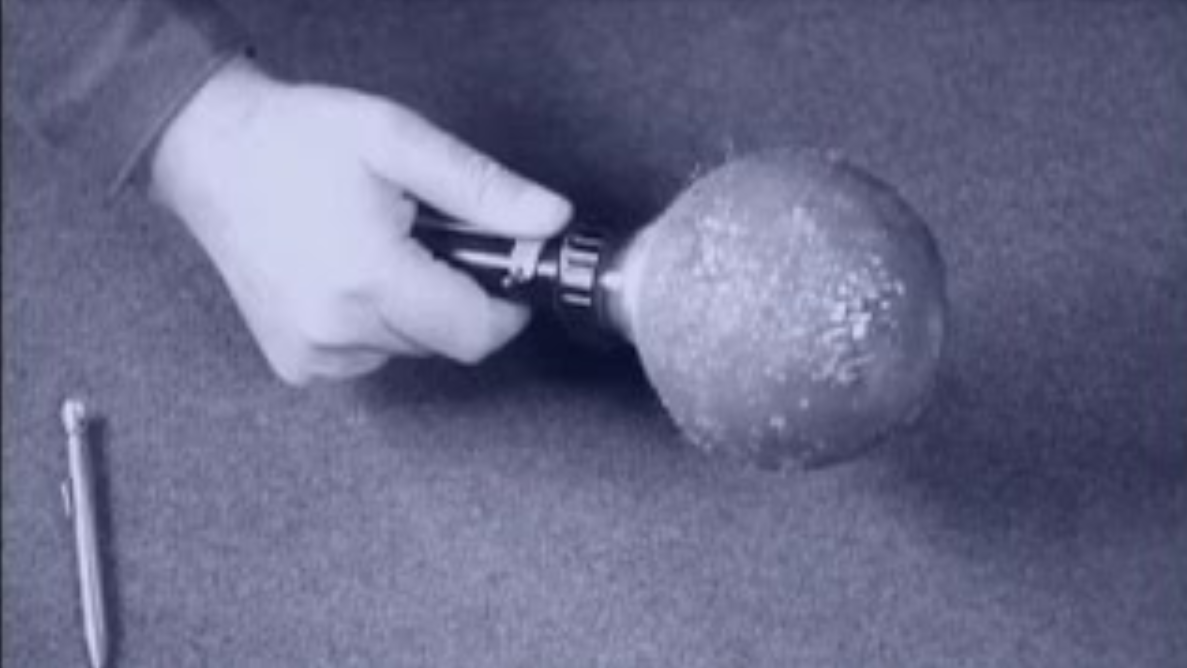
The British Sticky Bomb was one of World War II’s most misguided weapons. It was developed in the aftermath of the disastrous Battle of France and evacuation from Dunkirk, where most of the British Army’s anti-tank weapons had been left behind. Intended for use against tanks, the Grenade, Hand, Anti-Tank No. 74, commonly known as the Sticky Bomb, was a maraca-looking device with an outer metal shell that covered a bomb coated with an adhesive. As seen below, it had a fatal flaw.
A Flawed Weapon

The Sticky Bomb user was supposed to pull a pin to remove the outer metal layer and expose the sticky bomb. He would then dash to a tank, stick the bomb to it, activate a five second fuse, then run away or dive to avoid the explosion. Users could throw the bombs at tanks, and hope they stuck to the surface. Unfortunately, the Sticky Bomb’s adhesive did not readily stick to dusty, muddy, or wet surfaces. Dusty, muddy, and wet surfaces were “a customary condition of tanks”, as Churchill’s chief military adviser could not help but point out.
That was not the only problem. There was a second problem, even worse than the Sticky bomb’s failure to stick to what it should. It had an unfortunate tendency to stick to what it should not: its user. In cartoon-like fashion, the adhesive had a tendency to leak and glue the bomb to its thrower’s hand or uniform. That likely led to situations that would have been funny, had they not ended so tragically and gruesomely.
Once Removed From Their Casings, Sticky Bombs Often Stuck to Their Users

A Sticky Bomb user could pull the pin to arm the five second fuse, then attempt to stick the bomb to a tank or throw it at one, only to discover to his horror that it was stuck to his hand instead. The unfortunate user might spend his last seconds on earth frantically shaking his hand like Wile E. Coyote with a stick of TNT glued to his paw.
As recounted by a British Home Guard member: “It was while practicing that a Home Guard bomber got his sticky bomb stuck to his trouser leg and couldn’t shift it. A quick thinking mate whipped the trousers off and got rid of them and the bomb. After the following explosion, the trousers were in a bit of a mess — though I think they were a bit of a mess prior to the explosion”. The Sticky Bomb went down in British Army lore as one of the least well-thought-out weapons of WWII.

_________________
Some Sources & Further Reading
D-Day Overlord – No. 74 Sticky Bomb
History Halls – Fashion History: 1970s Fish Tank Shoes
Imperial War Museum – Grenade, Anti-Tank, No. 74 Mk I (‘Sticky Bomb’)

