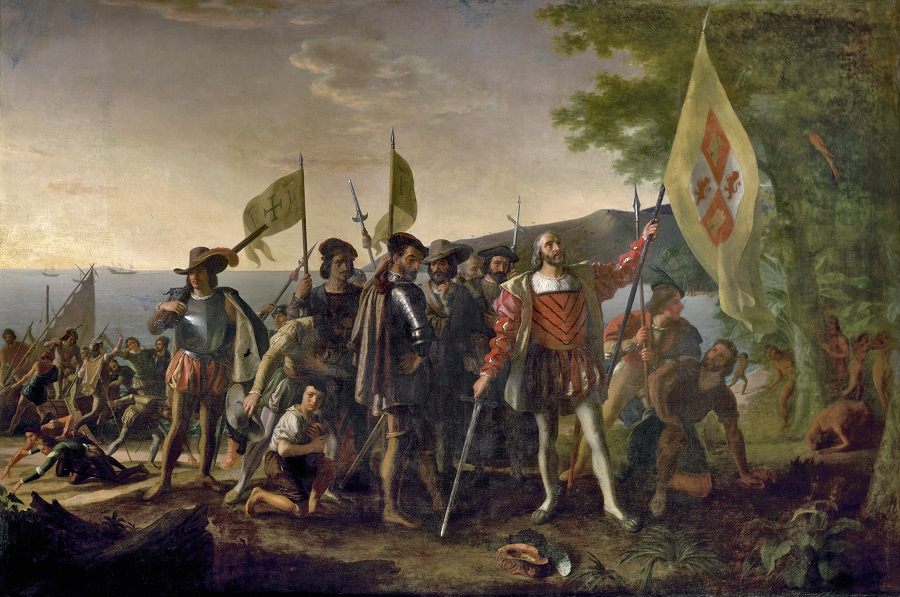
Christopher Columbus departed from Spain in 1492, and sailed westward in hopes of ending up in India. He never got there, because two massive continents were unexpectedly in his way. Even if the Americas had not barred his path, it is unlikely that Columbus would ever have made it to the Indies. As seen below, Columbus’ had used bad math when he calculated his journey.
Columbus’ Math Mistake

Contrary to myth, when Italian explorer and navigator Christopher Columbus (1451 – 1506) set out from Spain with the Nina, Pinta, and Santa Maria in 1492 and sailed into the sunset, he harbored no fears that he might fall off the edge of the world. Nor did his crew. It was common knowledge at the time that the Earth was round. The Ancient Greeks had known that more than two thousand years earlier, and educated people and sailors in Columbus’ day had no illusions that the world was flat. The issue for Columbus was not the shape of the planet, but the size of the ocean he intended to cross.
When Columbus set out on his first voyage across the Atlantic, his immediate destination was Japan, which he was convinced was less than three thousand miles away from Spain. Just a bit further beyond that, he figured, he would reach China, India, and the Spice Islands with their rich spice trade. As we now know, Japan is about twelve thousand miles away from Spain, more than four times that fewer than three thousand miles Columbus had expected. The reason he thought it was much closer was because he made a math mistake when he calculated the size of the globe. As a result, he figured that Earth was significantly smaller than it really is. It was one of history’s most momentous mistakes.
Why the New World Was Named America Instead of Getting Named After Columbus

On top of getting his numbers wrong, Columbus was unaware that there was a massive continental landmass between Spain and Asia. Ultimately, he reached the Caribbean, whose islands he believed were Asia’s western outskirts. So he named them the West Indies, and their people Indians. In subsequent voyages, he explored the Caribbean and South America’s northern coast. When he was not at sea exploring, Columbus acted as the Spanish king’s governor and viceroy of the Caribbean. In that capacity, he brutally mistreated, enslaved, and decimated the native population.
Until Columbus drew his last breath, he was convinced and insistent that he had reached Asia. Ironically, the New World he discovered would not bear his name, but was instead named after another Italian explorer, Amerigo Vespucci. Amerigo mapped the eastern shore of South America down to Brazil, and demonstrated conclusively that Columbus had not reached Asia. Instead, he had apparently stumbled upon a hitherto unknown world, which Amerigo called Mundus Novus, Latin for “New World”. A German mapmaker named Martin Waldseemuller was impressed by Vespucci’s work, and labeled the New World “America”, the Latinized form of Amerigo. Waldseemuller’s maps were quite popular during the 1500, so the name America spread and stuck.

_________________
Some Sources & Further Reading
History Halls – Lucky Mistakes: Sloppiness Led to a Discovery That Saved Millions of Lives
Smithsonian Magazine, October, 2009 – Columbus’ Confusion About the New World

