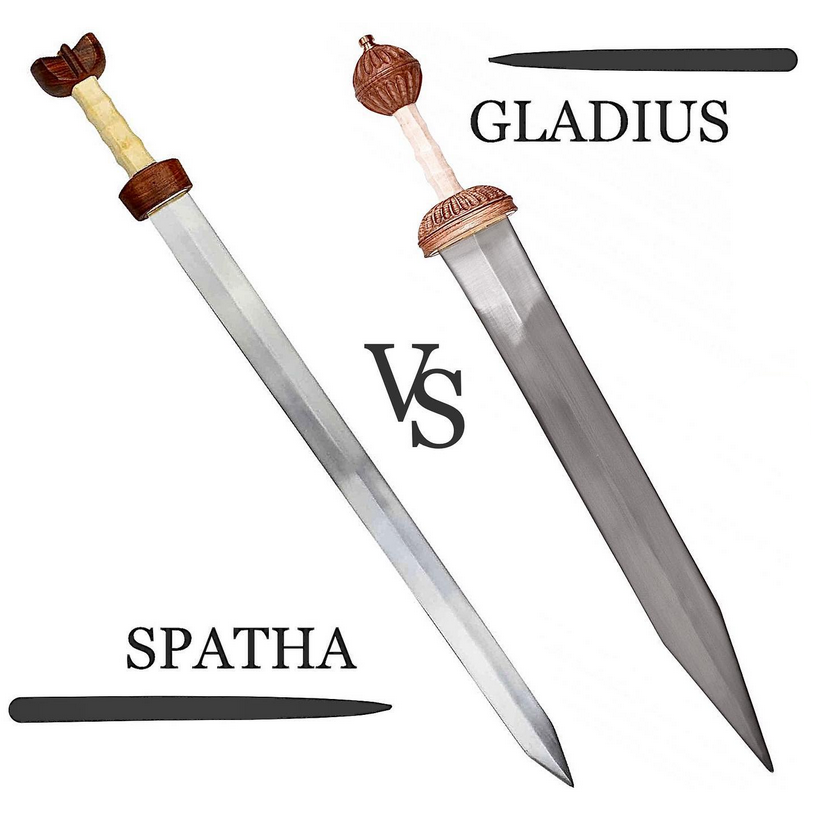
For roughly five hundred years, the standard sword of the Roman legionary was the gladius. A short-bladed sword with a ‘V’ shaped tip, the gladius was optimized first and first foremost for thrusting. By the third century AD, however, the gladius had been replaced as the legionary’s standard sword by the spatha. It featured a longer blade less optimized for stabbing, but with greater reach and ability to slash and cut. As seen below, the spatha’s legacy was not limited to the Romans. It went on influence European sword designs for many centuries after the fall of Rome.
The Spatha’s Celtic Origins

The spatha was used during the Roman Empire from the first to sixth centuries AD. A straight and double-edged long sword, it had a blade that measured between 30 to 40 inches. The spatha could be used single-handed or with a two-handed grip. Its name was derived from a Latin word meaning “broad sword”, and it survives to this day in Romance languages descended from Latin as the word for “sword”. For example, the Italian spada, the Spanish and Portuguese espada, the Catalan espasa, or Romanian spade, are all derived from the Roman spatha.
The spatha initially reached the Roman military via Celtic cavalry auxiliaries, who used their traditional swords with blades that measured about 33 inches in length. That gave them greater reach than the standard Roman gladius to strike and slash from horseback at targets below. From Celtic cavalry auxiliaries, use of the spatha spread throughout the Roman military, and over time, it was gradually adopted by foot soldiers. By the third century AD, the spatha had become the standard sword of Roman heavy infantry.
An Influential Sword Design

The spatha gave the Roman legionaries more reach when thrusting than they could with the traditional and shorter gladius. As the longer sword saw ever wider adoption, the gladius ended up relegated to the niche role of the light infantry’s sidearm. The cavalry version of the spatha had a rounded tip to reduce the risk of accidentally stabbing the rider’s foot or the horse’s flank. The infantry spatha, however, retained the gladius’ long and sharp point that was suitable for thrusting.
After it was introduced to the Roman army, the spatha was enthusiastically embraced by Rome’s Germanic auxiliaries, both infantry and cavalry. From Germanic auxiliaries, it spread to their Germanic tribes back home, where it became popular. From those Germanic tribes, the spatha became the template of early medieval swords following the fall of the Western Roman Empire. That evolved into the Viking sword centuries later, and later still, influenced the development of the arming sword. In the Eastern Roman Empire it survived in the Byzantine army and court for centuries more. Until their empire fell in the 1453, the Byzantines had a mid-level court title named spatharios, meaning “bearer of the spatha”.

_________________
Some Sources & Further Reading
History Halls – Swords Across the Millennia and From Around the World
Laking, Sir Guy Francis – A Record of European Armour and Arms Through Seven Centuries (1919)

