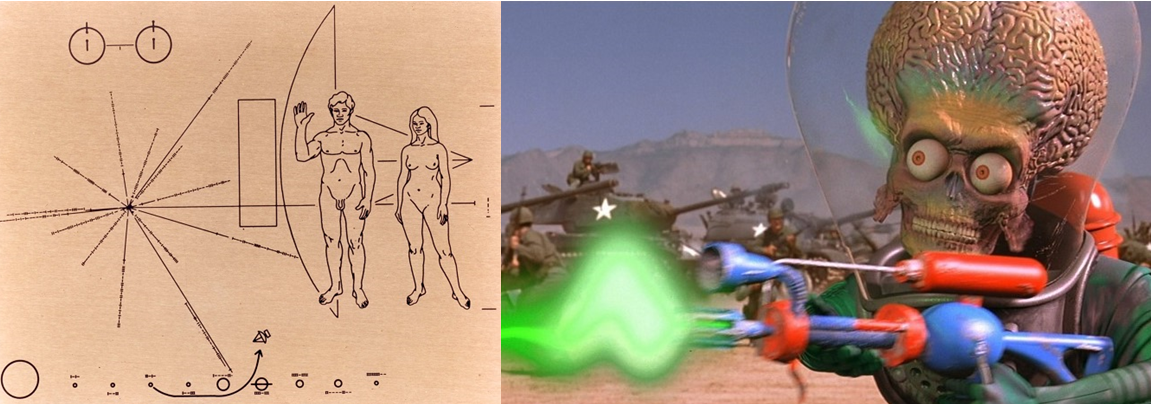
Pioneer 10 and Pioneer 11 were among the early Space Age’s most audacious and influential missions. Launched in the early 1970s, those probes were the first human-made objects to travel through the outer solar system. They were also the first to venture onto trajectories that would eventually carry them into interstellar space. Beyond their scientific achievements, the Pioneer missions are remembered for a bold symbolic gesture. Each carried a gold-anodized plaques with information about Earth, its inhabitants, and location. The decision to depict Earth’s location on the Pioneer probes plaque has sparked controversy that continues to this day.
Humanity’s First Foray Deep Into the Solar System and Beyond

Pioneer 10 was launched on March 2nd, 1972. The primary goal was to explore Jupiter, and demonstrated that a spacecraft could safely traverse the asteroid belt. At the time, there were lingering fears that the belt might contain enough debris to destroy a passing probe. Pioneer 10 dispelled those concerns when it flew through the belt without incident and reached Jupiter in December, 1973. During its flyby, it provided the first close-up images of the gas giant. It mapped Jupiter’s intense radiation belts, studied its magnetic field, and revealed details about its atmosphere and moons. After the encounter, Pioneer 10 became the first spacecraft to achieve escape velocity from the solar system, heading roughly in the direction of the constellation Taurus.
Pioneer 11 followed on April 6th, 1973. While it also visited Jupiter in 1974, its mission profile was even more ambitious. Using a gravity assist from Jupiter, Pioneer 11 was redirected toward Saturn. It became the first spacecraft to visit that planet in September, 1979. The probe returned critical data about Saturn’s rings, magnetic field, and atmosphere. It also helped identify hazards within the ring system – information that would prove vital for the later Voyager missions. After its Saturn flyby, Pioneer 11 was also placed on an escape trajectory, heading toward interstellar space in the general direction of the constellation Aquila.
The Pioneer Probes Plaque

Technologically, the Pioneer probes, each weighing about 250 kilograms (550 pounds), were modest by modern standards. They relied on radioisotope thermoelectric generators for power, and used the heat from decaying plutonium-238. Their scientific instruments included magnetometers, particle detectors, plasma analyzers, and imaging systems. Despite their simplicity, however, the Pioneers fundamentally reshaped understanding of the outer solar system. They also demonstrated that deep-space exploration was feasible. What set Pioneer 10 and 11 apart in the public imagination, however, was the Pioneer probes plaque.
Designed by astronomer Carl Sagan, astrophysicist Frank Drake, and artist Linda Salzman Sagan, the plaque was intended as a message from humanity to any extraterrestrial intelligence that might one day encounter the probes. Etched into the gold-anodized aluminum plate were several symbolic representations. There was a diagram of the hydrogen atom indicating the unit of measurement. A map showed the position of the Sun relative to 14 pulsars. A schematic of the solar system showed the probe’s origin. Figures of a nude human male and female depicted the appearance of the species that built the spacecraft.
Sharing Earth’s Address and Identifying Information With the Universe

The most controversial element of the Pioneer probes plaque was the pulsar map. Specifically, that it pinpointed Earth’s location in the galaxy. By showing the relative distances and periods of pulsars – highly regular cosmic beacons – the map was designed to allow an advanced civilization to triangulate the Sun’s position. To Sagan and his collaborators, that was a profound, hopeful gesture. It was a declaration that humanity existed and was curious enough to reach out across the stars. Critics, however, argued that broadcasting Earth’s location was reckless.
That concern later became more prominent in discussions of “active SETI” (Search for Extraterrestrial Intelligence), the idea of deliberately sending messages rather than merely listening. The core argument against the Pioneer probes plaque is rooted in caution. If extraterrestrial civilizations exist, their intentions are unknown, and advertising our presence could invite danger. The analogy often used was historical encounters on Earth. Technologically advanced societies have frequently exploited or destroyed less advanced ones after first contact. The result has been a decades-long controversy.
Negligible Risks?

Defenders of the Earth address on the Pioneer probes plaque countered that the risk was negligible. The Pioneer probes are tiny, slow-moving objects in the vastness of space. The likelihood of them being intercepted by an alien civilization is extraordinarily small. Even if a plaque was found, the distances involved mean that any response would take tens of thousands of years. That renders concerns about immediate harm unrealistic. Moreover, Earth has been unintentionally “broadcasting” its presence for over a century through radio and television signals.
Those transmissions have been leaking into space, which makes the plaques symbolic gestures rather than genuine escalations of risk. There was also a philosophical defense. The plaque was never primarily intended as a practical communication device. It was a cultural artifact, expressing humanity’s self-image at a particular moment in history. It embodied optimism, curiosity, and a belief in the universality of science and reason. In that sense, the controversy reflects deeper questions about whether humanity should approach the cosmos with fear or openness.
Optimism and Openness vs Fear and Caution

In short, for the plaque’s defenders, it seemed like a good idea to put Earth’s address on the gold plaques affixed to Pioneer 10 and 11. In hindsight, critics contend, that might have been an epically bad idea. After all, there is no guarantee that whatever aliens come across it and who can follow its directions to pay a visit will be friendly. In fiction and film, advanced aliens are often depicted as enlightened and, even though they are literally not human, humane.

For critics of the Pioneer probes plaque, that might be an unreasonable assumption. Beyond wishful thinking, there is no realistic basis to assume that a more advanced species that evolved in a different world and has nothing in common with us should think or behave like us. Indeed, we might have a problem if it arrives and behaves like us. We might have a problem if advanced alien visitors of a different species treat us not even as badly as how we treated other species on our planet, but how we treated members of our own species who were less powerful and could be exploited.
A Blunder that Might Save Us from the Consequences of an Earlier Blunder?

Critics contend that in handing out our address on the Pioneer probes plaque to let aliens know where we are, we might have been the equivalent of small and vulnerable creatures in the African Savannah who rather than avoid attracting predators’ attention, go out of their way to let predators know where they are. However, a second NASA blunder might save us from the consequences of the first NASA blunder should unkindly aliens ever come across our golden address plaque. When Pioneer 10 and 11 were launched, Pluto was considered a planet – the Solar System’s ninth.
Based on that, the Pioneer probes plaque described our solar system as having nine planets. However, we now know that Pluto never should have been a planet. There are other even bigger bodies in the Solar System that are not considered planets. Indeed, our Solar system has at least five moons that are bigger than Pluto. In light of that, Pluto was removed from the list of planets in 2006. NASA, working off contemporary astronomy conventions, basically screwed up the address by putting a wrong description on the Pioneer plaques.
The Ongoing Debate About the Pioneer Probes Plaque

So the Pluto-is-a-planet screwup might save us. If unkindly aliens ever arrive in this part of the galaxy looking for Earth based on the Pioneer probes plaque, they will presumably be looking for a solar system with nine planets. Since our system does not have nine planets, they might just ignore it without coming in for a closer look. Fingers crossed. After all, there are still all those broadcast signals emitted for generations, that might be traced back to Earth.
Both Pioneer 10 and 11 eventually fell silent – Pioneer 10’s last signal was received in 2003, and Pioneer 11’s in 1995. However, they still continue their journeys through interstellar space. Long after Earth itself may have changed beyond recognition, the Pioneer probes plaques will endure as silent emissaries. Whether wise or risky, the decision to include Earth’s location transformed these probes from scientific instruments into enduring symbols of humanity’s desire to be known. They have raised questions that remain unresolved as exploration pushes ever farther beyond our home world.

_________________
Some Sources & Further Reading
Angelo, Joseph A. – Robot Spacecraft (2014)
History Halls – Petr Mikhailovich Borisov: The Soviet Scientist Who Wanted to Melt the Arctic
Launius, Roger D. – Frontiers of Space Exploration (2004)
Wolverton, Mark – The Depths of Space: The Story of the Pioneer Planetary Probes (2004)
Newest Articles
- The 365 Crete Earthquake and Tsunami: A Disaster that Devastated the Ancient Mediterranean World
- The Daimler Armoured Car: Britain’s Most Successful WWII Reconnaissance Vehicle
- The Sinking of the Scharnhorst: Ending Germany’s Surface Fleet Threat in WWII
- SS War Criminal Joachim Peiper Burned Hundreds of Innocents, and Was Burned to Death in His Home After WWII
- Anne Bonny: Fierce Female Pirate of the Caribbean

