British politician Edward Gibbon Wakefield played a key role in the colonization of Australasia. Indeed, he is considered by many to be New Zealand’s founder. Before that, however, Wakefield had earned a footnote in history as the criminal defendant in the Shrigley abduction, a scandalous 1826 case involving the abduction and coerced marriage of Ellen Turner, a fifteen-year-old heiress.
Elopement as the Road to Riches

Edward Gibbon Wakefield and Ellen Turner were at the center of one of early nineteenth-century Britain’s most sensational scandals. It was a case of abduction, coercion, and forced marriage that destroyed Wakefield’s reputation in England. Amazingly, he bounced back and later reinvented himself as a colonial reformer. Edward Gibbon Wakefield was born in 1796 into a well-connected and politically engaged family. Intelligent, ambitious, and restless, he entered diplomatic service as a young man and moved in respectable circles. He exploited that, and in 1816 eloped with a seventeen-year-old wealthy heiress.
The girl’s father was understandably furious, but he eventually accepted it as a done deed. Wakefield got out of him a marriage settlement equivalent to roughly $10 million in 2026 dollars. However, his wife died soon after childbirth in 1820. Thanks to the elopement, Wakefield was now wealthy. However, he wanted more money to launch a political career. That quest eventually led him in 1826 to fifteen-year-old Ellen Turner, a rich heiress from Pott Shrigley in Cheshire. At age thirty, he made a decision that forever stained his name and made it synonymous with the Shrigley abduction.
The Shrigley Abduction

Edward Gibbon Wakefield decided to abduct Ellen Turner. He would force her into marriage, and reap another financial windfall like he had from his first wife’s father. Ellen was the only child of William Turner, a prosperous textile manufacturer. As an heiress, she was expected to inherit a large fortune, which made her an attractive target for fortune seekers. Wakefield, heavily in debt and eager for wealth and advancement, saw in Ellen the answer to his prayers. However, he knew that her father would never consent to a marriage.
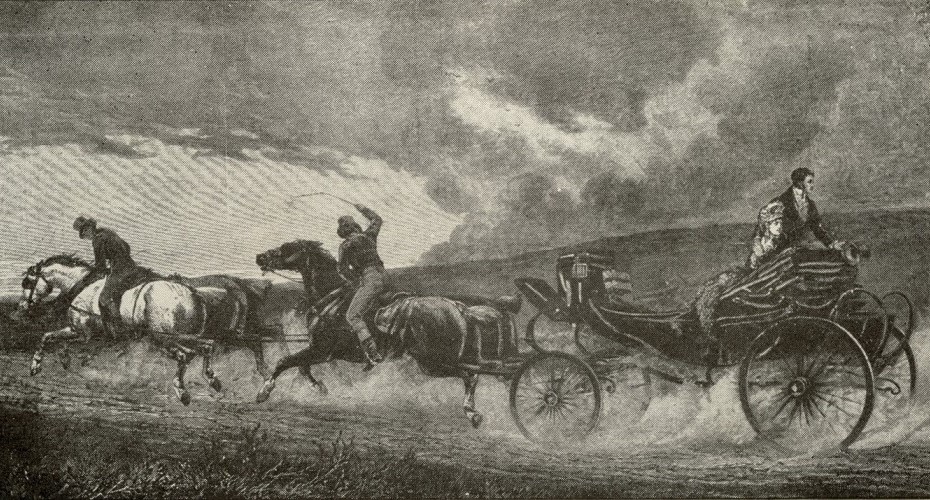
So assisted by his brother William, Wakefield devised a calculated plan. He would elope with Ellen, expecting that her parents would eventually relent and respond as his first wife’s parents had. Wakefield sent a carriage to Ellen’s Liverpool boarding school, with a message to the headmistress stating that Ellen’s mother was dying, and wished to see her daughter one last time. Ellen was taken to a Manchester hotel, where Wakefield told her that her father had suffered a severe financial disaster.
A Convoluted Scheme

Wakefield variously claimed that Ellen’s father had been ruined and was on the run from creditors, or had been arrested. He convinced her that only by marrying him could she help preserve her family’s honor and security. Her father, per Wakefield, had consented to the marriage. Isolated from her family and surrounded by adults manipulating her, the teenager was taken to Scotland. At the time, Scottish marriage law was far more permissive than English law. As such, it was the preferred destination of elopers.
A simple declaration before witnesses was enough to constitute a valid marriage, and parental consent was not required. In Gretna Green, famous for elopements, Wakefield and Ellen Turner were married by a blacksmith in 1826. However, things did not go as Wakefield had hoped they would after the marriage. Ellen eventually asked to see her father, and Wakefield promised to make it happen, but the meetings always fell through. He convinced her that her father had gone to France, and wanted his daughter and her husband to follow him.
The Shrigley Abduction Falls Apart

In the meantime, Edward Gibbon Wakefield had written Ellen’s father, to let Mr. Turner know that he now had a son-in-law. He was disappointed in his expectation that Mr. Turner would react like his first wife’s father. Instead, Ellen’s father, who also happened to be High Sheriff of Cheshire, launched an intensive search. He also called in favors from the British Foreign Office to help with what became known as the Shrigley abduction. The Foreign Office obliged, and sent a lawyer and a policeman to France. There, they found Wakefield and Ellen in a Calais hotel, and the girl was returned to her father.
The marriage was annulled by a special Act of Parliament, which declared it invalid on grounds of fraud and coercion. As to Wakefield and his brother, they were arrested and tried for the Shrigley abduction. The trial attracted enormous public attention. The prosecution portrayed Wakefield as a calculating predator who had exploited a minor for her fortune. The defense argued that Ellen had consented, but neither the court nor public opinion were persuaded. Wakefield was convicted in 1827, and sentenced to three years’ imprisonment in Newgate Prison.
Edward Gibbon Wakefield Reinvented Himself as a Colonial Reformer

The Shrigley abduction scandal was a devastating blow to Wakefield. Victorian society, even before the Victorian era formally began, was deeply concerned with female virtue and family honor. The image of a grown man manipulating a schoolgirl heiress for financial gain was shocking. Ellen Turner, meanwhile, became a figure of public sympathy. After the annulment, she resumed her maiden name. She later married Edward Stanley, with whom she lived a comparatively quiet life. The episode remained a dark but closed chapter for her, though the public scrutiny must have been traumatic.
For Edward Gibbon Wakefield, prison became a turning point. While incarcerated, he turned his attention to theories of systematic colonization. He developed ideas about planned settlement, land pricing, and social structure in new colonies. He argued that colonial land should be sold at a “sufficient price” rather than given away freely. The proceeds were to then be used to fund the migration of laborers. He argued that would prevent the social disorganization that plagued earlier colonial ventures, and replicate a balanced British society overseas.
Significance of the Shrigley Abduction

Edward Gibbon Wakefield gradually reentered public life after his release. However, he could never entirely escape the stain of the Shrigley abduction. Nonetheless, he became a central figure in British colonial policy debates despite his past. He was influential in the founding of South Australia. Later, he played a key role in New Zealand’s colonization through the New Zealand Company. His ideas shaped patterns of land settlement and migration in the British Empire. However, critics argued that his schemes often benefited investors more than settlers or Indigenous peoples.
The contrast between Wakefield’s later career and his earlier crime is striking. On one hand, he was a disgraced abductor who manipulated a teenage girl for money. On the other, he was an innovative, if controversial, thinker whose colonial theories had lasting global consequences. Wakefield’s personal scandal did not prevent him from exerting influence in political and intellectual circles. It was a testament both to his abilities, and to the complexities of nineteenth-century British society. The story of Edward Gibbon Wakefield and Ellen Turner thus reveals much about power, gender, and class in their era. For Turner, the Shrigley abduction was an ordeal survived. For Wakefield, it was a disgrace that became the unlikely prelude to a second career on the imperial stage.

_________________
Some Sources & Further Reading
Ashby, Abby, and Jones, Audrey – The Shrigley Abduction (2005)
Atkinson, Kate M. – Abduction: The Story of Ellen Turner (2002)
History Halls – ‘England’s Worst Husband’
Latest Articles
- The Johnstown Flood – Thousands Perished When A Dam Collapsed After Gilded Age Tycoons Modified it for their Private Resort
- The Jacquerie: The Medieval Peasant Uprising That Terrified France’s Aristocrats
- Things That Weren’t Thought Through: WWII’s Sticky Bomb Stuck to Users’ Hands Once Activated
- German Tanks of World War II – The Panzer 38(t), a Czech Tank in German Service
- Nicholas Alkemade: The WWII Airman Who Survived an 18,000 Foot Fall From a Bomber Without a Parachute

