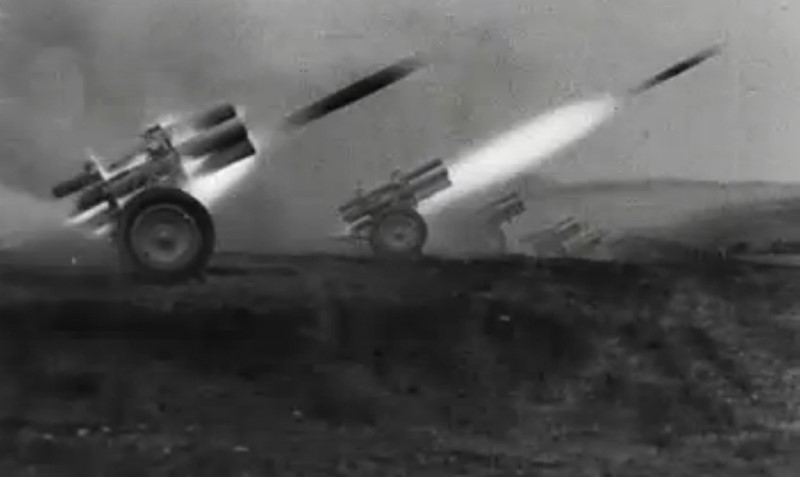
The 15 cm Nebelwerfer 41 was one of the most distinctive and feared German weapons of World War II. It combined psychological terror with devastating area firepower. Though often described as a rocket launcher, the Nebelwerfer was originally developed for a far different role: chemical warfare. It evolved, however, to become a key component of German artillery on multiple fronts.
Chemical Warfare Origins

The word Nebelwerfer translates roughly to “smoke thrower”. In the 1930s, the German Army sought a weapon that could deliver smoke screens and chemical agents in large volumes. That responsibility fell to the Nebeltruppen, specialized units trained in chemical warfare. By the time war broke out in 1939, Germany had largely abandoned plans to use poison gas offensively. The effort had been wasted, though: the launchers designed for that purpose proved ideal for firing high-explosive rockets instead. The result was the 15 cm Nebelwerfer 41, which entered service in 1940.
The Nebelwerfer 41 consisted of six tubular launchers arranged in a circular frame. It was mounted on a two-wheeled carriage similar to that of the 3.7 cm Pak 36 anti-tank gun. Each tube fired a 150 mm rocket, officially designated the 15 cm Wurfgranate 41. The launcher could be towed by a truck, half-track, or even horses. That made it relatively mobile compared to conventional heavy artillery. Once emplaced, it could unleash all six rockets in a rapid ripple fire, usually within ten seconds. The rockets were fin-stabilized and powered by solid fuel. The exhaust was vented through angled nozzles around the rocket’s base. That angled nozzles made the rockets spin in flight, which improved stability. It also produced an unexpected but useful side benefit: a distinctive shrieking sound that terrified enemy troops.
“The Screaming Mimi”

The moaning howl of incoming 15 cm Nebelwerfer 41 rockets was often the first warning of an imminent strike. Allied troops quickly dubbed the weapon the “Screaming Mimi” or “Moaning Minnie”. The psychological impact of that terrifying sound was significant, and frequently caused panic even before the rockets landed. In terms of performance, the Nebelwerfer 41 had a maximum range of about 6,900 meters (roughly 4.3 miles). Its accuracy was inferior to that of traditional artillery, as rockets were more susceptible to wind and manufacturing inconsistencies. However, that was offset by its ability to saturate a target area with explosive force in a very short time.
A full salvo could blanket a wide zone with shrapnel and blast effects. That made it particularly effective against infantry concentrations, supply areas, and defensive positions. Tactically, Nebelwerfer units were used as area-denial and shock weaponsm rather than precision tools. They were often deployed just behind the front lines and fired in massed salvos to support infantry assaults or disrupt enemy preparations. After firing, crews were trained to rapidly relocate. The thick smoke trails left by the rockets made launch positions easy to spot, inviting counter-battery fire. Survival of the Nebeltruppen thus depended on speed, coordination, and concealment.
Impact and Legacy of the 15 cm Nebelwerfer 41

The 15 cm Nebelwerfer 41 saw extensive service on the Eastern Front. There, its ability to devastate Soviet troop formations proved valuable, especially during large-scale operations in 1941 and 1942. It was also widely used in North Africa, Italy, and Western Europe, including during the Normandy campaign. Its success led to the development of a bigger sibling, the 21 cm Nebelwerfer 42, that launched a bigger, 210 mm (8.1 inch) rocket. In urban and defensive fighting, the Nebelwerfer’s limitations became more apparent, as the minimum safe distance and lack of pinpoint accuracy reduced its usefulness in close combat situations. Despite those drawbacks, the Nebelwerfer 41 influenced postwar military thinking. Its effectiveness demonstrated the potential of rocket artillery as a complement to conventional guns.
Both the Soviet Union and the Western Allies expanded their own rocket artillery programs during and after the war. That eventually led to the development of modern multiple launch rocket systems. By the end of WWII, the 15 cm Nebelwerfer 41 had become an iconic symbol of German rocket artillery. It never replaced traditional artillery. However, it filled a unique niche, and delivered sudden, terrifying barrages that could break up enemy formations and sap morale. Its legacy lies not only in its battlefield impact, but also in how it helped shape the future development of indirect-fire weapons in the modern era.

_________________
Some Sources & Further Reading
Bull, Stephen – Encyclopedia of Military Technology and Innovation (2004)
Engelmann, Joachim – German Rocket Launchers in WWII (1990)
History Halls – The Stug III: The Formidable WWII Assault Gun Turned Tank Destroyer
Latest Articles
- The Johnstown Flood – Thousands Perished When A Dam Collapsed After Gilded Age Tycoons Modified it for their Private Resort
- The Jacquerie: The Medieval Peasant Uprising That Terrified France’s Aristocrats
- Things That Weren’t Thought Through: WWII’s Sticky Bomb Stuck to Users’ Hands Once Activated
- German Tanks of World War II – The Panzer 38(t), a Czech Tank in German Service
- Nicholas Alkemade: The WWII Airman Who Survived an 18,000 Foot Fall From a Bomber Without a Parachute

