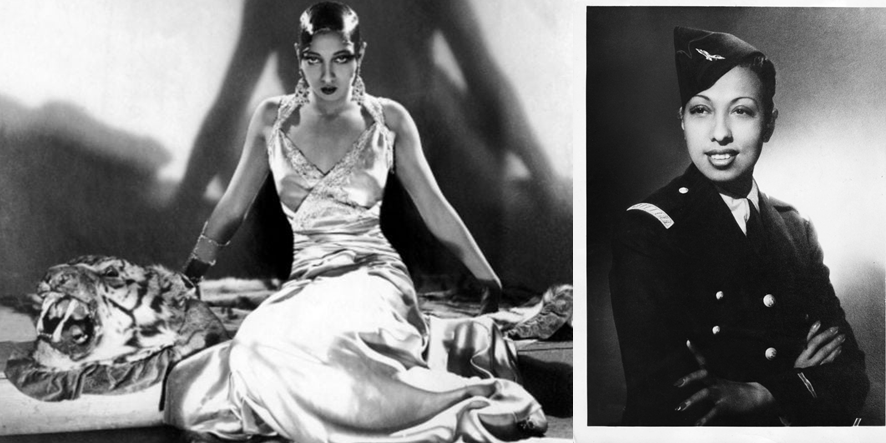
Josephine Baker is mostly remembered as an electrifying entertainer – an American-born dancer and singer who became an interwar Paris sensation. In World War II, however, she lived a parallel life as an intelligence operative, courier, and French Resistance propagandist. Baker had moved to Europe seeking opportunities racism had denied her in the US, and made France her home. When her adopted home was conquered by the by the Nazis, she joined the French Resistance. Her wartime service was not a brief celebrity gesture. It was a sustained and often dangerous commitment that put her fame, freedom, and life at risk. Baker’s role in WWII illustrates how cultural capital could be transformed into a powerful weapon, and how a woman known for glamour and spectacle could become a serious actor in the clandestine struggle against fascism.
Josephine Baker Came to See France as Her Adoptive Home

Born Freda Josephine McDonald in St. Louis, Missouri, in 1906, Baker grew up in poverty. She experienced racial violence firsthand, including the 1917 East St. Louis riots. Those early experiences shaped her worldview, and made her deeply hostile to racism and authoritarianism. Baker discovered a talent for entertainment at an early age, and achieved success as a performer. However, 1920s America was not that hospitable to Blacks seeking to realize their full potential. Tired of the racism glass ceiling that capped her career prospects, Baker decided to bet on herself.
She left America in search of greener pastures abroad, and moved to France, where her career flourished. Paris embraced her, and by the 1930s she was one of the most famous women in Europe. France offered Baker something America had not: widespread admiration, personal freedom, and a sense of belonging. She came to regard France not merely as a host country, but as her adoptive home. When Germany invaded Poland in 1939 and France declared war, Baker was at the height of her fame.

Rather than flee Europe or retreat into safety, Baker volunteered her services to French military intelligence. French officials were initially hesitant. She was a celebrity, highly visible and seemingly ill-suited to secret work. But intelligence officers soon recognized her unique value. Baker’s fame granted her access to elite social circles across Europe. Diplomats, military officers, and collaborators spoke freely in her presence, assuming she was apolitical or simply an entertainer. That kind of access made her an ideal intelligence asset.
Smuggling Secrets in Music Sheets

Josephine Baker was recruited by the Deuxieme Bureau, French military intelligence. She later worked with Free French intelligence networks loyal to Charles de Gaulle. Baker had initially expressed support for the Italian invasion of Ethiopia in the 1930s. So when the Axis defeated and occupied France in 1940, they assumed that she was friendly to their cause. She was not. Her role against them was not that of a spy in the cinematic sense: she did not carry weapons or commit sabotage.
Instead, Baker gathered information, transmitted secrets, and served as a courier between resistance cells and Allied contacts. Her performances and social engagements provided perfect cover, and her fame opened doors. Rubbing shoulders with high ranking Axis personnel, she charmed officials she met in social gatherings to collect information. At embassies, parties, and nightclubs, she listened carefully to conversations about troop movements, airfields, fuel supplies, and political intentions. She had an extraordinary memory, and could retain details without taking notes – critical in espionage.

Baker used her sheet music to facilitate her espionage. Intelligence information was written in invisible ink between the lines of musical scores or hidden in the margins. To anyone inspecting her luggage, they were simply the materials of a touring entertainer. Baker traveled extensively in Europe and North Africa in the war’s early years carrying such documents across borders. Her celebrity status often exempted her from thorough searches, as guards were reluctant to subject her to invasive inspections. In that way, Baker moved intelligence that would otherwise have been extremely difficult to transport.
Poor Health Complicated Baker’s Espionage

Things grew perilous for Josephine Baker after France fell in 1940. Paris was occupied by German forces, and many resistance members were arrested or executed. Baker relocated to her chateau, Les Milandes, in the Dordogne region. It became a refuge for resistance fighters, refugees, and others fleeing the occupation. There, she continued her intelligence work while maintaining the appearance of a wealthy, somewhat eccentric celebrity living a private life. In reality, her estate functioned as a node in resistance networks, sheltering people and facilitating communication.
Baker’s health deteriorated during the war, adding another layer of danger to her activities. She suffered from a serious infection in 1941 that required multiple surgeries and long periods of convalescence. Even while gravely ill, she refused to abandon her work. At times she was so weak she could barely stand. Yet, she continued to host gatherings and maintain contacts that were useful to the resistance. Her illness also provided cover: German and Vichy authorities were less likely to suspect a bedridden entertainer of active espionage.
Josephine Baker Risked Life and Limb to Fight the Fascists

In 1941, Baker traveled to North Africa, which was under Vichy French control until the Allied landings in 1942. There, she worked to support Free French forces and Allied efforts. Later in the war, she joined the French Women’s Auxiliary Air Force, in which she was commissioned as a lieutenant. She also performed for troops, boosting morale while continuing to collect and transmit information. Her concerts were not mere entertainment. They were strategic acts that strengthened loyalty to the Free French cause, and countered Axis propaganda. Baker understood the psychological dimension of war, and used her presence and popularity to influence hearts and minds.
The risks she faced were real and severe. Had she been discovered, her fame would not have protected her. On the contrary, it might have made her execution more certain and public as a warning to others. She was fully aware of that. Baker later remarked that she had “two loves: my country and Paris”, and that she was willing to give her life for France. That was not rhetorical bravado, as the Gestapo and its French collaborators monitored artists and public figures closely. The line between tolerated celebrity and unmasked betrayer traitor could be crossed suddenly, and Nazis were not known for mercy.
Baker’s Wartime Experience Mattered Greatly to Her

The wartime service of Josephine Baker also intersected with her broader political and moral commitments. She saw the fight against Nazism as inseparable from the fight against racism that she knew all too well. Having experienced segregation and discrimination in the US, she viewed Nazi ideology as an extreme and deadly manifestation of beliefs she already despised. Her decision to risk her life for France was therefore both patriotic and ideological. It was a rejection of a world built on racial hierarchy and oppression.
Baker’s contributions were formally recognized by the French state after the war. She was awarded the Croix de Guerre with palm, one of France’s highest military honors, and was named a Chevalier of the Legion d’Honneur by General Charles de Gaulle himself. Those were not honorary awards given lightly to a celebrity: they reflected genuine service under dangerous conditions. Baker wore her uniform and medals with pride, and often appeared in public in military dress rather than stage costumes. Her wartime service mattered deeply to her.
The Fight Against Nazism Shaped Baker’s Postwar Life

Josephine Baker’s wartime service was not widely known in the immediate postwar years, particularly outside France. In the United States, for example she continued to be seen primarily as an entertainer, and her intelligence work was simply overlooked for years. That reflected a broader pattern in which the wartime contributions of women – especially women of color – were minimized or forgotten. Baker herself did not aggressively promote her espionage activities. That was partly out of discretion, and partly because she believed she had simply done her duty.
Baker’s WWII experience profoundly shaped her postwar life, and she became an outspoken advocate for civil rights and racial equality. She refused to perform for segregated audiences in the US, and used her fame to challenge discriminatory practices. She also adopted children from different ethnic and religious backgrounds, creating what she called her “Rainbow Tribe”. It was a living demonstration of her belief in human unity. While those actions belong to the postwar period, they were informed by her wartime experiences and her conviction that tolerance and solidarity were necessary to prevent future catastrophes.
Josephine Baker Walked the Walk at the Moment of Truth

Josephine Baker’s role in World War II complicates and enriches our understanding of resistance and espionage. She was neither a soldier in the conventional sense, nor a spy who fit the archetype of secrecy and anonymity. Instead, she weaponized visibility, charm, and celebrity. Her life demonstrates that resistance took many forms, and that cultural figures could play crucial roles in intelligence and morale-building. Baker’s story also challenges assumptions about who participates in war and how. It shows that courage and patriotism are not confined to battlefields.
Upon her death in 1975, Josephine Baker became the first American woman buried with military honors in France, including a twenty one gun salute. In recent years, her wartime service has gained renewed recognition. In 2021, she became the first Black woman to be honored in France’s Pantheon, a mausoleum reserved for the nation’s most revered figures. The citation explicitly acknowledged her role in the French Resistance during WWII. It cemented her place not only in culture, but in the military and political history of the war.

Baker’s WWII story is ultimately one of transformation and resolve. A woman who escaped poverty and racism through performance chose, at the moment of greatest danger, to risk everything for the ideals of freedom and equality. Her courage lay not only in defying the Nazis, but in redefining what it meant to serve. In doing so, Josephine Baker left a legacy that extends far beyond the stage. It reminds us that in the fight against tyranny, unexpected heroes often play key roles. At the moment of truth, Baker walked the walk and put her life on the line to fight the fascists.

_________________
Some Sources & Further Reading
History Halls – Phyllis Latour: The WWII SOE Agent Who Posed as a Teenager in Nazi-Occupied France
Jones, Sherry – Josephine Baker’s Last Dance (2018)
Rose, Phyllis – Jazz Cleopatra: Josephine Baker in Her Time (1989)
Latest Articles
- Edward England, the Humane Pirate Captain Deposed by His Men for Being Too Nice
- American Presidents: Abraham Lincoln, Hall of Fame Wrestler
- Henry Jennings: The Privateer-Turned-Pirate Who Set the Stage for the Caribbean’s Golden Age of Piracy
- Fighting Women: Tomoe Gozen, the Fearsome Female Samurai
- From the NFL to the Sands of Iwo Jima: Medal of Honor Recipient Jack Lummus

