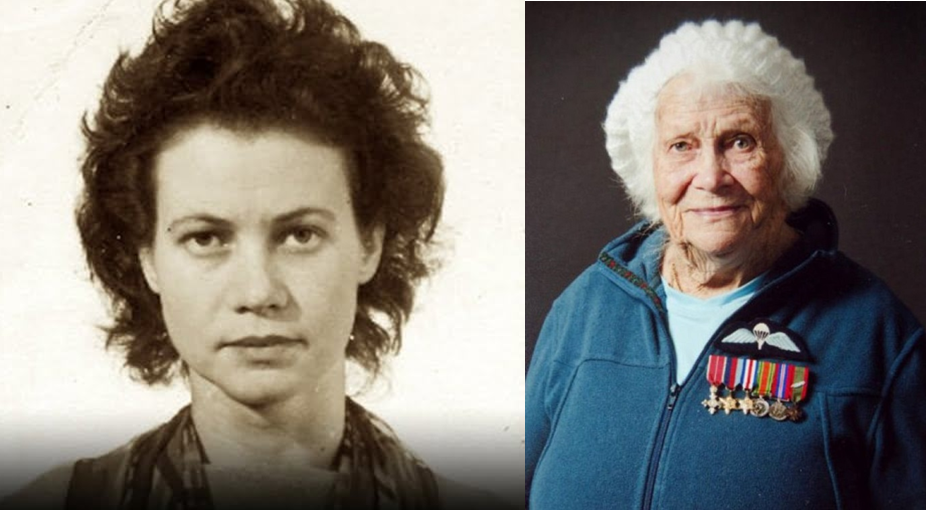
Phyllis “Pippa” Latour Doyle was one of World War II’s most remarkable female agents. As a young woman, her courage and ingenuity helped gather vital intelligence during the critical months leading up to D-Day. She risked torture and death on a daily basis behind enemy lines to help free Europe from Nazi tyranny. Hers was a story of tragedy, determination, and a fierce sense of justice.
Phyllis Latour’s Quest for Justice

Phyllis Latour was born on April 8th, 1921, in Durban, South Africa, to a French mother and a British father. Her father, a doctor, was killed while working in the Congo when she was a child. Her mother remarried, but Latour’s relationship with her stepfather was strained. She was eventually sent to live in Kenya with relatives, and later educated in England. That diverse upbringing made her fluent in both French and English – invaluable for her future work as a secret agent. From a young age, she displayed intelligence, independence, and a sense of adventure.
Latour was athletic, fond of riding and outdoor activities, and had a talent for mechanical and technical work. When WWII broke out in 1939, she was just eighteen, but determined to contribute to the war effort. Latour’s decision to join the fight against Nazi Germany was deeply personal. A close family friend was captured and executed by the Germans early in the war. The cruelty of his death had a profound impact on her, and strengthened her resolve to fight. As she later recalled, she wanted revenge – not for herself, but for the countless victims of Nazi occupation.
Taking on the SOE’s Most Dangerous Task

Initially, Phyllis Latour enlisted in the Women’s Auxiliary Air Force (WAAF) in 1941. Her intelligence and linguistic skills soon attracted the attention of Britain’s Special Operations Executive (SOE). A secret organization, the SOE was established by Winston Churchill to “set Europe ablaze” through sabotage, subversion, and espionage. Latour was selected for one of the most dangerous jobs in wartime Europe: an undercover wireless operator in Nazi-occupied France. Wireless transmissions were crucial for communication between local resistance groups and London. However, wireless operator was among the SOE’s most perilous roles.
The Germans had sophisticated direction-finding equipment that could locate a transmitter in minutes. As a result, the average life expectancy of an SOE radio operator in France was only about six weeks. Latour’s training was grueling. She learned how to use and repair wireless radios, code and decode messages with cipher keys, handle firearms and explosives, and practice self-defense. She also received extensive clandestine operations training – how to assume false identities, blend into crowds, and survive interrogations if captured. Despite her youth and small stature – barely five feet tall – she impressed her instructors with her calm composure and resourcefulness.
Posing as a Teenage Girl in Nazi-Occupied France

Phyllis Latour trained for months in the harsh Scottish highlands. In addition to tapping code until her fingers bled, she was taught hand-to-hand combat, how to use a variety of weapons, how to kill silently, how to resist torture if captured, and one instructor, a former burglar, taught her to scale walls, move through darkness like smoke, and disappear when she needed to. In May, 1944, only weeks before D-Day, Latour parachuted into occupied France. She was dropped into Normandy’s Orne region under the codename Genevieve. Her small size and youthful appearance allowed her to pose as a teenage French girl displaced by the war.
Latour’s key task was to transmit coded messages about German troop movements and military installations to SOE headquarters in London. She was also to assist the French Resistance however she could. To conceal her true identity, Latour used the cover story of an apprentice seamstress. She carried her radio equipment – crucial but bulky and dangerous – in a bicycle basket, hidden beneath sewing materials. To avoid suspicion, she moved constantly from one safe house to another. She also often transmitted her messages from remote barns, attics, or abandoned buildings.
The Struggle to Stay One Step Ahead of the Gestapo

Phyllis Latour developed clever ways to conceal her work. She knitted, and encoded messages in knitting patterns: each stitch and row represented letters and numbers corresponding to military information. That allowed her to appear as a harmless girl knitting a sweater while actually preparing vital intelligence for the Allies. Over the course of several months, she sent over 135 coded messages to London. Her work helped coordinate the French Resistance’s efforts, and prepare the ground for the D-Day landings on June 6th, 1944.
Operating behind enemy lines was a constant game of survival. The Gestapo was ruthless in its hunt for Allied agents, and many of Latour’s colleagues in the SOE were captured, tortured, and executed. Wireless transmissions were especially risky because German detection vans could triangulate a signal’s source within twenty minutes. Latour minimized her transmissions to a few minutes each time. and changed locations frequently. She sometimes had to run or cycle for miles in the dark to avoid capture. She recalled later that she was often terrified, but never lost focus.
An Ability to Improvise

Latour’s greatest weapons were her wits and her ability to appear inconspicuous. Once, she narrowly escaped arrest after a suspicious German officer stopped her for questioning. She pretended to be an innocent village girl, and smiled and flirted long enough to convince him she was harmless. He even asked her out and set up a date. She stood him up. Latour’s ability to improvise under pressure saved her life more than once. When Allied forces advanced through France in the summer of 1944, her work became even more crucial.
Latour relayed updated information on German retreats, bridge demolitions, and roadblocks, which Allied troops navigate occupied areas more safely. After the liberation of Normandy, she continued to work in the field until late 1944, when she was finally recalled to London. After the war, she resumed a quiet civilian life. She married an engineer named Patrick Doyle, and moved to New Zealand, where she raised a family. Like many SOE veterans, she rarely spoke about her wartime experiences. The secrecy surrounding SOE operations meant that much of her heroism remained unknown to the public until years later.
A Symbol of Quiet Courage

Phyllis Latour Doyle’s extraordinary service was eventually recognized by both Britain and France. She was awarded the Member of the Order of the British Empire (MBE), and the French Croix de Guerre for her bravery. Latour’s story resurfaced in the 2000s, as historians and journalists began to highlight women’s overlooked role in wartime intelligence. In 2014, the French government honored then-ninety-three-year-old Latour with the Legion d’Honneur, France’s highest decoration. It was further acknowledgement of her immense contribution to the liberation of France.
Latour lived to the ripe old age of 102, before she passed away in 2023. She became a symbol of the quiet courage of those who risked everything for freedom. She was among a remarkable generation of women agents who served in the SOE, alongside figures like Violette Szabo, Noor Inayat Khan, and Odette Sansom, who operated in the shadows. They performed acts of extraordinary bravery in an era when women were still fighting for recognition in military service. Their missions often meant certain death if caught, yet they persevered with remarkable resolve.
The Legacy of Phyllis Latour

Like most of the Silent Generation’s heroes and heroines, Latour never sought fame or glory. She once said that she joined because she simeply believed that “it was the right thing to do”. Her humility and resilience encapsulate the spirit of countless unsung heroes who worked behind the scenes to defeat the Nazis. Latour’s story is a testament to courage under unimaginable pressure. As a young woman parachuted behind the lines in enemy territory, she displayed exceptional bravery, intelligence, and resourcefulness.
Her coded messages helped pave the way for the liberation of France and the eventual defeat of Nazi Germany. She lived much of her life in quiet anonymity. However, her legacy endures as part of the broader history of the women and men who fought in the shadows. In remembering Phyllis Latour, we honor more than just a single spy. We remember an entire generation that risked it all for freedom and to defeat fascism. Her courage remains a shining example of how determination and ingenuity can triumph even in the darkest of times.

_________________
Some Sources & Further Reading
History Halls – Fighting Women: Vitka Kempner, the Inspirational WWII Jewish Partisan Leader
Latour, Pippa – The Last Secret Agent (2024)
Liane, Jones – A Quiet Courage: Women Agents in the French Resistance (1990)

