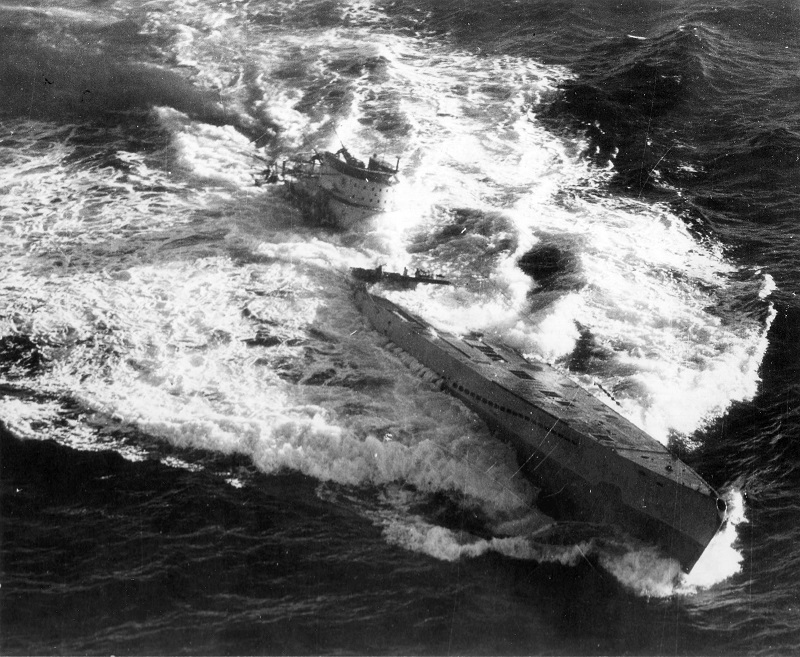
Amid the darkest days of the Battle of the Atlantic in December, 1941, a convoy codenamed HG 76 became a pivotal event in the struggle between Britain and German U-boats. The engagement that surrounded this convoy marked one of the first decisive Allied victories at sea in World War II. It demonstrated the growing effectiveness of coordinated air and naval defense against the deadly U-boat wolfpacks that had long terrorized the Atlantic shipping lanes.
The U-boat Peril

By late 1941, the Battle of the Atlantic had been raging for over two years. Germany’s U-boat fleet under Admiral Karl Donitz sought to strangle Britain by cutting off its supply lines. Merchant convoys carrying food, raw materials, and military goods were prime targets, and losses were mounting. The Royal Navy and Royal Air Force Coastal Command struggled to provide sufficient escorts and air cover across the ocean. The threat was serious, and had Donitz succeeded, Britain would have been starved into submission. As Winston Churchill wrote in his WWII memoirs: “The only thing that ever really frightened me during the war was the U-boat peril”.
HG convoys, short for “Homeward from Gibraltar”, were among the most vulnerable. They sailed from Gibraltar, at the southern edge of the Iberian Peninsula, to British ports. Through agents in neutral Spain who could easily spot them, the Germans always knew when convoys left Gibraltar. That usually gave them time to prepare an interception. HG convoys also passed through the “air gap,” a vast mid-Atlantic region beyond the reach of Allied land-based aircraft, but within reach of long-range German reconnaissance and bomber aircraft, and in which U-boats could attack safe from aerial interference. Convoy HG 76 departed Gibraltar on December 14th, 1941, just as the Allies were implementing implement new anti-submarine measures and tactics. That set the stage for a dramatic confrontation.
Convoy HG 76 Sets Sail

Convoy HG 76 consisted of 32 merchant ships that carried essential cargoes from North Africa and the Mediterranean to Britain. The convoy’s protection reflected a new level of Allied preparedness. It was protected by 36th Escort Group, commanded by Commander Frederic John Walker, one of the Royal Navy’s most brilliant and aggressive anti-submarine officers. The escorts included the sloop HMS Stork, Walker’s flagship; the corvettes HMS Bluebell, Gardenia, Pentstemon, Rhododendron, Samphire, and Vetch; the destroyers HMS Blankney and Stanley; and the escort carrier HMS Audacity.
The Royal Navy’s first operational escort carrier, Audacity had been converted from a captured German merchant ship. She carried a small complement of Grumman Martlet – the British name for the American F4F Wildcat – fighters to provide air cover against long-range German reconnaissance aircraft. When possible, the Martlets were also to spot and attack U-boats. That combination of surface and embedded air protection was a new defensive measure being tried out for the first time. It would prove decisive. The German Navy was well aware of the convoy’s sailing. Reconnaissance aircraft from Luftwaffe Focke-Wulf Fw 200 Condor squadrons based in France shadowed HG 76 as it moved north from Gibraltar.
Fighting Through a Wolf Pack

Donitz dispatched a U-boat wolf pack designated Seerauber (“Pirate”) to intercept Convoy HG 76. Among them were U-127, U-131, U-434, U-574, and U-751, which operated from bases along the French Atlantic coast. The stage was set for one of the fiercest convoy battles of the early war. On December 17th, 1941, as HG 76 passed west of the Portuguese coast, HMS Stanley detected U-131 on radar. Audacity’s Martlet fighters swooped in, and forced the submarine to dive. The escorts then converged and dropped depth charges that forced U-131 to the surface, where it was shelled and sunk.
The engagement’s first U-boat kill boosted morale both in the convoy and back home in the Admiralty. The following day, another submarine, U-434, attempted an attack, but was detected and destroyed by HMS Blankney and HMS Stanley after a fierce depth-charge assault. However, the victory came at a cost. On December 19th, U-574 torpedoed and sank HMS Stanley, killing 136 of her crew. HMS Stork swiftly counterattacked, rammed, and sank U-574. The battle raged on for several more days, during which both sides continued to trade blows.
The Pioneering Use of an Escort Carrier to Protect Convoy HG 76

The coordination between escorts and HMS Audacity’s aircraft proved invaluable. The carrier’s Martlets repeatedly drove off Condor bombers, and prevented them from shadowing the convoy and guiding in further U-boats. Audacy’s presence revolutionized the struggle over convoy protection. Before escort carriers, convoys were entirely dependent on surface ships for protection. Audacity’s greatly increased the convoy protectors’ capabilities. They now had aircraft that could range far ahead, scout for U-boats and attack them when possible. Audacity’s commander, Captain D. W. MacKendrick, used his small force of Martlets to patrol continuously. During the running battle, the Germans would lose three Condors, with others driven off. That greatly reduced the Germans’ ability to track the convoy. Without aerial spotting, the U-boats found it difficult to coordinate attacks effectively.
Audacity’s pilots, including Sub-Lieutenant Eric “Winkle” Brown – who would later become a famous test pilot – demonstrated that even a small carrier could make a huge difference. Their success in defending Convoy HG 76 was a turning point in Allied anti-submarine warfare. Despite her successes, HMS Audacity herself became a target. On the night of December 21 – 22, the carrier’s commander took her out of the convoy in a misguided bit of chivalry. Aware that she was the most tempting U-boat target, he wanted to reduce the risk to nearby ships from torpedoes intended for Audacity. So he took the carrier ten miles away from the convoy. As HG 76 approached the Bay of Biscay, U-751, commanded by Kapitanleutnant Gerhard Bigalk, tracked down the unprotected carrier, and launched his torpedoes. Audacity was struck three times, and sank.
An Impressive Victory

The loss of HMS Audacity was deeply felt, as she had been instrumental in protecting Convoy HG 76. However, her contribution before she sank had made a huge difference. The convoy itself remained largely intact, and the lessons learned from Audacity’s performance influenced the design and deployment of future escort carriers. When HG 76 reached Liverpool on December 23rd, 1941, 27 of its 32 ships had survived the perilous journey. The convoy’s escorts had destroyed five U-boats – U-127, U-131, U-434, U-567, and U574. Only three were known to the Admiralty at the time, which still considered that a huge and unprecedented success. It was only after the war that the British learned that the Germans had actually lost five U-boats. That made the victory that much more impressive.
Such successes against German submarines were unprecedented. In contrast, the Allies lost only two escorts, Stanley and Audacity, and two merchant vessels. For the first time in the war, the balance of losses in a major convoy battle favored the Allies. That was a severe blow to the Kriegsmarine’s morale, and a powerful validation of new Allied tactics pioneered by Commander Frederic John Walker, in charge of the escorts. Convoy HG 76 marked the beginning of a new phase in the Battle of the Atlantic.
Lessons Learned

Several key lessons were learned from the running battle to protect Convoy HG 76. An integrated air-sea defense had been vital to the Allied success. The use of HMS Audacity demonstrated the effectiveness and lethality of combining air and naval assets in convoy protection. Escort carriers became a standard feature in later Atlantic convoys, extending air cover deep into the mid-ocean. Leadership and aggression made a huge difference. Commander Walker’s tactics emphasized relentless pursuit and coordination. His aggressive approach to hunt U-boats rather than merely react defensively set a new standard.
Walker went on to become Britain’s greatest anti-submarine commander. Technological advancements had also helped turn the tide. Radar and High-Frequency Direction Finding (HF/DF, or “Huff-Duff”) were crucial in detecting U-boats and coordinating attacks. HG 76 proved these technologies could be decisive when used aggressively. The battle also had a significant psychological impact, as its outcome shattered the perception of the German submarines’ invincibility. U-boat crews, who had previously operated with near impunity, now faced an increasingly dangerous foe. Donitz himself later admitted that HG 76 was “a defeat of the first order”.
The Significance and Legacy of Convoy HG 76

The victory of Convoy HG 76 was more than a tactical success: it marked a strategic turning point. While the Battle of the Atlantic would continue until 1945, the innovations tested during HG 76’s voyage laid the foundation for eventual Allied supremacy at sea. In the months that followed, escort carriers proliferated, air coverage expanded, and escort groups like Walker’s became the backbone of the Royal Navy’s anti-submarine warfare effort. The combination of improved technology, leadership, and doctrine first proven in this convoy, eventually turned the tide against the U-boats.
Convoy HG 76 stands as a landmark in naval history – a story of innovation, courage, and adaptation under fire. What began as another perilous crossing from Gibraltar ended as a decisive demonstration that the U-boat threat could be beaten. Through the determination of Commander Frederic John Walker, the pioneering use of HMS Audacity, and the bravery of sailors and airmen alike, HG 76 showed that with the right tools and tactics, even the darkest depths of the Atlantic could be made safe once more. It was, in every sense, a victory that signaled the beginning of the end for Germany’s submarine menace.

_________________
Some Sources & Further Reading
Blair, Clay – Hitler’s U-Boat War: The Hunters, 1939-1942 (2000)
Blair, Clay – Hitler’s U-Boat War: The Hunted, 1942-1945 (2000)
Burn, Alan – The Fighting Captain (2022)
Konstam, Angus – The Convoy: HG 76, Taking the Fight to Hitler’s U-Boats (2023)
Robertson, Terence – Walker, RN: The Story of Captain Frederick John Walker (1956)
If you liked this article, you will like Flower Class Corvettes: The Unglamorous Ships That Averted Allied Defeat in WWII

