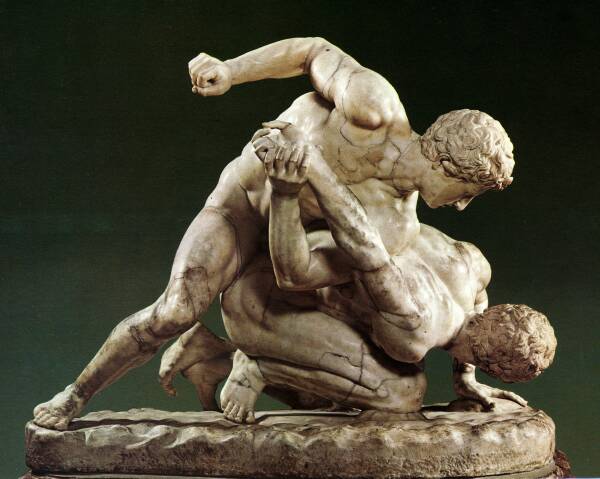
Arrhichion of Phigalia is one of the most striking figures in the history of ancient Greek sport. He is remembered not only for his victories, but also for the extraordinary manner of his death. It occurred during the ancient Olympic Games, where athletics, religion, and ideas of honor were tightly bound together. His demise became a powerful symbol of the Greek ideal that glory and victory could transcend even life itself.
The Ancient Ancestor of MMA

Arrhichion was a citizen of Phigalia, a city in Arcadia in the central Peloponnese. Little is known about his early life, but by the 570s to 560s BC, he had become a celebrated athlete. He competed in pankration, one of the most demanding and dangerous events in the Olympic Games. Pankration was a brutal combination of boxing and wrestling, with very few rules. Strikes, throws, joint locks, and chokeholds were all permitted. Only biting, eye-gouging, and attacking an opponent’s genitals were forbidden. Victory came when an opponent submitted or was rendered incapable of continuing. Serious injury and death were accepted risks. Pankration is considered the ancestor of modern Mixed Martial Arts (MMA).
Arrhichion was champion of that sport in the 572 BC and 568 BC Olympiads. He again competed in the 564 BC Olympics, seeking a third consecutive championship. Such an achievement would secure his reputation among the greatest athletes of his age. The Olympics were not merely sporting contests, but sacred games held in honor of Zeus. Repeated victories brought immense prestige not only to the athlete, but to his home city as well. Arrhichion reached pankration’s final bout, where he faced an unnamed opponent. By then, age might have been catching up with him, because as seen below, he soon got in trouble.
“Victory or Death”? No: Victory and Death

In the title bout, Arrhichion of Phigalia was caught in a powerful hold. His opponent locked his legs around Arrhichion’s body and applied a choke, compressing his neck and cutting off his breath. According to the ancient writer Pausanias, Arrhichion was clearly in grave danger. The hold was so tight that he began to lose consciousness, and his body showed signs of suffocation. In that moment, Arrhichion made a desperate and decisive move. Feigning loss of consciousness, he tricked his opponent into relaxing a little. When he did, the wily title holder snapped back into action, and snapped his opponent’s ankle while shaking and throwing him off with a convulsive heave. The sudden excruciating pain induced his opponent into the Ancient Greek equivalent of tapping out. He promptly made the sign of submission to the referees.
Almost simultaneously, Arrhichion’s body went limp. In throwing off his opponent while the latter still had him in a powerful chokehold, he ended up with a broken neck. When the dust settled, the judges faced an unprecedented situation. One athlete was alive but had conceded defeat, while the other was dead but technically victorious. They ruled in favor of Arrhichion as his opponent had submitted first. Arrhichion was declared the winner, even though he had died in the act of winning. It was perhaps the only time in Olympics history that a corpse was crowned champion. Arrhichion thus added a wrinkle to the athletic ideal of “victory or death” by gaining victory and death.
The Legacy of Arrhichion of Phigalia

For the ancient Greeks, the fact that Arrhichion was crowned victor even though he was dead was not a contradiction. It was a profound statement about arete – the Greek concept of excellence and virtue. Arrhichion had demonstrated absolute commitment to victory, and endured death rather than accept defeat. His willingness to press on without surrender exemplified the ideal of heroic endurance celebrated in Greek culture, reminiscent of warriors who fell in battle at the moment of triumph. His death resonated deeply with later writers and philosophers. Some praised Arrhichion as the embodiment of courage and determination. Others saw in his fate a warning about the extreme demands placed on athletes.
The story was also used in moral discussions about pain, endurance, and the limits of human will. Stoic philosophers, in particular, found the tale useful as an example of resolve in the face of unbearable suffering. Arrhichion’s city honored him as a hero. Statues were erected in his memory, and his name lived on as a symbol of ultimate athletic dedication. Though pankration would continue for centuries, no other death at the Olympics achieved quite the same legendary status. Arrhichion of Phigalia remains a haunting figure: an athlete who achieved victory at the very instant life left his body.

_________________
Some Sources & Further Reading
Bleacher Report – MMA History: How Pankration Champion Arrichion Won Olympic Crown After His Death
History Halls – Zeuxis, the Ancient Greek Painter Who Laughed Himself to Death
Journal of Combative Sport, September, 2003 – Arrichion’s Last Fight: What Really Happened?
Newest Articles
- The Johnstown Flood – Thousands Perished When A Dam Collapsed After Gilded Age Tycoons Modified it for their Private Resort
- The Jacquerie: The Medieval Peasant Uprising That Terrified France’s Aristocrats
- Things That Weren’t Thought Through: WWII’s Sticky Bomb Stuck to Users’ Hands Once Activated
- German Tanks of World War II – The Panzer 38(t), a Czech Tank in German Service
- Nicholas Alkemade: The WWII Airman Who Survived an 18,000 Foot Fall From a Bomber Without a Parachute

