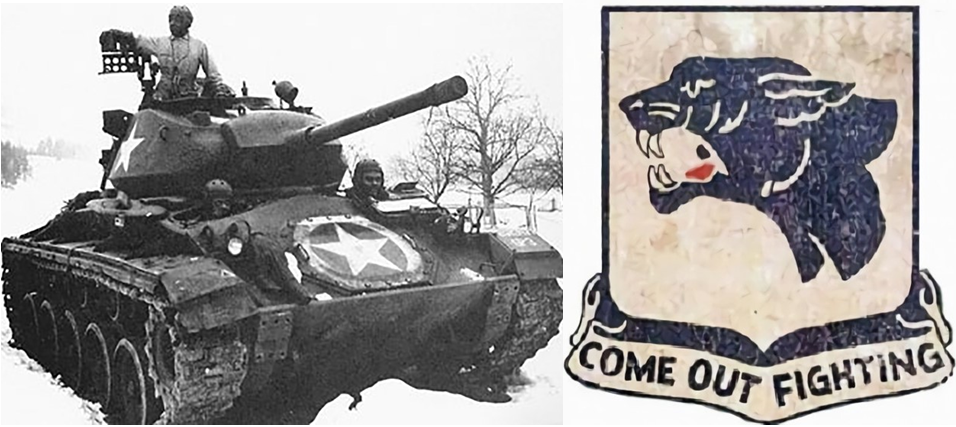
The 761st Tank Battalion occupies a singular place in the history of the United States Army and of World War II. Known as the “Black Panthers”, the battalion was the first predominantly African American armored unit to see combat in WWII. Its story is inseparable from the broader struggle against racial segregation in the United States. The men of the 761st fought two wars simultaneously, only one of which was against Nazi Germany on Europe’s battlefields. The other was against deeply entrenched racism that sought to limit their roles, deny their abilities, and erase their accomplishments. Their sacrifice left a lasting legacy that reshaped the American military and contributed to the long fight for civil rights.
The US Military’s Belief that Blacks Were Unsuited for Combat

The 761st Tank Battalion was constituted in March, 1942, and was activated the following month at Camp Claiborne, Louisiana. At the time, the US Army was strictly segregated, reflecting the racial attitudes of American society at large. African American soldiers were often relegated to labor, service, or support units. That was based on a widespread belief that they lacked the intelligence, discipline, or courage for frontline combat. Armored warfare in particular was considered a technically demanding and aggressive form of fighting. Many senior officers doubted that Black troops could perform effectively in such roles.
The creation of the 761st Tank Battalion was therefore both an experiment, and a concession to political pressure from civil rights organizations and African American leaders demanding greater opportunities for Black soldiers. From the outset, the battalion faced obstacles that went beyond ordinary military challenges. Training was prolonged and demanding, and lasted far longer than that of many white tank units. Even as they prepared to fight the Nazis overseas, they had to fight another war against vicious racism at home.
“Come Out Fighting”

The 761st Tank Battalion trained first at Camp Claiborne and later at Camp Hood, Texas. There, they learned to operate and fight in M5 Stuart light tanks. Later, they were sent to Fort Hood, Texas, for further training on M4 Sherman medium tanks and other armored vehicles. Officially, the extended training was justified as necessary preparation. In practice, it reflected Army leaders’ skepticism, and a reluctance to deploy the unit into combat. All in all, the 761st was kept in training for two years. White tank units were sent into combat with significantly less training.
In the segregated South, the men faced racist hostility from civilians and unequal treatment on and off base. The battalion’s most famous member at that time was baseball’s Jackie Robinson. During training, a white bus driver ordered him to the back of the bus, but he refused. He was arrested, but the 761’s commander refused to have him court martialed. He was transferred to another unit whose commander signed off on the necessary documents. Robinson was court martialed, but was acquitted of all charges.

Despite the discrimination and dehumanization, morale remained high, strengthened by a strong sense of pride and cohesion. The unit adopted the motto “Come Out Fighting” and chose the black panther as its symbol. It was a reflection of their determination to prove themselves, and henceforth they were nicknamed the “Black Panthers”. After more than two years of preparation, the 761st finally received orders to deploy overseas in 1944. The battalion landed in France in October, several months after the Normandy invasion, and at General George S. Patton’s request, was assigned to his Third Army.
The Black Panthers of the 761st Tank Battalion Fought the Nazis to Their Front, and Their Own Side’s Racism to Their Rear

Patton was known for his aggressive command style and blunt language. His address to the 761st Tank Battalion before combat made clear both the stakes and the prejudices involved. He acknowledged that many doubted Black tankers’ ability, but emphasized that he cared only about their performance in battle. That moment underscored that the Black Panthers would be judged not as individuals, but as representatives of their race. Attached to the 26th Infantry Division, they entered combat in early November, 1944, during the Allied advance through northeastern France. Their first engagements quickly demonstrated their competence and courage under fire.
Operating in close coordination with infantry units, 761st tank crews faced entrenched German defenses, minefields, anti-tank guns, and determined resistance. They advanced through towns and countryside under constant threat, and often took heavy casualties. Their performance earned the respect of many of the white infantrymen they supported. That helped break down racial barriers at the front, even as segregation persisted behind the lines. Over the next six months, the Black Panthers fought almost continuously in 183 days of continual operational deployment. They accumulated the longest uninterrupted combat records of any American unit in WWII.
Brutal Combat Across Europe

The 761st Tank Battalion participated in the Lorraine Campaign and pushed through the Vosges Mountains. They also played a significant role during the Battle of the Bulge in the winter of 1944–45. In that brutal campaign, fought in freezing temperatures and harsh conditions, the battalion helped blunt the German offensive and protected vital supply routes. Tank crews often fought in snow and ice, with limited visibility and under constant danger from enemy armor and ambushes. The conditions tested even the most seasoned soldiers, yet the 761st continued to advance.
As the Allied armies moved into Germany itself, the battalion took part in breaching the Siegfried Line, a formidable network of fortifications designed to defend the Reich. Fighting through fortified positions and heavily defended towns, the Black Panthers contributed to the rapid collapse of German resistance. In the war’s final weeks, they advanced deep into Central Europe. They were among the American units that linked up with Soviet forces, symbolizing Nazi Germany’s imminent defeat. By the time hostilities ended in May, 1945, the battalion had compiled an impressive combat record, destroying enemy tanks and vehicles, capturing prisoners, and liberating occupied territory.
Unrecognized Heroism

If heroism was easy, everybody would be a hero. Unfortunately, it comes at high cost, which the men of the 761st Tank Battalion paid in blood. The Black Panthers suffered significant casualties in killed, wounded, or missing in action. Individual acts of bravery were common, as tankers repeatedly exposed themselves to enemy fire to rescue comrades, repair damaged vehicles, or press attacks forward. Among the most notable examples was Staff Sergeant Ruben Rivers. Although mortally wounded, he continued to fight and directed his tank crews in actions critical to the mission’s success. His heroism went largely unrecognized at the time due to racial bias within the military awards system. Throughout the entirety of WWII, not a single Black serviceman received a Medal of Honor.
It was only in 1997 that the injustices in military honors began to be addressed, and Sergeant Rivers was posthumously awarded the Medal of Honor he earned with his valor and at the cost of his life. When the war ended, the men of the 761st returned home with mixed emotions. They had helped defeat one of history’s vilest regimes, but came back to a country that still denied them basic rights and dignity. Many veterans encountered discrimination in employment, housing, and public life. Their wartime service did not shield them from segregation or violence. Unlike many white units, the 761st received little public recognition in the immediate postwar years. Parades, headlines, and honors were often reserved for others, while the story of the Black Panthers faded into relative obscurity. Nevertheless, the impact of their service was profound and enduring.
Impact of WWII’s Black Combat Units

The combat performance of the 761st Tank Battalion, along with that of other African American units such as the Tuskegee Airmen, undermined the arguments used to justify segregation in the armed forces. Military leaders could no longer credibly claim that Black soldiers were incapable of fighting effectively. That shift in perception contributed directly to President Harry S. Truman’s decision to desegregate the military. In 1948, he issued Executive Order 9981, which ended segregation in the US armed forces. While integration was gradual and uneven, the order marked a turning point. The example set by the Black Panthers played a crucial role in making it possible.
Formal recognition of the battalion’s achievements came slowly. In 1978, more than three decades after WWII, the 761st Tank Battalion was awarded the Presidential Unit Citation. That belated acknowledgment reflected the persistence of veterans and advocates who worked to preserve the battalion’s history. It also resulted from a broader reassessment of African American contributions to US history. In 1997, after a systematic review of cases involving Black WWII veterans, Ruben Rivers was posthumously awarded the Medal of Honor, finally granting him the nation’s highest military decoration.
Legacy of the 761st Tank Battalion

The 761st Tank Battalion is today firmly established as a symbol of courage, perseverance, and the fight for equality. Their story is taught in military institutions, commemorated in museums and memorials, and explored in books, documentaries, and popular culture. Their tale is a critical chapter in the struggle to reconcile America’s democratic ideals with its history of racial injustice. The men of the 761st proved, under the most extreme conditions imaginable, that skill and bravery are not defined by race.
The battalion’s motto, “Come Out Fighting”, resonates beyond the context of WWII. It speaks to the determination required to confront prejudice and demand recognition in the face of adversity. The Black Panthers fought with tanks and guns in Europe. At home, their legacy helped dismantle barriers. Their deeds influenced the integration of the armed forces, and inspired later generations in the civil rights movement. In that sense, the Black Panthers of the 761st Tank Battalion did more than help win a war. They helped change the nation they served, and left an enduring mark on American history.

_________________
Some Sources & Further Reading
Lee, Ulysses – US Army in WWII Special Studies: The Employment of Negro Troops (1966)
Newest Articles
- The 365 Crete Earthquake and Tsunami: A Disaster that Devastated the Ancient Mediterranean World
- The Daimler Armoured Car: Britain’s Most Successful WWII Reconnaissance Vehicle
- The Sinking of the Scharnhorst: Ending Germany’s Surface Fleet Threat in WWII
- SS War Criminal Joachim Peiper Burned Hundreds of Innocents, and Was Burned to Death in His Home After WWII
- Anne Bonny: Fierce Female Pirate of the Caribbean

