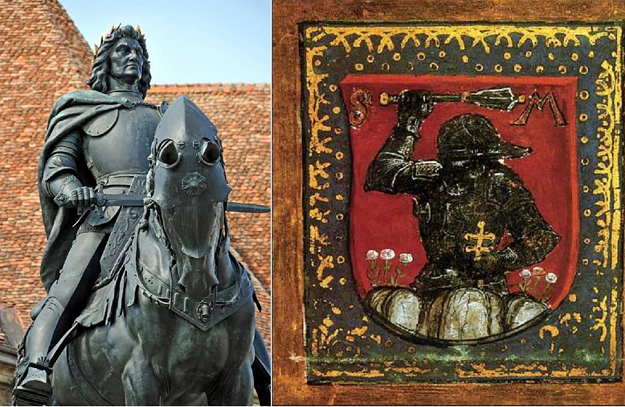
The Raven King and his mercenary Black Army sound like something straight out of Game of Thrones. However, they refer to a real life medieval monarch and military unit. Specifically, Hungary’s King Matthias Corvinus (1443 – 1490), whose name translates as “Matthew the Raven”, and a mercenary army he assembled to hold back the Ottoman Turks. They became Europe’s most formidable warriors in the second half of the fifteenth century.
The Unexpected Election of a Fifteen-Year-Old King

Hungary’s Matthias Corvinus, the Raven King who reigned from 1458 to 1490, was among late medieval Europe’s most remarkable rulers. He was renowned both as a warrior-king and a Renaissance patron. He transformed Hungary into a major Central European power at a time when the region was threatened by Ottoman expansion. And he did that despite internal noble rivalries, while having to also deal with the ambitions of neighboring dynasties. Central to his success was the creation of a professional standing army known as the Black Army of Hungary. An innovative and formidable force, it distinguished Matthias from most contemporary rulers and underpinned his military and political achievements.
Matthias was born in 1443 in Kolozsvar, modern Cluj-Napoca, Romania. His father was John Hunyadi, the great Hungarian general and regent famous for his campaigns against the Ottomans. Hunyadi’s military reputation and political influence shaped Matthias’ early life, but his youth was also marked by danger and upheaval. In 1457, Matthias’ elder brother Laszlo was executed by King Ladislaus V, and he himself was taken hostage. Only months later, Ladislaus V died suddenly. In the ensuing political vacuum the Hungarian Diet elected the fifteen-year-old Matthias king in January 1458. His election was unusual: he was young, and not of royal blood in the traditional sense. He was chosen largely due to his father’s prestige, and the support of key nobles and military leaders. The early years of Matthias’ reign were devoted to consolidating power within Hungary.
Rise of the Raven King

The nobility expected the Raven King to be a pliable figurehead. The plan was for Matthias’ uncle to rule as regent until the new king came of age. The teenager surprised everybody, though. Matthias quickly demonstrated independence and political acumen, and took personal charge. He curtailed powerful magnates’ influence, reasserted royal authority over crown lands, and reformed taxation to strengthen the royal treasury. Those financial reforms were essential. Matthias’ ambitions – defending against the Ottomans, asserting influence in Bohemia and Austria, and maintaining internal stability – required sustained military strength.
Matthias had ascended the throne only five years after the Ottoman Turks had conquered Constantinople and extinguished the Byzantine Empire. The Turks, brimming with confidence, turned their attention to Hungary. Military matters were thus high on the list of state affairs that attracted Matthias’ attention. It was in that context that the Black Army emerged as a central pillar of his rule. Against all precedent, Matthias taxed Hungary’s nobles, and ignored their howls of protest. He used the proceeds to recruit 30,000 mercenaries, mainly from Germany, Poland, Bohemia, and Serbia, and after 1480, from Hungary.

The Black Army was not created overnight, nor was it entirely without precedent. Hungary already possessed a tradition of frontier warfare and military service, especially in regions exposed to Ottoman raids. However, Matthias departed from the feudal levy system that dominated medieval European warfare. He did not rely primarily on nobles to provide troops for limited periods. Instead, he assembled a standing army composed largely of mercenaries, paid directly by the crown and available year-round. That was a radical and expensive innovation, but it gave Matthias unprecedented military flexibility and control.
The Formidable Black Army

The name “Black Army” (Fekete sereg in Hungarian) is somewhat mysterious. Contemporary sources offer several explanations. Some suggest it derived from the black armor or shields used by parts of the force. Others connect it to the black banners under which it marched. Another tradition holds that the name arose only after Matthias’ death, when the army became associated with mourning or destruction. Regardless of its precise origin, the term came to symbolize a disciplined, professional, and feared military organization. The Black Army likely numbered between 15,000 and 30,000 soldiers, although exact figures varied depending on campaigns and finances. That made it one of the largest standing armies in Europe at the time. Its composition was diverse, reflecting the multinational character of late medieval mercenary warfare.
The Raven King and his Black Army mercenaries were formidable. They dominated Central Europe and the Balkans, and held back the Ottomans for decades. Hungarians formed a substantial core, but many soldiers came from Bohemia, Moravia, Germany, Poland, Serbia, and other Balkan regions. Veterans of the Hussite wars in Bohemia were particularly important, and they brought with them advanced tactical experience. The Black Army was organized around a mix of light infantry that operated around a base of heavily armored infantry. The infantry was supplemented by even more heavily armored knights. In a pioneering innovation that took advantage of recent firearms developments, every fourth soldier was armed with an arquebus.
The Black Army Was a Rare Disciplined and Professional Medieval Army

The Black Army was organized into distinct units that combined traditional heavy cavalry with increasingly important infantry and artillery. Heavy cavalry, including armored knights and men-at-arms, remained crucial for shock action on the battlefield. However, Matthias placed great emphasis on infantry, especially pikemen and handgunners. The influence of the Hussites was evident in the use of wagon forts, coordinated infantry formations, and early firearms. The Black Army also possessed a strong artillery arm. Its mobile cannons could be used effectively in both field battles and sieges.
Discipline and regular pay were key features of the Black Army that set it apart from many contemporary forces. Soldiers were contracted for service, and expected to adhere to strict rules. Looting without authorization was punished, and commanders were held accountable for maintaining order. Regular pay, though sometimes delayed due to financial strain, fostered loyalty to the Raven King rather than to individual nobles. That loyalty allowed Matthias to bypass the traditional power of the aristocracy, and assert direct royal control over military force.

The Black Army proved its effectiveness in a series of campaigns that reshaped Central European politics. While Matthias continued his father’s struggle against the Ottomans, he was often pragmatic rather than crusading in his approach. He recognized that Hungary’s resources were limited, and that outright conquest of Ottoman territory was unrealistic. Instead, he focused on defending Hungary’s southern borders. He supported buffer states such as Serbia and Bosnia when possible, and launched punitive raids to deter Ottoman incursions. The Black Army’s mobility and professionalism were well suited to that kind of warfare.
Hegemon of Central Europe

The Raven King is best remembered for his fight against the Ottomans to his south and east. However, his most ambitious campaigns were directed westward. In 1469, he opposed King George of Podebrady of Bohemia, and later claiming the title of king of Bohemia himself. Although he never fully conquered Bohemia, he gained control over Moravia, Silesia, and Lusatia, which significantly expanded Hungarian influence. The Black Army’s experience in Hussite-style warfare was invaluable in these campaigns. It was able to operate effectively in the rugged terrain and fortified towns of the region.
Even more dramatic was Matthias’ conflict with the Habsburgs. From the 1470s onward, he waged war against Emperor Frederick III, and later his son Maximilian. In a bold and unprecedented move, Matthias invaded Austria and captured key fortresses and cities. In 1485, his forces took Vienna, which Matthias made one of his royal residences. The occupation of Vienna was a striking demonstration of his power and the effectiveness of the Black Army. It also demonstrated the army’s ability to conduct long campaigns far from Hungary’s traditional frontiers. Beyond the battlefield, the existence of the Black Army had profound political and social consequences. It took heavy taxation and efficient administration to maintain such a force. So the Raven King reformed the tax system. Matthias replaced traditional irregular levies with more predictable forms of revenue, such as a so-called “extraordinary tax.”
The Raven King Was a Renaissance Man

The Raven King was not just a soldier and administrator. He was also a leading figure of Renaissance culture north of the Alps. He cultivated the image of a learned ruler, and earned the epithet “Matthias the Just” in later Hungarian tradition. His court attracted humanist scholars, artists, and scientists from Italy and beyond. The Bibliotheca Corviniana, his royal library, became one of the largest and most prestigious collections of Renaissance manuscripts in Europe. Although this cultural flourishing was not directly tied to the Black Army, the army’s success and the revenues it protected made Matthias’ patronage possible.
Matthias’ reforms and efficient taxation strengthened the central government, but generated resentment among nobles and peasants alike. His authority kept opposition in check during his lifetime, but those tensions resurfaced after his death. Despite his achievements, Matthias’ system rested heavily on his personal authority and abilities. His accomplishments were mostly undone after his death because he failed to secure a legitimate male heir. He tried to have his illegitimate son John Corvinus recognized as successor, but the Hungarian nobility rejected that plan. When Matthias died unexpectedly in 1490, the delicate balance he had maintained collapsed. Without his leadership and financial backing, the Black Army quickly became a liability rather than an asset.
Significance and Legacy of the Raven King and His Black Army

The new king, Vladislaus II of the Jagiellonian dynasty, lacked both the resources and the will to maintain a large standing army. Soldiers of the Black Army went unpaid, discipline broke down, and many units began to plunder the countryside. Within a few years, the army was disbanded or destroyed, notably when royal forces defeated its remnants in 1492. The dissolution of the Black Army marked the end of Hungary’s brief experiment with a powerful, centralized military state. The consequences were far-reaching. Without a strong standing army, Hungary became increasingly vulnerable to external threats, particularly the Ottomans. The weaknesses that emerged after Matthias’ death led to Hungary’s catastrophic defeat at Mohacs in 1526, and its subsequent partition.
In retrospect, the Raven King and his Black Army represented a high point of medieval Hungarian power. It was a moment when the kingdom stood as a major player in European politics. Matthias Corvinus’ legacy is thus inseparable from the Black Army. Together, they embodied a transition between medieval and early modern forms of warfare and governance. Matthias demonstrated that a strong central monarchy, supported by a professional army and efficient administration, could overcome entrenched noble power. Although short-lived, the Black Army left a lasting impression as one of its era’s most effective standing armies. It became a symbol of what Hungary briefly achieved under one of its greatest kings.

_________________
Some Sources & Further Reading
History Halls – The Hussite Revolution: An Uprising that Revolutionized Warfare
Klaniczay, Tibor – Matthias Corvinus and the Humanism in Central Europe (1994)
Newest Articles
- Edward England, the Humane Pirate Captain Deposed by His Men for Being Too Nice
- American Presidents: Abraham Lincoln, Hall of Fame Wrestler
- Henry Jennings: The Privateer-Turned-Pirate Who Set the Stage for the Caribbean’s Golden Age of Piracy
- Fighting Women: Tomoe Gozen, the Fearsome Female Samurai
- From the NFL to the Sands of Iwo Jima: Medal of Honor Recipient Jack Lummus

