Jan Hus was a pre-Protestant Czech advocate of religious reform. For his troubles, he was condemned by the Catholic Church and burned at the stake for heresy in 1415. Hus’ execution immediately transformed him into a religious martyr to his followers, and a national hero. It also triggered a massive uprising, the Hussite Revolution.
Hus and the Hussites

Jan Hus (circa 1369 – 1415) was a Czech philosopher, theologian, and a pioneering advocate of religious reforms. His writings eventually led to Protestantism a century later. Both the authorities and the Catholic Church opposed change and anything that rocked the boat, so they executed Hus. That triggered a backlash, and many Czech nobles and knights vowed to protect his followers from further persecution. In that, they were tolerated by Bohemia’s King Vaclav IV. However, Vaclav died in 1419, and was succeeded by his brother Sigismund, who hated the Hussites.
King Sigismund tried to enter Prague, but Hus’ followers, aware of his hostility towards them, kept him out of the Czech capital. So he turned to the Catholic Church and got the pope to issue a papal bull that declared a crusade against the Hussites. In response, Hus’ followers organized themselves into an army, comprised in the most part of infantry. The result was the Hussite Revolution, a series of wars fought in the fifteenth century between Hus’ followers and the forces of the Holy Roman Empire and the Catholic Church.
The Hussite Revolution

The Hussites hailed mostly from Bohemia – a kingdom whose territory overlapped that of today’s Czech Republic. The Catholic Church declared them heretics, and launched five crusades in the 1420s to crush them. Hus’ followers defended themselves and beat back each attempt to subdue them. They even went on the offensive, and took part in the wars of neighboring countries. The Hussites faced long odds. The resources available to the Catholic Church and the Holy Roman Empire greatly exceeded those of Hus’ followers.
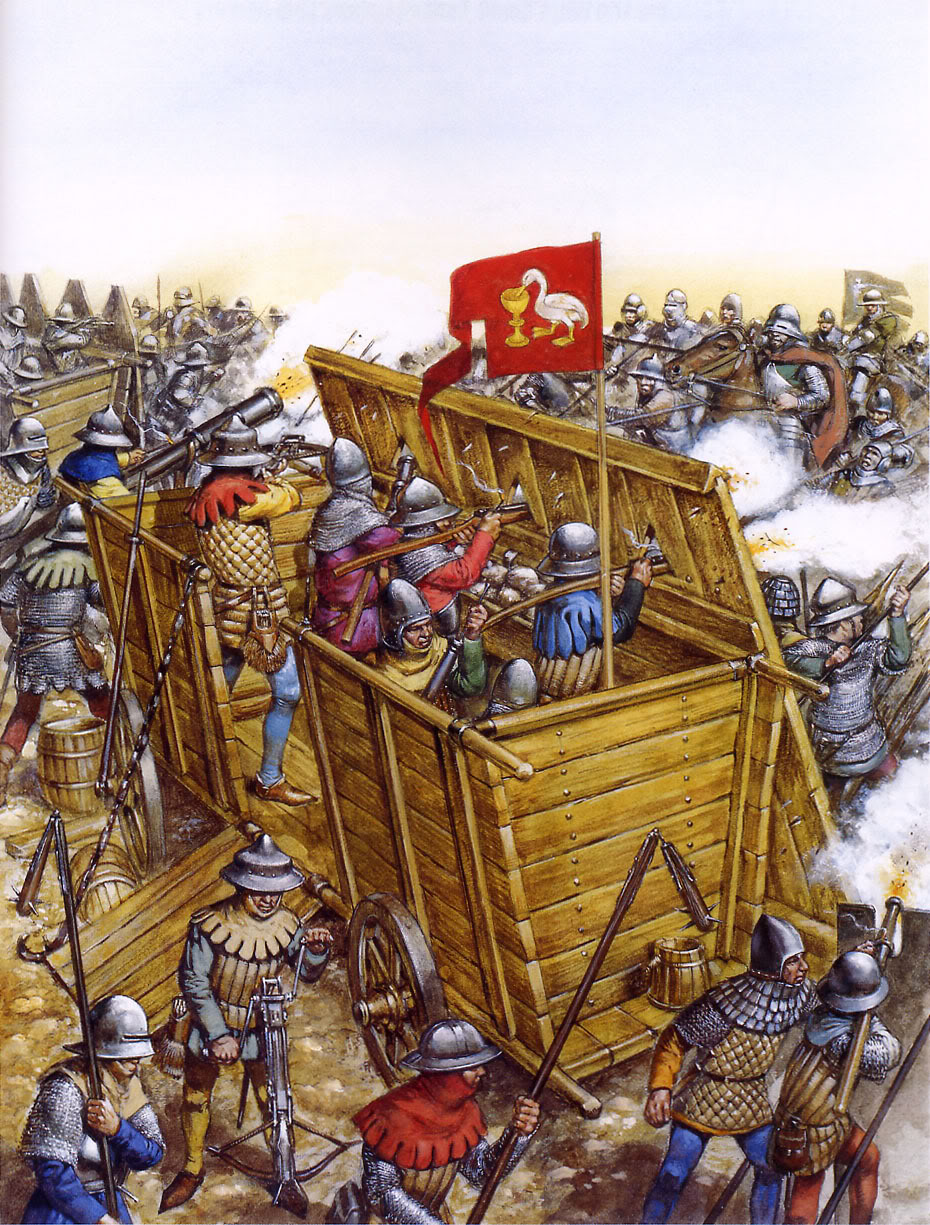
To give themselves a fighting chance, the Hussites turned to innovative military tactics and technologies. In so doing, they ended up revolutionizing warfare. Aware of their lack of both resources and training, the Hussites had to get creative. They became history’s first combatants to make extensive use of firearms, and turned to handheld gunpowder weapons such as muskets and hand cannons. They also adopted tactics such as the use of war wagons in circular formations, similar to those of American Pioneers fighting off Plains Indians.
An Uprising That Revolutionized Warfare

In Hussite hands, picks and shovels were just as important as the newly introduced firearms. Supplemented by trenches in front of their wagons, the forces of Hus’ followers were able to swiftly transform whatever ground they occupied into a fortress known as a wagenburg, or “wagon fortress”. From behind their defenses, the Hussites beat back charges by armored knights, shot them down with bullets or crossbows, then counterattacked and put their foes to flight. Hus’ followers successfully followed that script time and time again, helped by the strict discipline they maintained.
The combination of discipline, new weapons, and creative tactics proved highly effective. Led by Jan Zizka until his death in 1424, Hus’ followers won a series of stunning victories. The Hussite Revolution finally ended in 1434. Not because Hus’ followers were defeated by their external enemies, but as a result of an internal falling out amongst themselves. A moderate Hussite faction, the Utraquist, defeated the more radical Taborite faction. The Utraquists then negotiated a peace with the Catholic Church and the Kingdom of Bohemia. They agreed to submit, in exchange for the right to practice Catholicism with a Hussite bent and with modified rites.

_________________
Some Sources & Further Reading
Encyclopedia Britannica – Hussite Wars
Kaminsky, Howard – A History of the Hussite Revolution (2004)
Turnbull, Stephen – The Hussite Wars, 1419-36 (2024)

