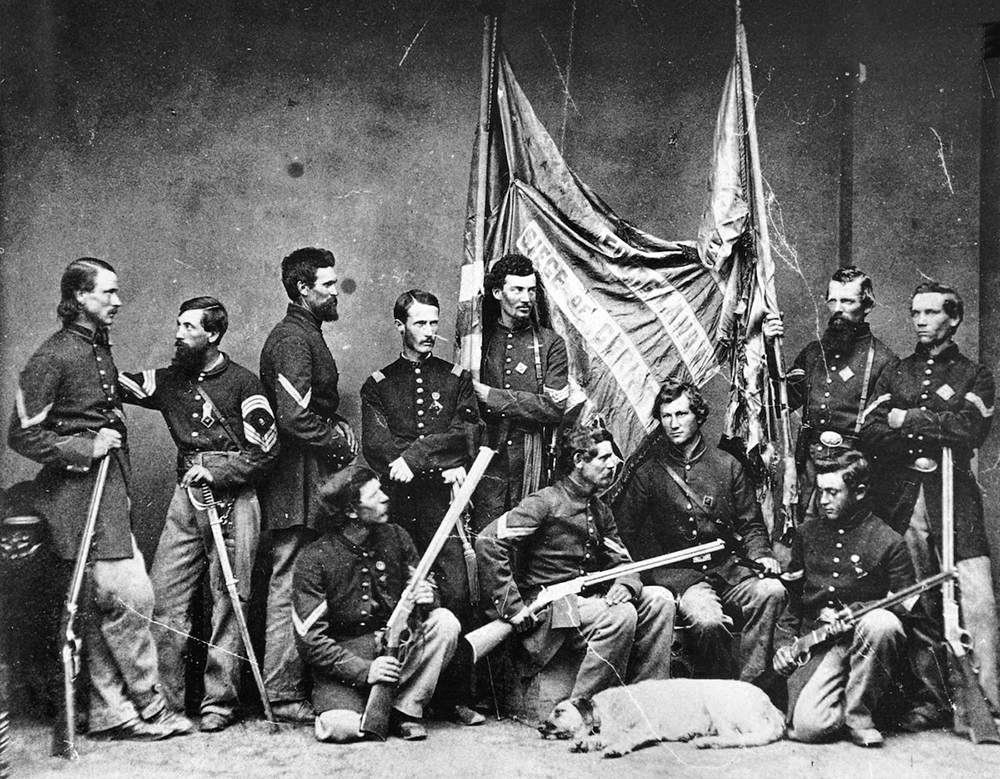
The Henry repeating rifle occupies a pivotal place in the history of firearms. It marks the moment when rapid, reliable, multi-shot weapons moved from experimental curiosities into practical military and civilian use. Introduced on the US Civil War’s eve, the Henry rifle fundamentally changed how soldiers and frontiersmen thought about firepower. Though produced in relatively limited numbers, its technological innovations laid the groundwork for the legendary Winchester rifles and the entire era of lever-action firearms that followed.
Designing a Firearm Around a Self-Contained Metallic Cartridge

The story of the Henry repeating rifle begins with Benjamin Tyler Henry, a gifted American gunsmith and mechanical designer. Henry worked for the New Haven Arms Company, which had earlier attempted to commercialize a repeating rifle based on the designs of Walter Hunt and later Lewis Jennings. Those earlier rifles used a lever mechanism but were hampered by unreliable ammunition. Known as the “Rocket Ball”, it was a hollow bullet that contained powder but had no separate cartridge case. While innovative, Rocket Ball ammunition lacked power and consistency, which limited the rifle’s success. What made the Henry revolutionary was not just the rifle, but the rifle and cartridge combination.
Henry had a brainstorm: why not design a firearm around a self-contained metallic cartridge? It was something that firearms technology was just beginning to make practical. By 1860, Henry had perfected a rifle chambered for the new .44 Henry rimfire cartridge. It integrated bullet, powder, and primer into a single brass case. That innovation dramatically improved reliability, ease of use, and rate of fire. The resulting rifle was patented in October 1860 and soon entered production. It was officially known as the Henry Repeating Rifle, though it was often simply called “the Henry”.
The Henry Repeating Rifle

The Henry repeating rifle was a lever-action, breech-loading repeating rifle. Its capacity far exceeded that of standard military arms of the period. Its most striking feature was its tubular magazine, located beneath the barrel. It could hold fifteen rounds, plus one in the chamber. That was an astonishing number at a time when most soldiers carried single-shot muzzle-loading rifles. Operating the Henry was straightforward. Lower the lever to simultaneously cock the hammer and extract the spent cartridge case. Raise the lever to chamber a fresh round from the magazine. Pull the trigger to fire the rifle. Repeat.
That system allowed a trained shooter to fire as many as twenty to twenty eight rounds per minutes. By contrast, standard muzzle-loading rifles like the Springfield Model 1861 typically fired two to three rounds per minute. Unlike later Winchesters, the Henry lacked a side loading gate. Instead, the shooter loaded the rifle from the front. The follower at the end of the magazine was rotated. The inner magazine tube was partially withdrawn. Cartridges were dropped nose-first into the tube. The magazine tube was then returned to position. That method allowed the rapid loading of many rounds at once. However, it also exposed the magazine and made reloading awkward under fire.
A Formidable Firearm

The Henry repeating rifle featured a 24-inch octagonal barrel, a receiver made of brass or gunmetal, often called “yellow boy” (though this term became more common with later Winchester models), and a walnut stock. The absence of a wooden fore-end meant the shooter’s supporting hand rested directly on the barrel or magazine tube. That was problematic, as those surfaces could become dangerously hot during sustained firing. The .44 Henry rimfire was revolutionary, but imperfect. It fired a 200-grain bullet propelled by approximately 26 grains of black powder. It produced modest muzzle velocity and limited stopping power compared to later centerfire cartridges. Its effective range was around two hundred yards, though practical accuracy was best at shorter distances.
Despite those limitations, the cartridge was more than adequate for close-to-medium range combat. When combined with the rifle’s high rate of fire, the result was a formidable firearm. Against troops armed with single-shot muzzle-loaders, the volume of fire a Henry rifleman could produce was devastating. The Henry rifle is most closely associated with the US Civil War, 1861 – 1865. It was never officially adopted by the US Army in large numbers, though. Conservative military doctrine, logistical concerns, and the cost of both rifle and ammunition limited its widespread issuance during the conflict.
A Rifle “You Load on Sunday and Shoot All Week!”

Although not officially adopted, several thousand Henry rifles found their way into service through private purchase, especially among Union troops. Soldiers recognized their immense battlefield advantage, and so often pooled money or used personal funds to acquire them. Confederate soldiers quickly came to fear the Henry repeating rifle. Rebel raider John Mosby described the Henry as: “That damned Yankee rifle you load on Sunday and shoot all week!” While exaggerated, it captured the psychological impact of facing an enemy who could fire continuously without reloading after every shot.
Henry rifles saw action in several theaters of the war, particularly in the Western campaigns. Units such as the 7th Illinois Infantry were equipped with Henrys, and demonstrated their effectiveness in skirmishes and defensive actions. At Allatoona Pass and engagements during Sherman’s Atlanta Campaign, Henry-armed troops beat back larger Confederate forces by sheer firepower. That was thanks to Henry rifle’s key advantages. Specifically, unprecedented rate of fire, high ammunition capacity, metallic cartridges resistant to weather, and easy training compared to muzzle-loaders. They made the Henry rifle exceptionally well-suited for defensive fighting, skirmishing, and mounted troops who valued sustained fire.
Revolutionary, but Imperfect

Despite its strengths, the Henry repeating rifle had several drawbacks. Lack of a fore-end made it uncomfortable and unsafe during prolonged firing. The rimfire ammunition had limited power. The open magazine was vulnerable to dirt and damage. It was also significantly more expensive than standard infantry rifles. Additionally, military logisticians worried about ammunition consumption. A Henry rifleman could expend cartridges at a rate the era’s supply trains struggled to meet. Production of the Henry rifle continued until 1866, with approximately 14,000 units manufactured. After the Civil War, the rifle faced competition from improved designs that addressed its shortcomings.
In 1866, the New Haven Arms Company reorganized as the Winchester Repeating Arms Company under the leadership of Oliver Winchester. The company introduced the Winchester Model 1866, often called the “Yellow Boy”, which was directly descended from the Henry rifle. Key improvements included a wooden fore-end, a side loading gate that allowed safer and faster reloading, and better magazine protection. Those refinements made the Winchester rifles more durable, user-friendly, and commercially successful, and cemented their place in American history.
Legacy of the Henry Repeating Rifle

Although overshadowed by later Winchesters, the Henry repeating rifle played a role in the postwar frontier. Some veterans brought their rifles West, where they were used by settlers, ranchers, and lawmen. The rifle’s rapid fire made it effective for defense against bandits or hostile encounters. Its most famous use came at the Battle of Little Born, in 1876. There, Sioux warriors, many armed with Henrys, exterminated Custer’s less well-armed 7th Cavalry. Eventually, however, the Henry’s limited power compared to newer cartridges eventually made it obsolete. The Henry rifle symbolizes a turning point in warfare: the moment when firepower began to outweigh linear tactics rooted in the age of muskets.
Armies were slow to adapt to the new technology. However, the Henry rifle demonstrated that individual soldiers equipped with repeaters could dominate traditional formations. Its influence extended beyond the battlefield. The rifle helped establish America’s reputation as a center of firearms innovation. It also set the stage for the lever-action rifle’s enduring association with the American identity. Especially the mythos of the Civil War and the Old West. The Henry repeating rifle was not merely a successful weapon. It was a technological leap that that reshaped expectations of what a rifle could do.
Though imperfect and relatively scarce, it introduced key concepts – metallic cartridges, high-capacity magazines, and practical repeating fire – that became standard in modern firearms. It bridged the gap between single-shot muskets and true modern rifles. That secured the Henry its place as one of the nineteenth century’s most important small arms. Its legacy lives on not only in museums and collections. It lives in every lever-action rifle that followed, each echoing the revolutionary design realized by Benjamin Tyler Henry in 1860.

_________________
Some Sources & Further Reading
Bresnan, Andrew L. – The Henry Repeating Rifle: Victory Thru Rapid Fire
Butler, David F. – United States Firearms: The First Century, 1776-1875 (1971)
History Halls – The Spencer Repeating Rifle: The Civil War Firearm That Revolutionized Battlefields
Sword, Wiley – The Historic Henry Rifle: Oliver Winchester’s Famous Civil War Repeater (2002)
Newest Posts
- Alexander the Great and Sisygambis, Mother of Persia’s King Darius III
- Unholy Holy Fathers: Pope Leo X’s Corruption Was So Brazen, it Triggered the Protestant Reformation
- Edward England, the Humane Pirate Captain Deposed by His Men for Being Too Nice
- American Presidents: Abraham Lincoln, Hall of Fame Wrestler
- Henry Jennings: The Privateer-Turned-Pirate Who Set the Stage for the Caribbean’s Golden Age of Piracy

