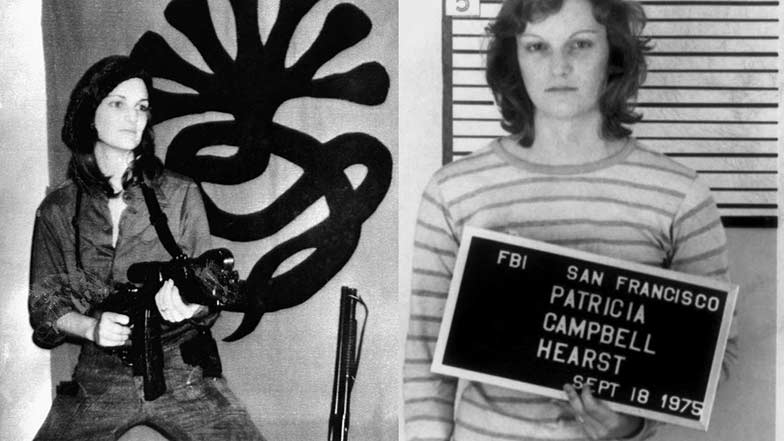
Wealthy heiress Patty Hearst and the Symbionese Liberation Army occupy a strange, unsettling corner of twentieth-century American history. They embody a moment when radical politics, media spectacle, psychological coercion, and celebrity culture collided. Their story is not just about than just a rich girl who turned outlaw and fugitive. It is about the atmosphere of paranoia and extremism that lingered in the United States after the 1960s. It is a toxic combination of violence, ideology, and power that warped individual lives in unpredictable ways.
The Kidnapping of a Wealthy Heiress

Patricia Campbell Hearst was born in 1954 into one of the most famous families in America. She was the granddaughter of newspaper magnate William Randolph Hearst, whose media empire helped shape modern journalism and popular culture. By the early 1970s, Patty Hearst was living a relatively ordinary life by elite standards. A student at the University of California, Berkeley, she was engaged to Steven Weed. She led a low key life largely removed from her family’s immense power and notoriety. That changed abruptly on the night of February 4th, 1974.
That evening, Hearst was kidnapped from her Berkeley apartment by members of the Symbionese Liberation Army (SLA). A tiny but violent revolutionary group, few Americans had heard of them before that moment. The SLA burst into the apartment, beat Weed unconscious, and dragged Hearst away at gunpoint. Within days, the group announced that they were holding her as a “prisoner of war”. They demanded that the Hearst family distribute millions of dollars’ worth of food to the poor as ransom. That demand, couched in revolutionary language, immediately turned the kidnapping into a national media event.
The Strange Symbionese Liberation Army

The kidnappers were an odd and unstable organization even by the standards of 1970s radical groups. Founded in 1973, the Symbionese Liberation Army never had more than a few dozen members, and often far fewer. Its ideology was an incoherent blend of Marxism, anti-racism, prison-rights activism, and vague revolutionary rhetoric. The group’s leader, Donald DeFreeze, who took the nom de guerre “Cinque,” was a former petty criminal and prison informant. At some point, he fashioned himself into a revolutionary commander. DeFreeze preached a doctrine he called “symbionese,” in which oppressed groups formed a single revolutionary organism to overthrow capitalist society.
In practice, the SLA functioned more like a cult than a political movement, and DeFreeze exercised near-total control over members. The SLA was already known to law enforcement for a notorious act before it kidnapped Patty Hearst. In November, 1973, it had murdered Oakland school superintendent Marcus Foster, a Black educator widely respected for progressive views. Foster was gunned down by SLA members who falsely believed that he supported the use of identification cards in schools as a tool of oppression.
The Transformation of Patty Hearst

The senseless murder of Marcus Foster horrified many on the left, and isolated the SLA from other radical organizations. That left it increasingly paranoid, violent, and cut off. After Hearst’s abduction, the SLA used tape recordings sent to radio stations to communicate with the public. At first, Hearst’s recorded statements sounded frightened and scripted, confirming that she was being held against her will. The group insisted that she was safe, but also threatened her life if their food ransom demands were not met.
In response, Hearst’s father, Randolph Hearst, funded a massive food distribution program in the Bay Area, costing millions of dollars. The effort was chaotic, poorly organized, and led to rioting in some neighborhoods. It failed to satisfy the SLA, which declared the ransom insufficient. Over the next several weeks, the tone of Hearst’s messages changed dramatically. In April, 1974, she released a tape in which she announced that she had joined the SLA voluntarily. She declared that she had taken the name “Tania,” after a female revolutionary associated with Che Guevara. She denounced her family, criticized American capitalism, and expressed solidarity with her captors. For many Americans, the transformation was shocking. Was Patty Hearst a brainwashed victim, or had she genuinely embraced revolutionary violence?
A Rich Girl Radical Revolutionary

The question of Hearst’s responsibility for her actions became even more urgent on April 15th, 1974. That day, cameras captured her wielding an automatic rifle during a San Francisco bank robbery carried out by the SLA. Surveillance images showed her standing guard as others took money. Shortly afterward, audio recordings emerged in which she claimed responsibility for the robbery, and declared her loyalty to the group. At that moment, public perception shifted sharply. Sympathy for the kidnapped heiress gave way to anger and disbelief. Patty Hearst was no longer seen merely as a hostage, but as an active participant in terrorism.
The SLA’s violent trajectory continued. In May, 1974, police sounded a Los Angeles SLA safe house, and demanded the occupants’ surrender. They violently resisted, resulting in a dramatic shootout and fire in which several members were killed. The incident, broadcast live on television, reinforced the sense that America was in a state of internal war. Hearst was not present at the safe house, and remained at large with surviving SLA members. Over the following year, she participated in additional crimes, including another bank robbery in Los Angeles. However, the extent of her willing involvement remained contested.
Brainwashed Victim, or Complicit Criminal?

In September, 1975, a year and a half after her kidnapping, Hearst was captured by the FBI in San Francisco. She was charged with armed bank robbery and the use of a firearm in the commission of a felony. That reignited the national debate over her responsibility. At the time of her arrest, Hearst was still in radical mode. She was photographed in handcuffs smiling and throwing up a revolutionary clenched fist. By the time of her trial, however, her attitude had changed. The prosecution argued that Hearst had freely chosen to join the SLA, and had committed crimes enthusiastically. The defense countered that she was a victim of extreme psychological and physical abuse. She had been confined in a closet, blindfolded, sexually assaulted, threatened with death, and constantly bombarded with ideological indoctrination.
At her trial in 1976, the concept of “brainwashing” or coercive persuasion took center stage. Expert witnesses testified that Hearst’s behavior was consistent with a victim of prolonged captivity and psychological manipulation. They likened it to what American prisoners of war had been subjected to in the Korean War. They argued that her apparent enthusiasm was a survival strategy, not genuine consent. The prosecution dismissed those claims as excuses. They emphasized the length of time she had spent with the SLA, and the absence of obvious attempts to escape.
A Shift in Public Perceptions

The jury was unconvinced by Hearst’s defense. She was convicted and sentenced to seven years in prison, though the sentence was later reduced. The verdict reflected broader skepticism in American society toward explanations that seemed to absolve individuals of personal responsibility. Especially at a time of widespread fears of domestic terrorism. Patty Hearst served twenty two months in prison, before President Jimmy Carter commuted her sentence in 1979. More than two decades later, in 2001, President Bill Clinton granted her a full pardon. By then, psychological research into trauma, abuse, and coercive control had advanced, and public attitudes had softened.
Many Americans came to see Hearst less as a traitor, and more as a victim of extraordinary circumstances. In the years after her release, Hearst rebuilt her life far from revolutionary politics. She married Bernard Shaw, a former policeman involved in her security, and became involved in animal welfare causes. Her later life, marked by relative quiet and philanthropy, stood in stark contrast to the chaos of her youth. The Symbionese Liberation Army, by contrast, left little lasting ideological legacy. Its actions were widely condemned, and its grandiose revolutionary claims collapsed under scrutiny.
Legacy of the Patty Hearst Kidnapping

The Symbionese Liberation Army is often remembered less as a serious political movement than as a tragic example of how violence and ideological rigidity can spiral into self-destruction. Its members’ deaths, long prison sentences, and lasting infamy underscore the futility of their campaign. However, the story of Patty Hearst and the SLA continues to resonate because it defies easy moral categorization. It forces uncomfortable questions about free will, victimhood, and accountability. How much choice does a person have under constant threat? At what point does survival become complicity? Those questions remain relevant in discussions of cults, human trafficking, and extremist radicalization today.
Ultimately, the Patty Hearst case was a mirror held up to American society in the 1970s. It reflected widespread fears about political extremism, class conflict, media power, and psychological vulnerability. The case showed how quickly narratives can shift, and how public sympathy can transform into condemnation. It illustrated how individuals can be swept up by forces far larger than themselves. Half a century later, Patty Hearst’s ordeal remains one of the most unsettling and debated episodes in modern American history.

_________________
Some Sources & Further Reading
Graebner, William – Patty’s Got a Gun: Patricia Hearst in 1970s America (2008)
History Halls – The Cangaco and Cangaceiros: The Bandits of the Brazilian Outback
Newest Articles
- The Johnstown Flood – Thousands Perished When A Dam Collapsed After Gilded Age Tycoons Modified it for their Private Resort
- The Jacquerie: The Medieval Peasant Uprising That Terrified France’s Aristocrats
- Things That Weren’t Thought Through: WWII’s Sticky Bomb Stuck to Users’ Hands Once Activated
- German Tanks of World War II – The Panzer 38(t), a Czech Tank in German Service
- Nicholas Alkemade: The WWII Airman Who Survived an 18,000 Foot Fall From a Bomber Without a Parachute

