
The rapier is one of the most distinctive swords in European history. It is closely associated with the social world of the Renaissance and early modern period. The rapier emerged in the late fifteenth century, and reached its height between the sixteenth and early seventeenth centuries. It was not a battlefield weapon, but a civilian sidearm designed for personal defense, dueling, and the assertion of status. Its long, slender blade and complex hilt reflected changing ideas about violence, honor, and technique in an increasingly urbanized Europe.
Emergence of the Rapier

The origins of the rapier lie in late medieval cut-and-thrust swords, particularly those used in Spain and Italy. As firearms reshaped warfare, armor declined in everyday life. As a result, the need for heavy cutting weapons diminished outside the battlefield. Urban elites instead required a sword suitable for daily wear, self-defense in narrow streets, and highly ritualized personal combat. The rapier’s narrow blade was optimized for thrusting. It was ideal for penetrating gaps in clothing or light armor, and for precise attacks in close quarters. Rapiers could cut, but their strength lay in the thrust, which required less space and offered greater reach and control.
Physically, the rapier is characterized by its length and balance. Blades were typically 100 – 120 centimeters (39 – 47 inches), which gave the wielder a significant reach advantage over shorter swords. Despite their length, rapiers were relatively light, and typically weighed between 1 and 1.5 kilograms (2.2 – 3.3 pounds). Their balance favored the hilt rather than the blade, which optimized quick point control rather than powerful blows. The hilt itself became a defining feature, and often incorporated swept guards, rings, and later cup or shell guards. The elaborate hilts protected the hand, enabled blade binding, and served as visual statements of craftsmanship and wealth.
The Weapon of Duelists
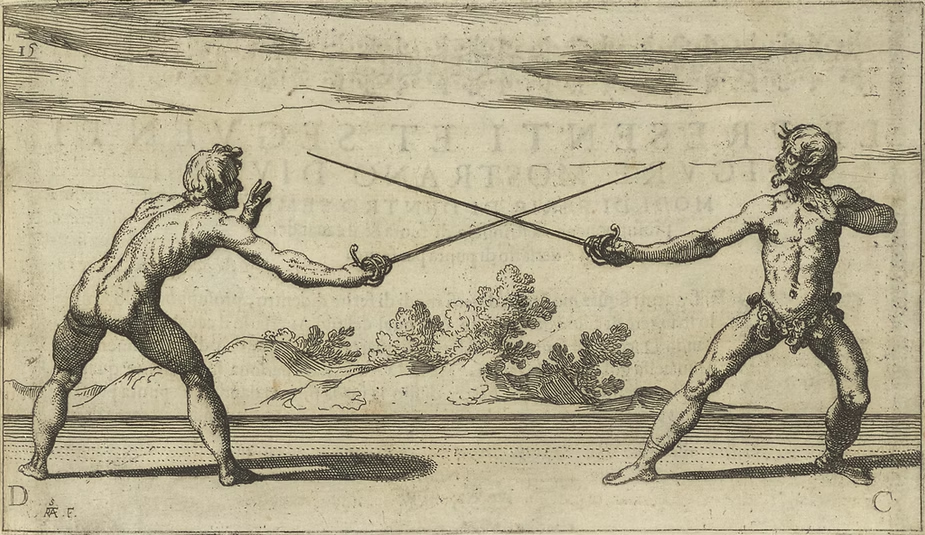
The rapier cannot be separated from the fencing systems that developed alongside it, especially in Italy and Spain. There, fencing became a formalized discipline grounded in geometry, timing, and theory. Italian masters such as Achille Marozzo and Ridolfo Capo Ferro emphasized linear movement, lunging attacks, and precise blade engagement. Spanish fencing, known as destreza, was even more theoretical. It framed swordplay as a mathematical science based on circles, angles, and proportional movement. Such systems treated the rapier not as a brute weapon, but as an instrument of reasoned violence, where intellect and technique were as important as physical strength.
Dueling culture played a major role in the rapier’s prominence. In an era when personal honor carried immense social weight, insults or slights easily escalated into formal or semi-formal duels. The rapier became the preferred weapon for such encounters, particularly among nobles and gentlemen. Duels were often fought with strict rules, seconds, and agreed-upon conditions. That further reinforced the rapier’s association with civility and controlled aggression. It was not all highbrow, though. Street fights and spontaneous violence were common, and many rapiers saw practical use in ambushes, robberies, and personal feuds.
Legacy of the Rapier

Despite its refined image, the rapier was not without controversy. Critics argued that its emphasis on thrusting encouraged lethal outcomes, as stab wounds were often deadlier than cuts. Fearing disorder and violence, some governments attempted to regulate sword length or ban civilian carrying altogether. Nonetheless, the rapier remained popular for decades, spreading across Europe and even influencing sword design beyond it. By the mid-seventeenth century, the rapier began to decline, gradually replaced by shorter, lighter thrusting swords such as the smallsword. Changes in fashion, dueling practice, and military needs favored weapons that were easier to carry and quicker to use in tight social settings.

The smallsword retained the rapier’s thrust-centric philosophy, but sacrificed blade length for elegance and speed. Today, the rapier endures as both a historical symbol and practice sword. It appears prominently in art, literature, and popular culture, often associated with swashbuckling heroes and courtly intrigue. In historical fencing communities, the rapier is studied seriously as a complex and intellectually demanding weapon. More than just a sword, the rapier represents a transitional moment in European history. It harkens back to an era when violence became codified, and personal combat was ritualized.

_________________
Some Sources & Further Reading
History Halls – Swords Across the Millennia and From Around the World
Kirby, Jared – Italian Rapier Combat (2012)
Windsor, Guy – The Duellist’s Companion: A Training Manual for 17th Century Italian Rapier (2007)
Latest Articles
- American Presidents: Abraham Lincoln, Hall of Fame Wrestler
- Henry Jennings: The Privateer-Turned-Pirate Who Set the Stage for the Caribbean’s Golden Age of Piracy
- Fighting Women: Tomoe Gozen, the Fearsome Female Samurai
- From the NFL to the Sands of Iwo Jima: Medal of Honor Recipient Jack Lummus
- The Zanj Rebellion: The African Slave Revolt That Rocked Medieval Mesopotamia

