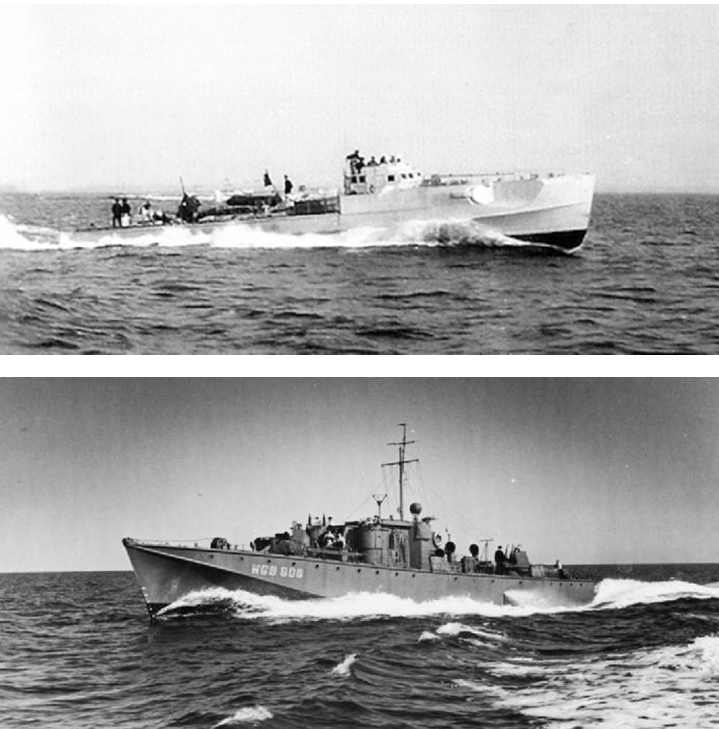
World War II witnessed a harrowing nocturnal struggle between British Motor Torpedo Boats and German E-boats – known formally as Schnellboote. It was a dangerous and relentless rivalry, fought at high speed and point-blank range in the narrow seas. It became an iconic part of the Battle of the Atlantic’s coastal theatre and the broader war for control of the English Channel and North Sea. Largely forgotten now, the MTB vs E-boat war was a battle of wits, engineering, training, and sheer nerve.
MTB vs E-boat

The British Motor Torpedo Boat and German E-boat were conceived for similar tactical purposes, but developed along different design lines. The Royal Navy’s most important early-war designs were the lightweight, wooden-hulled Vosper 70-foot Motor Torpedo Boat, and the larger Fairmile D Motor Gun Boat. Those craft prioritized speed and agility, and used petrol engines to achieve rapid bursts of acceleration. Their wooden construction allowed for rapid mass production in small yards. Their small size made them hard to spot at night, which was ideal for hit-and-run torpedo attacks. By contrast, the German E-boat, epitomized by the S-100 Schnellboot (“Fast Boat”), represented a more robust and refined engineering approach.
E-boats were built primarily of welded steel or light metal framing, with wooden outer planking. Their distinct round-bottom hull handled the rough waters of the North Sea and Channel far better than their British opponents. While the British favored gasoline engines, the Germans equipped their craft with powerful diesel plants. That gave the E-boat longer endurance, better safety from fire, and greater reliability. That fundamental engineering difference shaped many tactical encounters. Both had comparable speeds – around 43 knots sustained, and up to 48 knots in brief bursts. MTBs were smaller and struggled in choppy seas, in which they suffered heavy pounding and their crews’ visibility was reduced. The bigger and heavier E-boats, by contrast, maintained high speeds in rough weather. That allowed them to fight more effectively on nights when British boats were forced to throttle back.
British vs German Designs

MTBs were designed with torpedo attack as their primary mission. Early war boats carried two or four 18-inch torpedoes, along with machine guns or small automatic cannons for self-defense. As the war progressed, the British increasingly armed their coastal craft with heavier weapons. That ultimately blurred the line between MTBs, focused on torpedoes, and Motor Gun Boats (MGBs), which relied on guns. It culminated in multipurpose designs that could engage E-boats with significant firepower. The German E-boat, however, entered the war already designed for multiple combat roles. Most carried two or four torpedo tubes using 21-inch torpedoes – far more powerful than the British 18-inch types. Their gun armament, which began modestly, expanded considerably after 1942.
By the time of the S100 class, E-boats mounted 20 mm and 37 mm cannons fore and aft. That gave them formidable firepower in surface combat. German tactical doctrine also differed from the British approach. The Kriegsmarine used E-boats both offensively and defensively. They attacked North Sea Allied coastal convoys, laid mines, harassed Channel traffic, and occasionally intercepted invasion or landing operations. British MTBs by contrast focused on defending coastal convoys, intercepting E-boat raiders, and conducting limited offensive sweeps into German-controlled waters.
Terrifying Clashes in the Dark

The English Channel and southern North Sea was a uniquely dangerous environment: narrow, crowded with shipping, and heavily mined. Those waters forced MTBs and E-boats into tight spaces where encounters occurred at extremely close range. Night operations were the norm, and both sides relied on radar, searchlights, and flares to identify fleeting targets. British MTB bases at Dover, Felixstowe, and Great Yarmouth sat opposite German E-boat hubs in Holland and northern France, such as IJmuiden and Boulogne. That placed both forces within striking distance of each other. It ensured that almost every convoy escorted along the east coast ran the risk of high-speed night attack.
A typical MTB vs E-boat engagement was chaotic, fast, and extremely perilous. Small MTB or E-boat groups would sortie after sunset, cruising at moderate speed to preserve engines and reduce their wake. Radar contact or visual sighting might trigger a sudden acceleration, with both sides surging forward at thirty or forty knots. The sudden illumination of the darkness by tracer fire, star shells, and occasional searchlights, was often confusing and terrifying. The MTBs’ challenge was to close distance sufficiently to fire torpedoes. It was no easy task against an enemy just as fast, and often better armed. Meanwhile, E-boats used their superior sea-keeping and powerful forward guns to keep British craft at bay, while maneuvering into torpedo firing positions against merchant convoys.
From Early German Advantage to Parity

Collisions sometimes occurred in the chaotic MTB vs E-boat clashes, and the close-quarters fighting often resembled a naval dogfight. Crews had to operate weapons manually, endure the noise and vibration of high-speed engines, and maintain control in seas that could swamp a boat off course with a single rogue wave. German E-boats held significant advantages in the war’s early years. Their range, sea-keeping, and torpedo performance allowed them to strike British coastal convoys with deadly effect. In 1940 and 1941, E-boats inflicted substantial losses on North Sea shipping. In response, the British were forced to strengthen escort groups and reorganize convoy routes.
MTBs, still developing effective radar and lacking the heavier armament needed to counter E-boat gunnery, struggled to prevent those attacks. British MTBs in this period were able to conduct the occasional ambush of German traffic near occupied ports. They were not yet a match for the increasingly aggressive E-boat flotillas, though. By 1942, the Royal Navy had significantly improved its coastal forces. Newly equipped MTBs and MGBs carried better radar, higher-caliber guns, and improved torpedoes. The Fairmile D motor torpedo boat class, nicknamed “Dog Boats”, could carry a mix of torpedoes and guns that made them formidable opponents in gunfights, while still capable of launching torpedo attacks. The E-boats responded by improving their own weapons, especially anti-aircraft and surface guns, but the technological gap began to narrow.
The Tide Shifts

By mid-war, a typical encounter no longer favored the Germans automatically. British crews could counterattack more effectively, and radar allowed them to intercept E-boats before the Germans reached convoy routes. Crews on both sides displayed extraordinary skill and bravery. British Coastal Forces volunteers, often very young, served in cramped, exposed positions. Their lives hung by a thread during combat, as a single shell hit could ignite fuel tanks or detonate torpedoes. The Germans faced similar hazards, though they benefitted from diesel propulsion, which reduced the catastrophic fires that consumed gasoline-driven MTBs. One of the Germans’ greatest successes occurred at the Battle of Lyme Bay in April, 1944, when six E-boats infiltrated a poorly protected dress rehearsal for D-Day. In a devastating attack, they sank two landing ships crammed full of American GIs, and damaged two more. 749 soldiers lost their lives, and more than 200 were injured.
Leadership and crew training were critical. Many E-boat commanders were highly experienced and developed remarkable skill in torpedo attack and night fighting. British commanders, meanwhile, were noted for aggressiveness and willingness to take extraordinary risks to protect convoys or intercept German craft. The war’s later stages witnessed a gradual but definitive shift in British favor. Increasing Allied air superiority steadily limited German E-boat movements, especially during daylight. Improved radar coverage along the British coast reduced the E-boats’ ability to surprise convoys. Heavier British coastal craft, including hybrid MTB/MGB boats, were able to engage E-boats effectively. Offensive actions associated with the D-Day landings, during which the Allies poured prodigious resources into protecting their beachheads and lines of communication across the English the Channel, further reduced the E-Boats’ ability to operate.
Decline of the E-boat Menace

In the weeks after D-Day, E-boats attacked Allied invasion shipping and its defenders. They scored some successes, such as sinking the Norwegian destroyer Svenner off Sword Beach, but also suffered heavy losses. As the war progressed after D-Day, Allied pressure steadily reduced their operational capabilities. Both MTBs and E-boats were used for roles beyond direct combat. Mine-laying became an especially dangerous but important task. German E-boats were proficient at laying minefields in British coastal approaches, which caused severe shipping losses. British MTBs and MGBs, meanwhile, patrolled to intercept those missions. They also conducted their own raids on German supply routes, radar stations, and small coastal convoys.
British coastal forces also supported commando operations, and inserted small infiltration teams that raided German coastal positions. Towards war’s end, E-boats supported evacuation efforts, resupply missions to isolated garrisons, and anti-submarine patrols in the Baltic. By 1944–45, the E-boat threat declined sharply. The loss of forward bases, fuel shortages, and constant Allied air attack severely restricted their ability to operate. Many E-boats were destroyed in port by aerial bombing, while others were scuttled as Germany retreated or collapsed. British MTBs continued to operate through to the war’s final months, but the once-fierce battles of the Channel had dwindled. When Germany surrendered, surviving E-boats were seized by the Allies, and some later served briefly in post-war navies.
Significance and Legacy of the MTB vs E-boat War

The British MTB vs German E-boat duel left a lasting legacy in naval history. It demonstrated that small, fast attack craft could play vital roles in an age dominated by capital ships and submarines. Many veterans recalled the intensity and terror of those engagements. Fast, close, and deadly, fought on dark seas with little room for error. Technologically, the conflict shaped the post-war development of fast attack craft worldwide. Diesel propulsion, radar integration, and multipurpose armament became standard features, influenced heavily by lessons learned in MTB vs E-boat encounters.
Culturally, the exploits of British Coastal Forces gained recognition through memoirs and films that celebrated the bravery of crews who fought in fragile wooden boats against heavily armed opponents. Likewise, the reputation of the Kriegsmarine’s E-boats as exceptionally capable small craft endured long after the war. The battle between Motor Torpedo Boats and E-boats was a contest of engineering innovation, tactical skill, and raw courage. In narrow waters, they waged a relentless nocturnal war for control of the English Channel and North Sea. Though fought far from the great fleet battles, the MTB vs E-boat war was every bit as significant for those who lived – and often died – in its high-speed, high-stakes encounters.

_________________
Some Sources & Further Reading
Frank, Hans – German S-Boats in Action in the Second World War (2007)
History Halls – Flower-Class Corvettes: The Unglamorous Ships that Averted Allied Defeat in WWII
Williamson, Gordon – E-Boat vs MTB: The English Channel 1941-1945 (2022)

