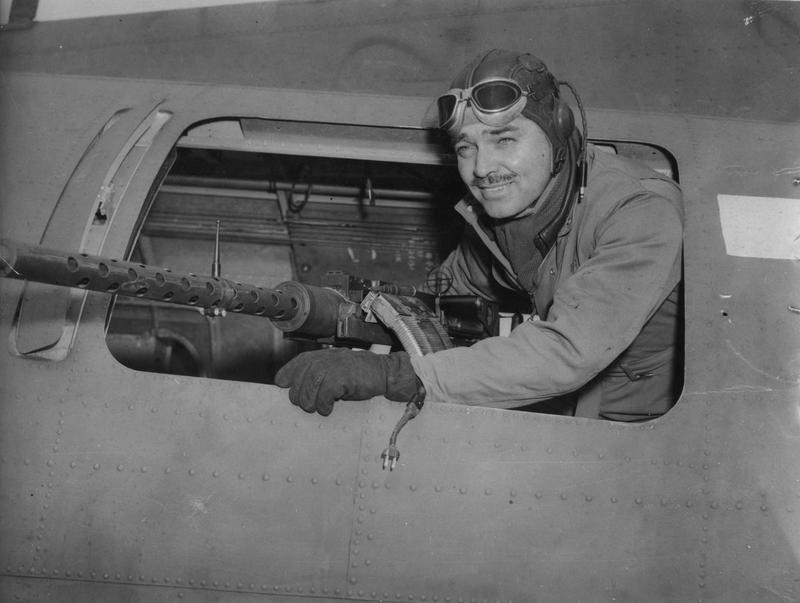
Clark Gable was one of Hollywood’s biggest stars when the United States joined World War II. He volunteered to serve, motivated by personal loss and a genuine sense of duty. Unlike many of his peers, Gable’s involvement in the conflict went far beyond symbolic patriotism or studio-managed publicity. He became one of the most prominent film actors to serve actively in combat during the war.
Ditching Hollywood to Fight the Fascists

Once known as “The King of Hollywood”, William Clark Gable (1901–1960) was one of the silver screen’s greatest legends. Perhaps best known for his role as Rhett Butler in the blockbuster Gone With the Wind, he won an Oscar as Best Actor for his lead in It Happened One Night. Gable had quit school at age sixteen to work in a tire factory. He decided to become an actor after he saw a play, so he began to take acting lessons.
In the meantime, Gable worked a variety of jobs to make ends meet, from oil field roustabout to selling neckties. In 1924, he married his acting coach and the couple moved to Hollywood so he could focus on his dream. He started working as an extra, and spent years on bit parts and stints in the theater. Gable finally got an MGM contract in 1930. He garnered notice for a powerful performance in his first starring role in The Painted Desert.
When MGM paired Gable with established female stars such as Joan Crawford and Greta Garbo, the combination steamed the screen. He became an insta-star, and by the time America entered WWII, Gable was MGM’s biggest earner. His decision to enlist was deeply influenced by tragedy. In January, 1942, his wife, actress Carole Lombard, perished in a plane crash while returning from a war bond tour. An antifascist, Lombard had been a vocal supporter of the war effort, and her death devastated Gable. To honor her memory, he decided to enlist and personally take on the fascists.
Clark Gable in Combat

In 1942, at the age of 41 – old for a recruit – and already a major celebrity, Gable enlisted in the US Army Air Forces (USAAF) as a private. He hoped to become an aerial gunner, but was sent instead to Officer Candidate School (OCS). After training, he was commissioned a second lieutenant in October, 1942. He sought frontline service, but was assigned instead to the First Motion Picture Unit, which produced instructional and morale films. He continued to press to see real combat.
Gable believed that anything less would dishonor Lombard’s memory. He finally convinced the USAAF’s General Henry “Hap” Arnold, Gable to send him to the Eighth Air Force in England. There, he was tasked with making a combat recruitment film for aerial gunners titled Combat America. Upon his arrival in England, Gable was attached to the 351st Bomb Group of the Eighth Air Force. He served as an aerial gunner and observer on Boeing B-17 Flying Fortress missions over occupied Europe and Nazi Germany.

Gable’s primary task was to film combat operations, and capture footage for a documentary intended to encourage aerial gunnery recruitment. Despite his official role as an observer, Gable flew on five combat missions. He endured flak and enemy fighter attacks like any other aircrew member. During one mission, his B-17 lost an engine and had its stabilizer damaged after it was hit by antiaircraft fire and was attacked by fighters. Over Germany, his B-17 had two crewmen wounded and another killed after it struck by flak. Shrapnel went through Gable’s boot and almost took off his head.
The Nazis Put a Bounty on Gable’s Head

The presence of Clark Gable aboard American bombers did not go unnoticed by the Germans. Nazi propaganda minister Joseph Goebbels saw the potential propaganda value of parading a Hollywood icon as a prisoner. So he reportedly placed a bounty on Gable’s head. While the threat of such a capture was realistically remote, it underscored the symbolic importance of Gable’s service. When MGM heard of its most valuable actor’s brushes with death, it worked its connections to yank him from combat. For his wartime efforts, Gable was awarded the Air Medal and the Distinguished Flying Cross. He later claimed he did not feel deserving of high honors.
In 1944, Gable was promoted to major, and that June, he was ordered back to the US. Higher ups judged his continued exposure to combat an unnecessary risk. Given his fame and popularity, the country would take a morale hit if he was killed. Gable sought another combat assignment, but none was forthcoming. Officially discharged in September, 1944, he stayed in the Air Forces reserves until 1947, when he finally resigned his commission. Unlike many wartime celebrities, his service had not been merely performative. He had shared the dangers of combat airmen, and put his life on the line to contribute to the war effort. Clark Gable rarely spoke about his wartime experiences, but his WWII service became an enduring part of his legacy.

_________________
Some Sources & Further Reading
American Air Museum in Britain – Clark Gable
History Halls – Obi Wan Kenobi in WWII: Sir Alec Guinness in the Royal Navy
Tornabene, Lyn – Long Live the King: A Biography of Clark Gable (1976)
Newest Articles
- Henry Jennings: The Privateer-Turned-Pirate Who Set the Stage for the Caribbean’s Golden Age of Piracy
- Fighting Women: Tomoe Gozen, the Fearsome Female Samurai
- From the NFL to the Sands of Iwo Jima: Medal of Honor Recipient Jack Lummus
- The Zanj Rebellion: The African Slave Revolt That Rocked Medieval Mesopotamia
- The Dacian Falx: The Curved Ancient Sword that Shocked the Romans

