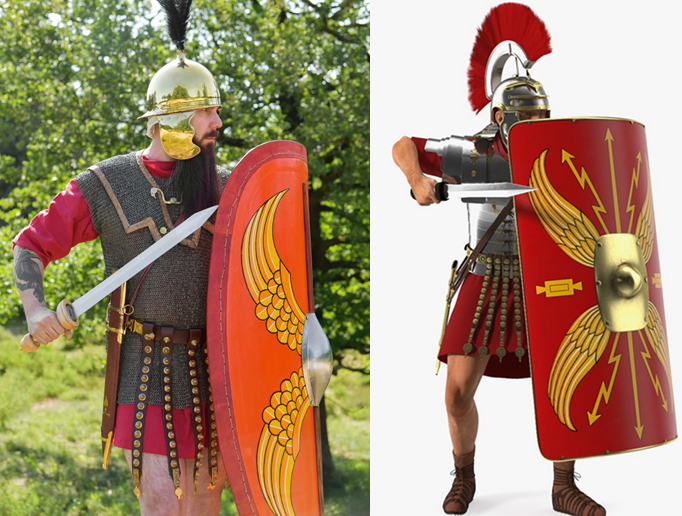
The scutum was the iconic shield of the Roman legionary. For centuries, it was as closely associated with Roman military power as the short sword, the gladius. More than just defensive equipment kit, the scutum shaped how Roman soldiers fought, moved, and even thought about battle. Its distinctive size and curved form helped turn Rome’s disciplined legions into the ancient world’s most formidable military machines.
The Classical Roman Shield

Early versions of the scutum appeared during the Roman Republic. They were likely influenced by contact with Italic peoples such as the Samnites in the fourth century BC. Until then, Roman soldiers had carried round shields similar to the Greek hoplon. As Rome expanded and fought wars in more varied terrain, a larger and more protective shield proved advantageous. By the time of the third century BC Punic Wars, it was standard equipment in the manipular legion. It remained central to Roman warfare well into the Imperial period.
The scutum was oval in the Republican era, and became rectangular with a pronounced curve by the Imperial era. Both provided coverage from chin to knee, and the classical Imperial scutum wrapped slightly around the bearer’s body. In the second century BC, they were typically around 120 centimeters (48 inches) high, and 76 centimeters (30 inches) wide. They became smaller (94-107 centimeters/ 37-42 inches high, 61-84 centimeters/ 24-33 inches wide) in the Imperial era and more curved. The curvature was not merely aesthetic: it allowed the shield to deflect blows to the sides. It also made it harder for enemies to hook or thrust past its edges. That shape also enabled Roman soldiers to stand close together without their shields clashing awkwardly, an important factor in tight formations.
The Scutum Was Part of a Weapons System

The scutum’s core was typically made from thin strips of wood laminated together. They were often arrayed in three layers, with the grain of each layer running in different directions to increase strength. The wooden body was then covered with canvas and leather, and edged with rawhide or metal at top and bottom. At the center sat the umbo, a metal boss that protected the handgrip and doubled as an offensive weapon. An umbo punch could stun or knock back an opponent, and create openings for a lethal strike with the gladius. The scutum was heavy by modern standards, at around 8 – 10 kilograms (18 – 22 pounds). However, Roman training emphasized endurance.
Legionaries drilled relentlessly to maneuver with their shield and sword as a single system. In combat, the scutum allowed legionaries to advance methodically under missile fire, and use its broad surface to block arrows, javelins, and sling stones. When locked together in formation, the shields created a near-continuous wall that was psychologically intimidating as well as physically effective. One of the shield’s most famous uses was the testudo, or “tortoise” formation. Soldiers at the formation’s edge held their shields on the front and sides, while those in the middle held theirs overhead to create a protective shell. The testudo was especially useful during sieges or when advancing under heavy missile fire.
Legacy of the Scutum

Beyond its practical role, the scutum carried symbolic weight. Shields were often painted with unit insignia, thunderbolts, wings, or geometric patterns that identified a legion and reinforced esprit de corps. The scutum was not discarded lightly: it represented a soldier’s place within the disciplined body of the legion. To lose one’s shield in battle was considered disgraceful. Over time, the scutum evolved. By the third century AD, Roman military tactics had shifted, and the army relied more on mobility and mixed troop types.

Large rectangular scuta were not well-suited to that newer warfare, and gradually gave way to smaller, oval or round shields. The new shields were a better fit for the more fluid style of warfare that characterized the later Empire. Even so, the image of rectangular scuta remains inseparable from that of Roman power. In the end, the scutum was more than a shield. It was a tool that embodied Roman values: discipline over individualism, formation over heroics, and methodical pressure over chaotic violence. Its design and use helped Rome dominate battlefields from Britain to the Near East.

_________________
Some Sources & Further Reading
Bishop, M. C. – Roman Shields (2020)
Goldsworthy, Adrian – The Complete Roman Army (2003)
History Halls – The Gladius: The Sword With Which Rome Won an Empire
Latest Articles
- American Presidents: Abraham Lincoln, Hall of Fame Wrestler
- Henry Jennings: The Privateer-Turned-Pirate Who Set the Stage for the Caribbean’s Golden Age of Piracy
- Fighting Women: Tomoe Gozen, the Fearsome Female Samurai
- From the NFL to the Sands of Iwo Jima: Medal of Honor Recipient Jack Lummus
- The Zanj Rebellion: The African Slave Revolt That Rocked Medieval Mesopotamia

