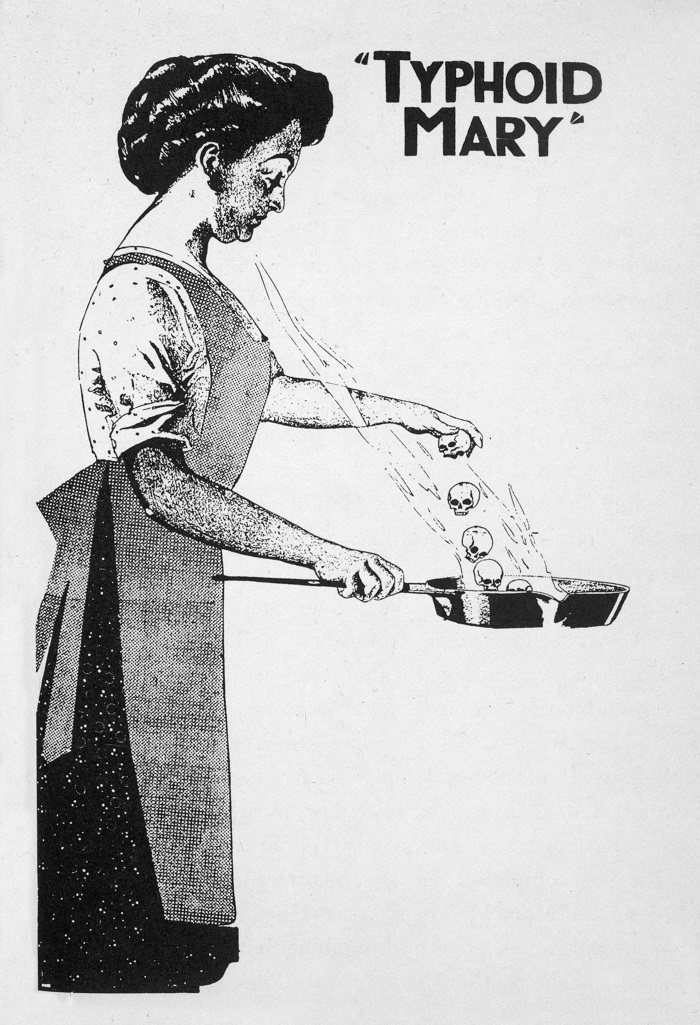
Mary Mallon, better known as “Typhoid Mary”, was one of the most infamous figures in the history of public health. Her story sits at the complicated intersection of medical discovery, immigration, class prejudice, civil liberties, and state power. Mallon was not a traditional villain: she never intentionally harmed anyone, and firmly believed in her own innocence. Nonetheless, as an asymptomatic carrier of an infectious disease, she caused dozens of typhoid fever cases and several deaths. Her life raises uneasy questions about how societies should balance individual rights against collective safety.
From Ireland to the United States

Mary Mallon was born in 1869 in County Tyrone, Ireland. It was a period when poverty and limited opportunity drove many Irish men and women to emigrate. Like millions of others, she left for the United States in search of work and stability. She arrived in New York City around 1884, when she was about fifteen years old. In the late nineteenth century, New York was teeming with immigrants, many of them Irish, Italian, or Eastern European. Mallon never married, had no children, and lived a largely solitary life, relying on her labor to survive.
Employment opportunities for women were limited, but domestic service offered relatively good wages and room and board. Mallon eventually found steady work as a cook, a prestigious role among household servants. Cooking paid better than other domestic jobs such as laundry or cleaning. It placed her in close contact with the families she served, who often vacationed in resorts and owned multiple homes. Unbeknownst to her or anyone else at the time, that profession made her one of America’s most dangerous workers.
Understanding Typhoid Fever in the Days of Mary Mallon

To understand Mary Mallon’s significance, it is essential to understand typhoid fever and the state of medical knowledge back then. Typhoid fever is caused by the bacterium Salmonella typhi, which spreads through contaminated food or water. Symptoms include high fever, abdominal pain, diarrhea or constipation, weakness, and sometimes death. Before antibiotics, typhoid was a major killer in urban environments with poor sanitation. By the early 1900s, germ theory was understood, and public health officials knew that diseases could spread through invisible microorganisms. However, one concept remained poorly understood: healthy carriers – people who harbored and transmitted pathogens, but showed no symptoms. Mallon became the most famous – or infamous – example of that phenomenon.
Mallon first came to the attention of authorities indirectly. Between 1900 and 1907, she worked as a cook for at least seven households. In nearly every case, outbreaks of typhoid fever followed soon her arrival. One especially alarming episode occurred in 1906, when she worked for a wealthy family vacationing in Oyster Bay, Long Island. Six of the eleven people in the household fell ill. So the vacation house’s landlord, aware that renting a property reputed to harbor typhoid would be difficult, hired George Soper, a sanitary engineer and epidemiologist, to investigate the outbreak.
Forcible Quarantine

Soper noticed a pattern: typhoid outbreaks appeared to follow the cook from household to household. After tracing her employment history, he concluded that Mary Mallon herself must be the source. When Soper confronted Mallon in 1907, she reacted with anger and disbelief. She had never been sick with typhoid and considered the accusation absurd and insulting. When Soper requested stool and urine samples for testing, she violently refused, and reportedly chased him away with a carving fork. From Mallon’s perspective, she was being blamed unfairly, targeted because she was an Irish immigrant and a servant.
Unable to convince Mallon voluntarily, New York City’s Department of Health took drastic action. In March, 1907, police officers escorted her to an ambulance, and she was forcibly transported to North Brother Island. A small, isolated island in the East River, it was used to quarantine people with contagious diseases. Tests soon confirmed that Mallon carried Salmonella typhi in her system, particularly in her gallbladder. Although she remained healthy, she was shedding bacteria capable of infecting others. Public health officials concluded that she posed a serious danger and ordered her indefinite quarantine.
Conditions for Release From Quarantine

Mary Mallon was outraged. She insisted she was being imprisoned without trial and compared her treatment to that of a criminal. She hired lawyers and filed lawsuits against the city, arguing that she was healthy and unlawfully detained. In 1909, the court sided with the health department, and ruled that public safety justified her confinement. She would remain on North Brother Island for nearly three years. In 1910, a new health commissioner, Dr. Ernst Lederle, reconsidered Mallon’s case. He believed that lifelong quarantine was excessive, and offered to release her under strict conditions.
Mallon was required to promise that she would never work as a cook again and that she would follow hygiene practices to prevent the spread of disease. Mallon agreed and was freed. However, her prospects were bleak. As a laundress or cleaner, she earned far less than she as a cook – $20 per month vs $50. She struggled financially and felt deeply resentful of the restrictions placed upon her. Moreover, she never fully accepted the idea that she was a danger to others. Eventually, Mallon returned to cooking, sometimes under assumed names, such as Mary Brown. Predictably, typhoid outbreaks followed.
“Typhoid Mary” Received Little Public Sympathy

In 1915, Mallon was linked to a severe outbreak at Sloane Hospital for Women in New York City. At least twenty five people were infected, and two died. This time, authorities acted swiftly. Mallon was arrested and returned to North Brother Island, where she would remain for the rest of her life. Unlike her first confinement, this second quarantine attracted less public sympathy. By now, Mallon’s refusal to comply with health regulations and her return to cooking were widely seen as reckless. She was portrayed in newspapers as stubborn, dangerous, and even malicious, which cemented her “Typhoid Mary” nickname.
In reality, Mallon was one of many typhoid carriers. Public health officials eventually identified hundreds of asymptomatic carriers, including some who caused more infections than Mallon. None of them were treated as harshly or publicly, though. Many were monitored, educated, and allowed to live freely. Typhoid Mary’s treatment was exceptional, and that exception raises troubling questions. During her decades on North Brother Island, Mallon lived in a small cottage. She worked occasionally as a laboratory assistant, washing test tubes. She rarely received visitors, and became increasingly withdrawn. Over time, she appears to have accepted her fate, though bitterness never fully left her.
Mary Mallon Was Treated More Harshly than Other Typhoid Carriers Who Caused far More Damage

Typhoid Mary suffered a stroke in 1932 that left her partially paralyzed. She spent her final years in a hospital ward on the island. Mary Mallon died on November 11th, 1938, aged sixty nine. She was buried in Saint Raymond’s Cemetery in the Bronx. The press played a major role in shaping the legacy of Typhoid Mary. Sensational headlines portrayed her as a menace, a “walking plague”, and a symbol of immigrant filth and ignorance. Cartoons depicted her cracking eggs filled with skulls into frying pans. Such portrayals ignored her humanity, and oversimplified a complex public health dilemma.
Importantly, Mallon never accepted that she was ill, because she never experienced symptoms. At a time when the idea of healthy carriers was new and poorly explained, her skepticism was understandable. Public health officials failed to communicate effectively, and relied instead on force and isolation. Mallon’s story cannot be separated from issues of class, gender, and ethnicity. As a poor, unmarried Irish immigrant woman, she had little social power. Wealthier carriers, including some doctors, were treated far more leniently. Mallon’s defiance made her an easy target for harsh measures and public condemnation.
Significance and Legacy of Typhoid Mary

The Typhoid Mary case highlights a persistent ethical dilemma: how far should the state go to protect public health? When does protection become punishment? Mallon was never charged with a crime, yet she spent more than twenty six years in confinement. That was longer than many convicted criminals of her era. Today, “Typhoid Mary” has entered the language as a metaphor for anyone who spreads trouble or disease unknowingly. However, that shorthand often obscures the real woman behind the name. Mary Mallon was neither a monster nor a martyr. She was a working-class immigrant caught at the dawn of modern epidemiology, when scientific understanding advanced faster than ethical frameworks.
Mallon’s case contributed significantly to the recognition of asymptomatic carriers. It also helped shape public health policies on surveillance, sanitation, and disease control. Simultaneously, it serves as a cautionary tale about scapegoating, coercion, and the dangers of reducing individuals to symbols. More than a century later, debates sparked by Typhoid Mary – about quarantine, consent, misinformation, and civil liberties – remain strikingly relevant. She still haunts the modern world, a reminder that medical progress should be matched by progress in justice and compassion.

_________________
Some Sources & Further Reading
Leavitt, Judith Walzer – Typhoid Mary: Captive to the Public’s Health (1996)
New York Academy of Medicine, Bulletin, October 1939, 15(10) – The Curious Career of Typhoid Mary
Newest Articles
- The Johnstown Flood – Thousands Perished When A Dam Collapsed After Gilded Age Tycoons Modified it for their Private Resort
- The Jacquerie: The Medieval Peasant Uprising That Terrified France’s Aristocrats
- Things That Weren’t Thought Through: WWII’s Sticky Bomb Stuck to Users’ Hands Once Activated
- German Tanks of World War II – The Panzer 38(t), a Czech Tank in German Service
- Nicholas Alkemade: The WWII Airman Who Survived an 18,000 Foot Fall From a Bomber Without a Parachute

