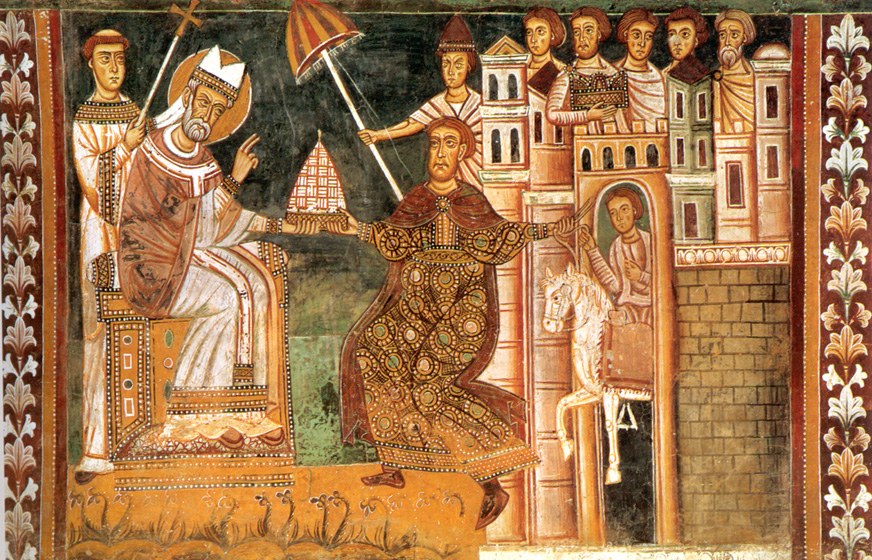
The Donation of Constantine is one of the most famous forgeries in Western history. A document that claimed to grant popes vas secular authority over the Western Roman Empire was blindly accepted as true. For centuries, it shaped political theory, justified papal power, and influenced the relationship between church and state. Its eventual exposure as a forgery in the fifteenth century marked a turning point in Renaissance scholarship. The revelation also critically reshaped European views of authority and historical authenticity. Understanding the Donation requires an examination of its content, origins, political uses, and the intellectual revolution that dismantled its credibility.
The Unprecedented Generosity of Emperor Constantine

The Donation of Constantine was a decree supposedly issued by Emperor Constantine the Great in in the early fourth century. Per the text, Constantine suffered from leprosy, until he was miraculously healed by Pope Sylvester I. In gratitude, the emperor allegedly converted to Christianity and granted the pope sweeping temporal powers. Between having his leprosy cured and his soul saved, Constantine was feeling pretty magnanimous toward the bishop of Rome. So he granted Sylvester supremacy over all other bishops, and gave him primacy within both the Eastern and Western Churches. He also donated the imperial palace of the Lateran and other properties to the Roman pontiff.
Constantine’s generosity had not run its course, though. He transferred authority over Rome, Italy, and the entire western half of the Roman Empire to the pope. He even relocated the imperial capital Constantinople in order to get out of the pope’s hair and not interfere with his governance of the West. If authentic, the Donation represented a monumental shift: the emperor had formally ceded political authority to the bishop of Rome. It was not authentic, though. No genuine imperial document from the fourth century makes such a claim. Nor did any contemporary historian ever mention such an unprecedented transfer of power. Nevertheless, by the early Middle Ages the Donation was circulating as though it was real.
The Need for the Donation of Constantine

The Donation of Constantine was almost certainly produced in the eighth century. It was an era in which the papacy faced political instability, and so had great need to bolster its standing. The historical context revolves around the papacy’s relationship with the Frankish rulers, especially during the pontificate of Stephen II, 752-757. At the time, the Byzantine Empire’s ability to protect Italy had collapsed. The Lombards threatened Rome, and the pope sought new allies. In 754, Stephen traveled to the Frankish kingdom to petition Pepin the Short for military support.
That alliance eventually produced the Donation of Pepin, which granted the pope control over central Italian territories. That became the foundation of the Papal States. Many scholars believe the Donation emerged during this era as part of the ideological justification for these new papal claims. The document provided a fictional historical precedent that showed that emperors had long recognized papal temporal authority. The Donation thus bolstered the papacy’s political legitimacy when it was claiming autonomy from both Lombard aggression and Byzantine oversight.
A Forgery that Formed the Legal Basis for Papal Temporal Authority

The earliest surviving Donation of Constantine copies appear in the Liber Pontificalis. They are incorporated into the Pseudo-Isidorian Decretals, a vast ninth-century collection of forged papal letters and legal texts designed to strengthen episcopal authority against secular interference. The Donation fits neatly within that broader tradition of ecclesiastical forgery. It was a way to manufacture historical legitimacy for the Church’s institutional claims. For several centuries, the Donation was widely accepted as authentic. Despite occasional doubts, it became a cornerstone of medieval political theology.
Popes cited the Donation to assert their right to rule the lands of central Italy. They also brandished it to claim authority over secular rulers, and to argue for superiority over emperors. During the eleventh century’s Investiture Controversy, popes and Holy Roman Emperors battled for control over the appointment of bishops. The Donation took on special significance amidst that tussle, and came in handy to support the papal position. If Constantine had granted the pope supreme authority, then the emperor’s interference in ecclesiastical appointments was an overreach. The document’s assertion that all bishops were subordinate to the pope helped reinforce Rome’s primacy. It gave historical weight to claims that the pope, not ecumenical councils or emperors, had ultimate authority over Church doctrine.
Growing Doubts

The Donation of Constantine was incorporated into canonical law collections such as Gratian’s Decretum in the twelfth century. As a result, generations of clerics, legal scholars, and administrators accepted it as genuine and used it in juridical arguments. The Donation also symbolized the harmony of spiritual and temporal authority, and presented the pope as both shepherd and sovereign. It became part of the ideological foundation of medieval theocracy. By the fourteenth century, however, cracks appeared in the Donation’s credibility. Some, such as Dante Alighieri, argued that the Church’s involvement in secular politics was harmful and unbefitting its spiritual mission.
Dante rejected the idea that Constantine could have legitimately transferred imperial authority, even if he had actually tried. Others, such as Marsilius of Padua and William of Ockham, also contested the papal interpretation of history and law. Few, though, accused the Donation of being a forgery outright. That changed in 1440, when Renaissance humanist and Italian scholar Lorenzo Valla produced a masterpiece of philological critique: De falso credita et ementita Constantini donatione(“On the False and Forged Donation of Constantine”). Valla, a gifted linguist and rhetorician, applied rigorous textual analysis—unprecedented for his time—to the document. As seen below, he and demonstrated conclusively that it could not have originated in the fourth century.
Lorenzo Valla and the Exposure of the Donation of Constantine as a Fraud

Lorenzo Valla’s first line of attack against the Donation of Constantine was its very text. The document was full of Latin terms and grammatical forms typical of the eighth century, not late antiquity. Many phrases also reflected medieval rather than Roman legal conventions. The document referenced institutions and titles that did not exist in Constantine’s era. For example, it applied feudal concepts to a time when feudalism had not yet developed. Valla noted mistakes in descriptions of Roman governance and territorial divisions. A genuine imperial decree from Constantine would have exhibited accurate administrative language. The text described Constantine transferring authority over the entire western empire to the pope. Such a move was both unprecedented and incompatible with the political realities of the fourth century. No emperor could arbitrarily divide the empire in such a manner.
Valla’s critique was devastating. Although the Church initially suppressed his work, the arguments spread through scholarly networks. By the sixteenth century, even before the Protestant Reformation, the Donation was widely recognized as fraudulent. The exposure of the Donation became a powerful weapon for Protestant reformers. Writers like Martin Luther used it to argue that the papacy’s temporal authority rested on deception. The Reformation emphasized Rome’s corruption, and the Donation’s falsity seemed to symbolize the excesses and abuses of the medieval Church. Catholic scholars gradually conceded the forgery, though often reluctantly. The papacy eventually acknowledged that the document was not genuine, but did not abandon its claims on temporal authority. It now rested them on divine sanction and longstanding tradition, instead of on Constantine’s imaginary gift.
Why Was Such a Crude and Obvious Forgery Accepted as True for So Long?

That the Donation of Constantine was a forgery now seems glaringly obvious. Why, then was such an obvious fraud accepted as true for centuries? To understand that, one must understand medieval attitudes toward history, authority, and documentation. The early Middle Ages lacked detailed, reliable records of the fourth century. Gaps in historical knowledge made it easier for forgeries to fill the void. The Donation served the immediate interests of the papacy, and was convenient for its secular allies like the Frankish kings. Political expediency and usefulness often triumphed over skepticism. Medieval society also tended to trust ancient or supposedly ancient documents. The Roman Empire was so prestigious, that any text linked to Constantine carried enormous weight.
Before Renaissance humanism, critical textual analysis was rudimentary. Scholars lacked the linguistic and historical methods needed to detect anachronisms systematically. The Donation did not succeed because it was sophisticated – it was actually quite crude and amateurish. It succeeded because it appeared at the right moment to meet political and ideological needs. The Donation remains significant today for several reasons. It is a prime example of how forged documents can influence centuries of political and religious life. It shaped papal policy, legal structures, and medieval political theory. Lorenzo Valla’s exposure of its falsity demonstrated the power of philological criticism. His methods went on to inspire generations of scholars, and helped usher in modern historical analysis.
Significance and Legacy of the Donation of Constantine

The Donation of Constantine played a central role in debates over whether the Church should wield secular power. Its unmasking as a fraud contributed to ongoing arguments about spiritual versus political authority. The forgery became emblematic of the need for critical scrutiny when evaluating historical claims. It also illustrated how institutions, even – or especially – religious ones, can rely on myths to support political aims. Although it was false, the Donation’s influence shows how beliefs, regardless of historical accuracy, can shape policy, identity, and conflict.
The Donation stands as a remarkable example of how a forged document helped shape the course of Western civilization. Created in the Dark Ages to bolster papal authority, it became embedded in canonical law and political theory for centuries. Its exposure by Lorenzo Valla marked a watershed in intellectual history. It demonstrated the power of linguistic and historical criticism, and helped erode the ideological foundations of medieval papal supremacy. Ultimately, the Donation reminds us that history is not only about events. It also about the stories of events, true or false, that people believe. Throughout history and through to the present, people don’t actually act based on what is real. They act based on what they believe is real.

_________________
Some Sources & Further Reading
Valla, Lorenzo – On the Donation of Constantine (2008 Translation)
Latest Articles
- Edward England, the Humane Pirate Captain Deposed by His Men for Being Too Nice
- American Presidents: Abraham Lincoln, Hall of Fame Wrestler
- Henry Jennings: The Privateer-Turned-Pirate Who Set the Stage for the Caribbean’s Golden Age of Piracy
- Fighting Women: Tomoe Gozen, the Fearsome Female Samurai
- From the NFL to the Sands of Iwo Jima: Medal of Honor Recipient Jack Lummus

