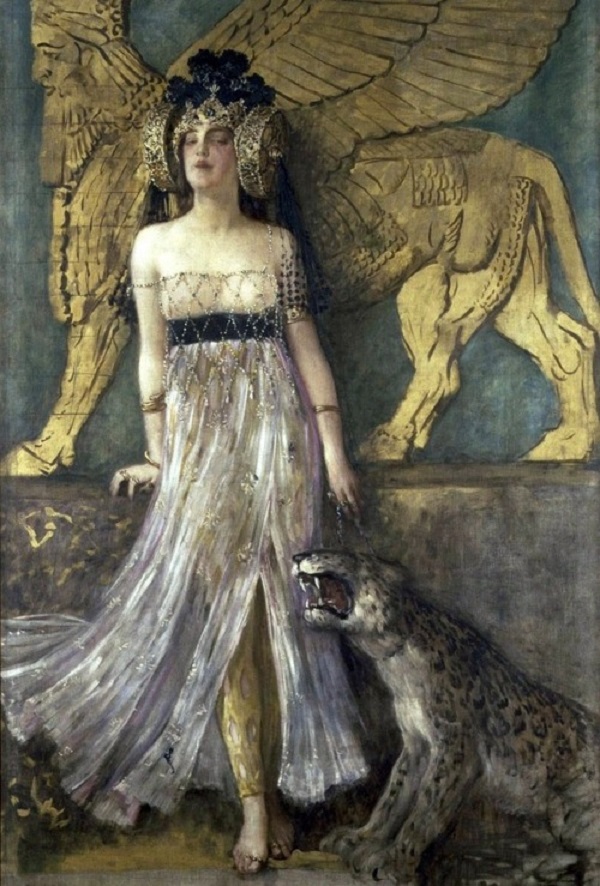
Semiramis in ancient Greek mythology was the daughter of a goddess and a mortal. Her divine mother abandoned her as an infant, but she was saved by doves who fed her. She grew to become a queen, led men into battle and conquered much of Asia, Ethiopia, and Libya. When not conquering, Semiramis restored the declining ancient Babylon to its former glory. She built the city’s famous Hanging Gardens, and protected it with impregnable defensive walls. That Semiramis is mythical, but the mythology was based on a real life ninth century BC Assyrian queen named Shammuramat.
The Exceptional Queen Shammuramat

Shammuramat was a remarkable woman of the early Neo-Assyrian Empire, who stands at the crossroads between history and myth. She was the wife of Shamshi-Adad V of Assyria, reigned 823 to 811 BC, and mother of Adad-nirari III, reigned 811 to 783 BC. Her political prominence and influence during her son’s early reign inspired the later legends of the semi-divine Semiramis. Over time, Shammuramat’s historical achievements became magnified and mythologized, and her real legacy merged with centuries of storytelling. In the process, she was transformed into one of the ancient world’s most enduring female archetypes.
Shammuramat’s existence is confirmed by several Assyrian inscriptions. That was an unusual distinction in an era when royal women were rarely mentioned in official records. One key inscription, the Stela of Adad-nirari III from Nimrud, mentions her by name and title. It refers to her as “queen” and “palace woman of Shamshi-Adad”. Another remarkable monument, the Pazarcık Stele from modern-day Turkey, bears both her name and that of her son. That demonstrates that she exercised authority during his early reign, perhaps as a regent. Such inscriptions imply that Shammuramat maintained significant power at court after her husband’s death – a rare feat in Assyrian tradition.
From Shammuramat to Semiramis

Shammuramat was likely regent circa 810 to 806 BC, when Adad-nirari III was still a child. At the time, Assyria was consolidating its control over vast territories that stretched from the Tigris River to the Mediterranean. Shammuramat may have been instrumental in stabilizing the empire, guiding campaigns against rebellious provinces, and maintaining loyalty among vassal states. One stele even associates her with military success in the west, perhaps in Syria. That suggests that she played a direct role in Assyrian expansion.
Shammuramat’s prominence in official inscriptions indicates that she was not a mere caretaker, but a ruler of real political stature. She became Semiramis centuries after her death, as Greek and Persian writers reinterpreted Assyrian history through the lens of legend. The name “Semiramis” itself is a Hellenized form of Shammuramat. By the fifth century BC, Greek historians such as Ctesias of Cnidus had woven a fantastical biography around her. They claimed that she was of divine or miraculous birth, the daughter of the goddess Derketo and a mortal man.
A Woman Who Inspired Admiration and Induced Anxiety

According to mythology, Semiramis rose from humble origins to marry King Ninus of Assyria, a mythical counterpart to Shamshi-Adad V. After his death, the widowed Semiramis ruled as queen in her own right. In these tales, she became a near-mythical conqueror and builder. She was credited with founding Babylon, constructing its mighty walls, and initiating great engineering projects across Mesopotamia. Other legends attributed to her the conquest of India and the invention of cross-dressing to disguise herself as a man in battle.
The Semiramis narratives reflect both admiration and anxiety toward powerful women. Greek and later Roman authors often portrayed her as simultaneously brilliant, ambitious, and licentious. She was a ruler who defied gender norms and moral expectations. The myth of Semiramis continued to evolve through the centuries. She appears in works by Diodorus Siculus, Justin, and later medieval and Renaissance writers. She became a symbol of the exotic and dangerous East, and came to embody themes of female ambition, sexual transgression, and imperial grandeur.
The Fusion of Shammuramat and Semiramis

In Dante’s Inferno, Semiramis is placed among the lustful. It was a reflection of how her legend had been reshaped into a moral parable. Behind the moralizing layers, however, there remained the real woman who once wielded power in the heart of Assyria. Modern historians and archaeologists have peeled back the layers of myth to recover Shammuramat’s true role. She was not the fantastical conqueror of legend. Instead, she was a capable political figure who maintained stability in a turbulent empire.
Shammuramat’s exceptional visibility in Assyrian inscriptions suggests that contemporaries viewed her as extraordinary. She was a woman who, for a brief moment, stood at the pinnacle of Near Eastern politics. The connection between Shammuramat and Semiramis illustrates how memory and myth intertwine in the ancient world. Shammuramat’s historical deeds inspired awe, which later cultures amplified into mythology and legend. Through that fusion, she became a timeless symbol of female power, both celebrated and feared. Whether as the real life queen or the legendary Semiramis, her name endures as a bridge between fact and fable.

_________________
Some Sources & Further Reading
History Halls – Midas, and the Real Life King Who Inspired the Mythology
Mayor, Adrienne – The Amazons: Lives and Legends of Warrior Women Across the Ancient World (2016)
World History Encyclopedia – Semiramis

